Pink
Primary visual colorWhere Is Hutt Lagoon?
Western Australia · Australia
Drag or zoom the real map. Verified shoreline geometry is highlighted with the lake’s LakeColors palette color when available.
Hutt Lagoon on the Globe
Rotate the world or focus directly on the lake.
Why Pink, Red and Lilac Are All Possible
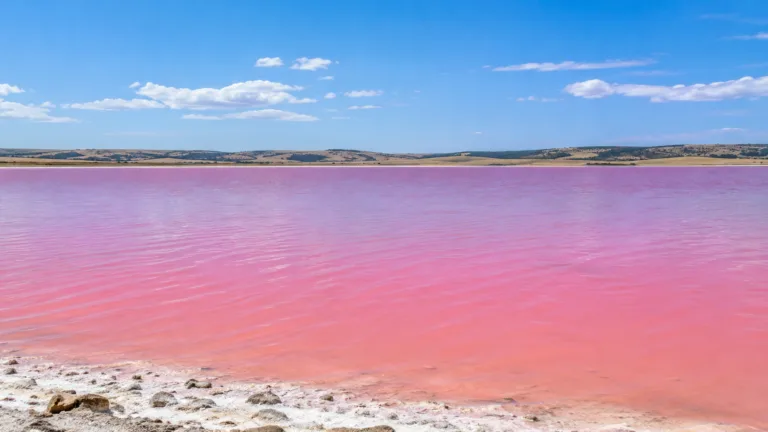
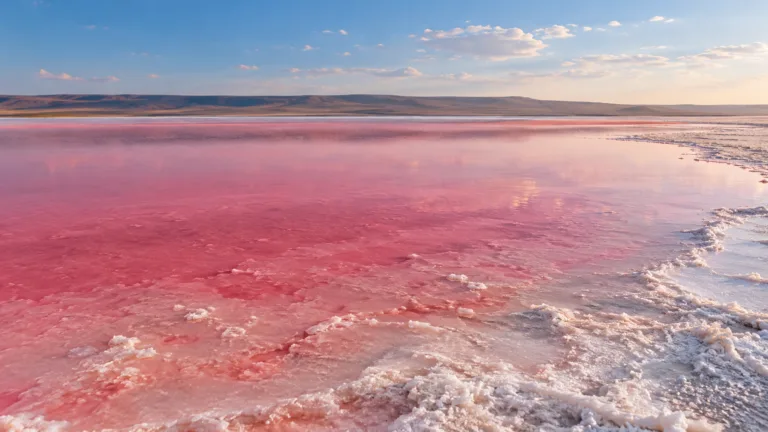
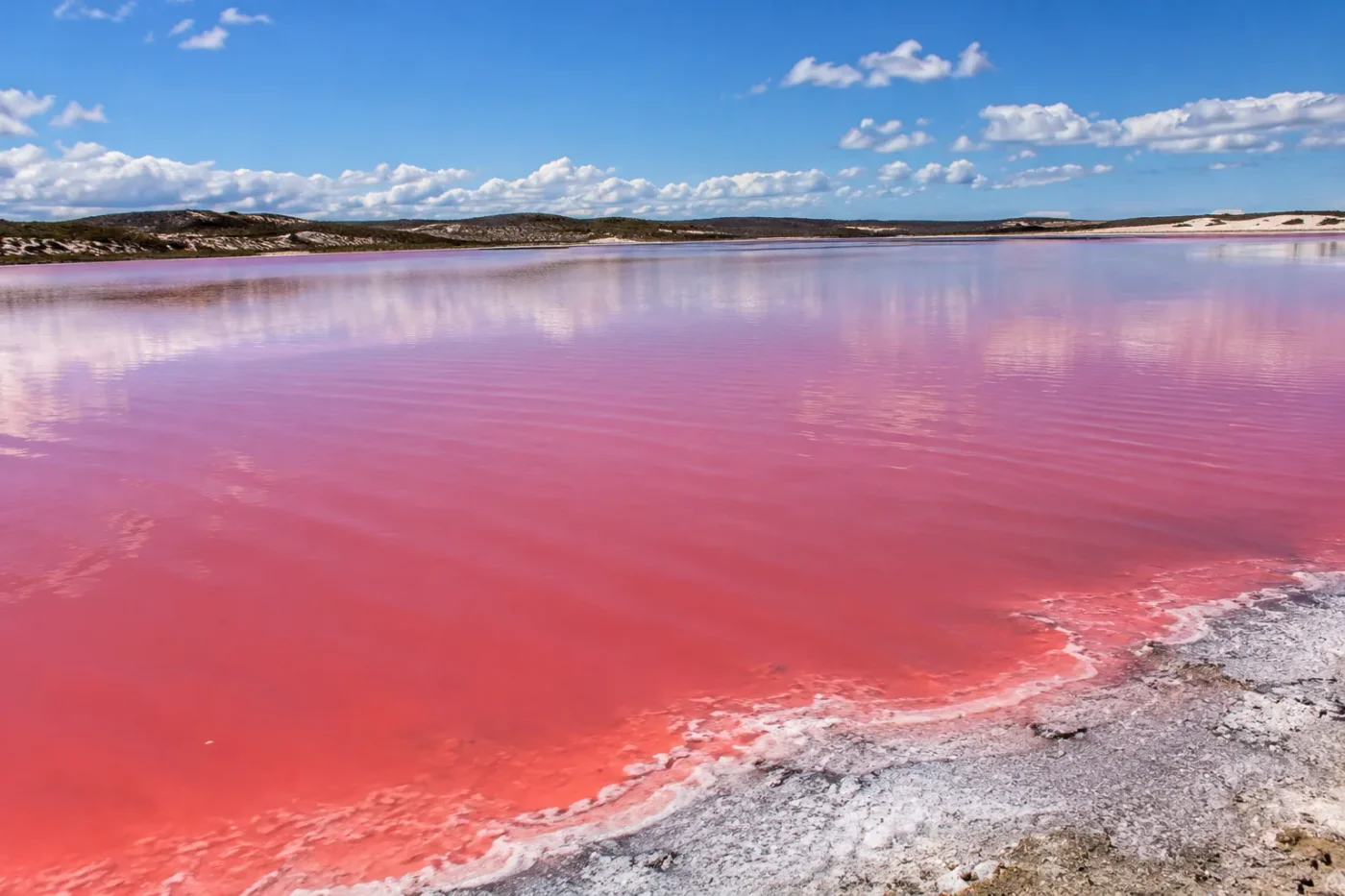
Appearance: Pink
Status: Primary documented appearance
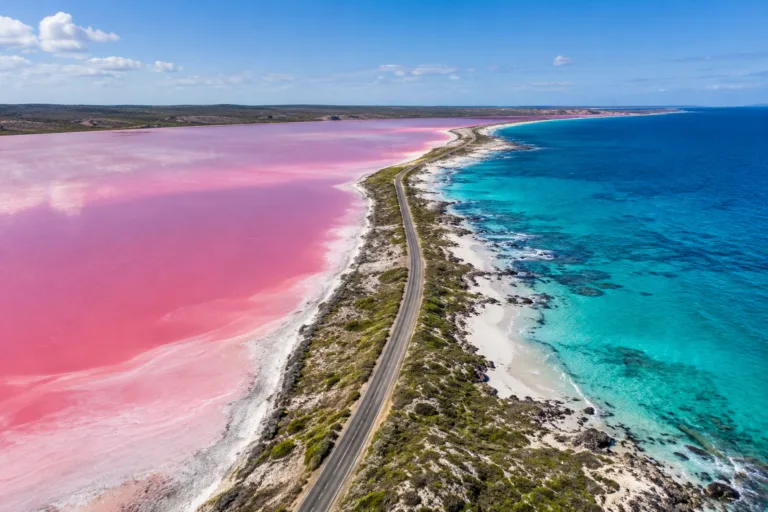
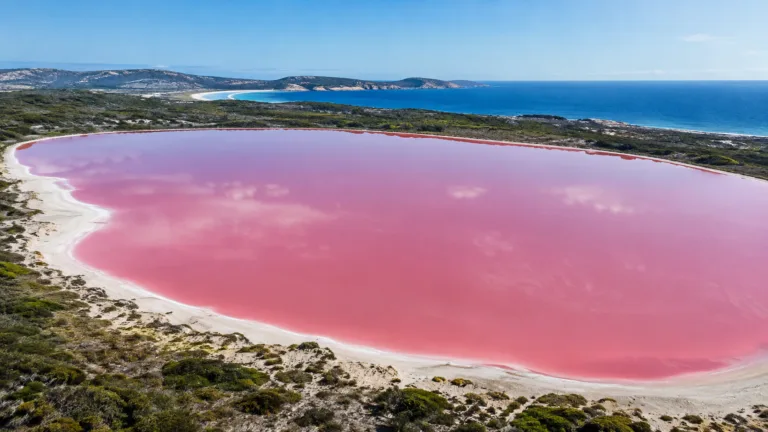
Pigment-rich hypersaline water provides the lagoon's characteristic pink identity. Local environmental reporting specifically identifies abundant Dunaliella salina and links it with the pink colour.
Provenance: Official Description
Evidence: High
Appearance: Red
Status: Occasional documented appearance
Red and deep-red appearances are documented, but the available Hutt Lagoon sources do not establish a single red-only chemical trigger. Pigment concentration, water conditions and illumination can all influence how saturated the brine appears.
Provenance: Observed
Evidence: Moderate
Appearance: Lilac
Status: Documented visual variant
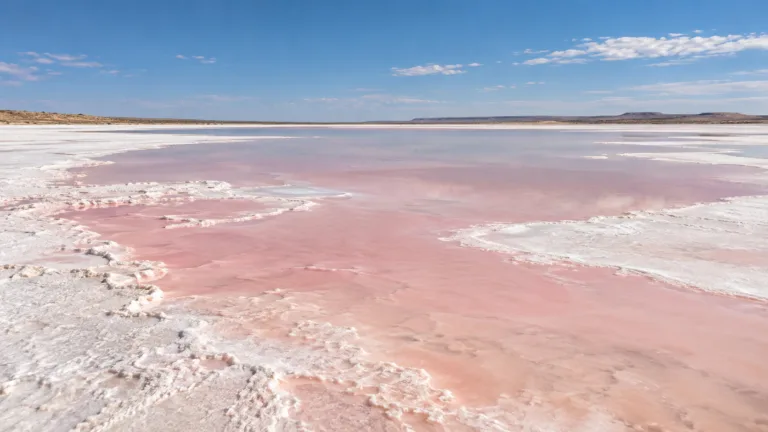
Lilac is a documented surface appearance rather than evidence for a separate lilac pigment state. Tourism and satellite descriptions both associate the lagoon's changing appearance with time of day, cloud cover and season.
Provenance: Observed
Evidence: Moderate
Color and Water State Through the Year
How Hutt Lagoon Builds Its Pink-Red Color
Water Chemistry Behind the Color System
Documented measurement dataThe lagoon was classified as naturally highly saline. This is a water-chemistry measurement, not a direct color measurement.
The reported conductivity is consistent with concentrated brine conditions.
How the Hutt Lagoon Color Profile Is Supported
Claim-level supportWestern Australian environmental reporting identifies abundant D. salina in the lagoon, while published work documents commercial beta-carotene production from the species at Hutt Lagoon.
Department of Environment and Conservation — Hutt Lagoon Resource Condition ReportDevelopment of Western Biotechnology's Algal Beta-Carotene PlantEvidence: HighWestern Australian tourism material and NASA descriptions independently record a broader visual range than pink alone.
Tourism Western Australia — Hutt LagoonNASA MODIS — Hutt LagoonEvidence: ModerateGovernment and hydrochemical sources describe seasonal water-depth and concentration changes produced by rainfall, inflow and evaporation.
Department of Environment and Conservation — Hutt Lagoon Resource Condition ReportHydrochemistry of Surficial Brines in Hutt LagoonEvidence: HighThe sources describe variability with weather, illumination and season but do not define a repeatable monthly pink-to-lilac-to-red progression.
Tourism Western Australia — Hutt LagoonTourism Western Australia — Pink and Rainbow LakesDepartment of Environment and Conservation — Hutt Lagoon Resource Condition ReportNASA MODIS — Hutt LagoonEvidence: ModerateHutt Lagoon is best known as a pink hypersaline lagoon, but pink is not its only documented appearance. Western Australian sources describe the water as shifting through bubblegum pink, lilac and occasional red, while scientific and environmental records link the underlying pink-red colour system most strongly to salt-tolerant microorganisms, especially Dunaliella salina and the carotenoid pigments it produces. The exact shade visible at one moment is not a fixed chemical label: water coverage, microbial conditions, sunlight, cloud and reflections all affect what reaches the eye.
Hutt Lagoon Is Pink Because Salinity Creates a Habitat for Pigment-Rich Microorganisms
Calling Hutt Lagoon “pink because it is salty” skips an important step. Sodium chloride does not act like pink dye. Instead, the lagoon’s extreme salinity creates an environment in which salt-tolerant microorganisms can thrive while many ordinary freshwater organisms cannot.
A Western Australian Department of Environment and Conservation assessment described Hutt Lagoon as naturally highly saline, with salinity above 150 grams per litre, and recorded Dunaliella salina as abundant phytoplankton. The same report directly associates this microalga with the lagoon’s pink colouring. Earlier biotechnology work at Hutt Lagoon also documented the cultivation of D. salina for beta-carotene production.
Beta-carotene matters because Dunaliella can accumulate large quantities of carotenoid pigment under stressful conditions such as intense light and high salinity. Research on the genus shows that strongly carotenogenic cells can become red-orange rather than remaining visibly green. When enormous numbers of pigment-rich cells occur in shallow brine, their combined optical effect can shift the water toward pink and red.
The lagoon’s salt concentration helps shape the microbial community and the physiological conditions under which carotenoids accumulate. The visible pink-red colour is biological and optical rather than the natural colour of dissolved salt.
The Algae Explanation Is Strong, but a Hypersaline Lagoon Is a Microbial Community
Dunaliella salina has unusually strong local evidence at Hutt Lagoon. It appears in Western Australian environmental reporting, commercial beta-carotene research and official descriptions of the lake. That makes it more than a generic explanation borrowed from other pink lakes.
There is still a reason not to reduce every visible shade to a single species. NASA’s description of Hutt Lagoon places its bubblegum colour within the broader community of pink, red and salmon-coloured microorganisms found in hypersaline water, including algae, bacteria and archaea. These organisms can carry different carotenoid and light-active pigments.
That broader microbial context does not overturn the documented role of Dunaliella. It means that a natural brine lake should not be treated as a container of one pigment at one constant concentration. Biological abundance, salt concentration, water volume and illumination can all change together.
Lilac Does Not Require a Separate “Lilac Pigment” in the Lagoon
Official Western Australian material repeatedly describes Hutt Lagoon as sometimes lilac, while NASA notes appearances extending from lilac-purple toward deep red. Those descriptions establish that the hue range is real, but they do not identify a special biological event that switches the lake into a chemically distinct lilac state.
Water colour at the surface is the result of light leaving the water after absorption, scattering and reflection. A pink-red body of shallow brine can therefore appear cooler or more purple when the balance of direct sunlight, skylight and reflected cloud changes. Tourism Western Australia also records grey or silver appearances under some overcast conditions and notes that reflected clouds can strongly alter the scene.
This distinction matters because photographs taken hours apart can show visibly different colours without proving that the microbial population completely changed during those hours. Some variation is a change in the water itself; some is a change in how the same water interacts with the sky and the observer.
The cited sources document all three appearances and describe variation with time of day, weather and season, but they do not support a rule such as “pink in one month, lilac in another and red in a third.” Hutt Lagoon’s colour is better treated as a variable visual range than a three-stage calendar.
Red Can Be More Saturated, but It Is Not a Simple Salinity Meter
Red is the least routinely described of Hutt Lagoon’s three headline colours, yet it appears in both Western Australian tourism material and NASA’s account of the lagoon. A redder view is compatible with a stronger contribution from carotenoid-rich microorganisms, since beta-carotene-rich Dunaliella cells themselves can become strongly red under carotenogenic conditions.
That does not justify turning the visible shade into a direct salinity reading. Salinity influences the ecosystem, but a lake that looks redder at one moment is not automatically more saline than a pink-looking lake photographed on another day. Water depth, microorganism abundance, pigment content, turbidity, solar angle and reflected light can change the final appearance simultaneously.
The scientifically safer interpretation is therefore conditional: hypersaline conditions support the pigment-producing system, while the exact surface shade emerges from both biological state and viewing conditions.
Summer Drying Changes the Canvas on Which the Pink Colour Is Seen
Hutt Lagoon is not a constant-depth basin. Government environmental reporting describes its depth as highly seasonal, and hydrochemical research found a predictable annual concentration cycle controlled by water inputs and evaporation. The regional climate is Mediterranean, with hot, dry summers and about 70 percent of annual rainfall falling from May through August.
Tourism Western Australia reports a visible consequence: much of the lagoon can dry during summer, while the water that remains tends to look less vividly pink. This may seem counterintuitive if evaporation is expected to concentrate salts and pigments, but surface appearance is not controlled by concentration alone. Shrinking areas of open water, exposed salt, changing water depth and biological responses all alter the scene.
During wetter parts of the year, a greater area may hold water, but there is still no reliable rule that assigns one particular shade to each wet-season month. Weather and illumination continue to matter on top of the hydrological cycle.
The annual pattern is strongest as a water-state pattern: dry summer conditions versus the wetter part of the year. The evidence is much weaker for assigning a precise pink, red or lilac colour to individual months.
Evaporation Keeps Hutt Lagoon in the Extreme Salinity Range
Hutt Lagoon occupies a coastal setting where water supply and evaporation continually reshape the brine. The government condition report describes a naturally saline, sodium-chloride-dominated lagoon, while a peer-reviewed hydrochemistry study documented a repeating annual concentration cycle produced by the balance between water influx and evaporative loss.
This hydrological cycle helps explain why the lagoon can support organisms adapted to conditions that would exclude most ordinary algae. It also explains why the visual system is dynamic. As the water budget changes, so do depth, dissolved salt concentration, available habitat and the optical path through the brine.
The measured salinity and conductivity values on this page are therefore environmental measurements, not instrument measurements of the colour itself. None of the cited Hutt Lagoon sources supplies a standardized RGB, CIELAB or dominant-wavelength record that could define one permanent scientific “Hutt pink.” Terms such as pink, lilac and red remain documented visual descriptions rather than fixed colorimetric coordinates.
What Makes Hutt Lagoon’s Color Story Different
Many salt lakes are described online with the same short formula: salt plus algae equals pink. Hutt Lagoon supports a more specific account. Its Dunaliella salina population has been documented in Western Australian environmental work, its hypersaline water chemistry has been measured, beta-carotene production has been studied commercially at the site, and remote-sensing and tourism sources independently record a visual range extending beyond pink.
The most defensible model is therefore not that Hutt Lagoon repeatedly “changes pigment” from pink to lilac to red. It is a hypersaline, pigment-rich biological system whose visible colour moves through several appearances as microbial conditions, hydrology and incoming and reflected light interact.
Sources
- Tourism Western Australia — Hutt Lagoon — Official description of the lagoon’s pink, lilac and red appearances and variation with season and time of day.
- Tourism Western Australia — Pink and Rainbow Lakes of Western Australia — Hutt Lagoon colour, Dunaliella salina, beta-carotene, weather effects and summer drying.
- Department of Environment and Conservation — Hutt Lagoon Resource Condition Report — Salinity, conductivity, hydrology, climate and the documented abundance of Dunaliella salina.
- Hydrochemistry of Surficial Brines in Hutt Lagoon, Western Australia — Peer-reviewed study of the lagoon’s annual brine concentration cycle and water balance.
- Development of Western Biotechnology’s Algal Beta-Carotene Plant — Published research on cultivation of Dunaliella salina and beta-carotene production at Hutt Lagoon.
- Biosynthesis and Regulation of Carotenoids in Dunaliella — Scientific background on beta-carotene accumulation and red coloration under carotenogenic conditions.
- NASA MODIS — Hutt Lagoon — Satellite context and description of pink-to-red microbial colour and lilac-to-deep-red visual variability.
- OpenStreetMap-Derived Hutt Lagoon Geographic Record — Structured geographic identity, representative coordinates and OpenStreetMap waterbody feature reference.