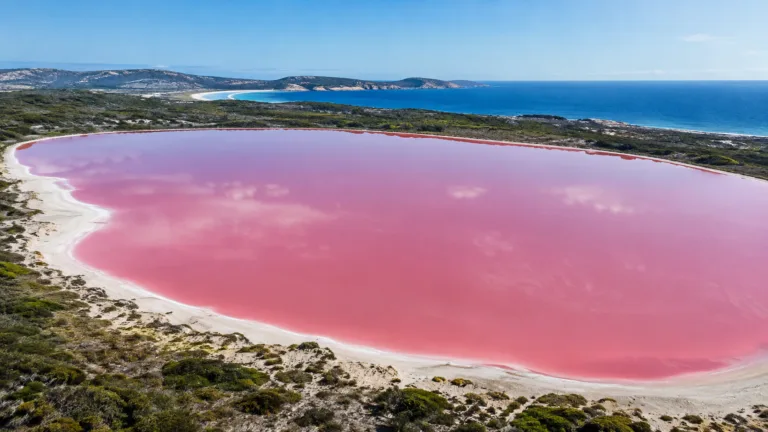
Pink
Primary visual colorWhere Is Tuz Gölü (Lake Tuz)?
Central Anatolia · Türkiye
Drag or zoom the real map. Verified shoreline geometry is highlighted with the lake’s LakeColors palette color when available.
Tuz Gölü (Lake Tuz) on the Globe
Rotate the world or focus directly on the lake.
Why July Is Not the Same Every Year
A July 19, 2026 observation documented a strong pink phase after a wetter period, while earlier reporting described the red phase ending during July as water levels fell. The shift to white salt is therefore hydrologically timed rather than fixed to one date.
Lake Tuz can move through ice-blue water, pink or red brine, and a bright white salt surface as its shallow water balance changes. The pink phase comes from pigments associated with salt-tolerant microorganisms living in increasingly concentrated brine; the white phase appears when evaporation removes much of that water and exposes the lake’s salt crust. The transition is seasonal, but rainfall and water level can shift its timing considerably from one year to another.
The Pink Water Is Biological, Not Pink Salt
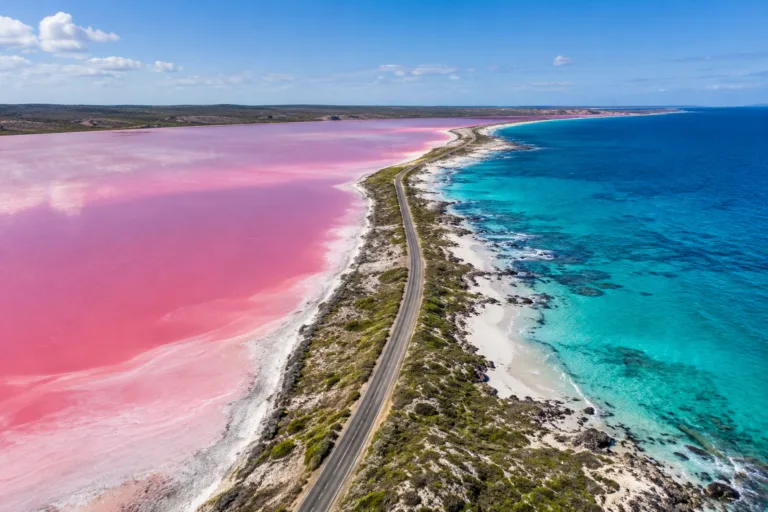
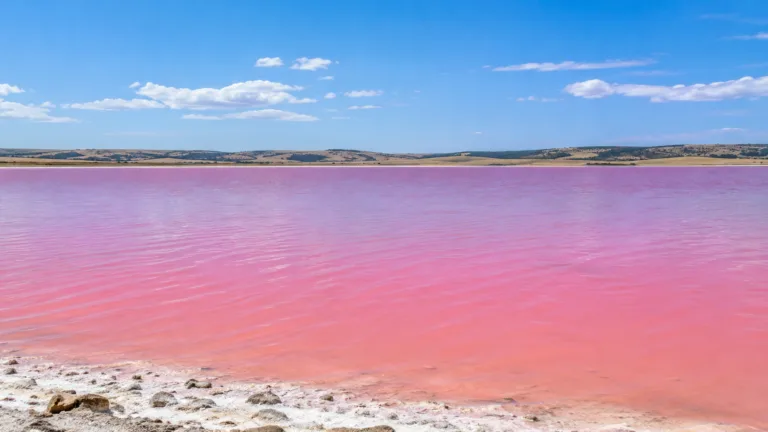
The colored phase occurs while liquid brine is still present. Dunaliella, a salt-tolerant microalga found in Lake Tuz, is one of the best-supported contributors. Research on a Dunaliella strain isolated from the lake confirmed that it can produce β-carotene, an orange-red carotenoid pigment. When pigment-rich microorganisms become abundant in shallow hypersaline water, the combined optical effect can shift the lake from pale pink to much stronger red tones.
It is useful not to reduce every colored patch to a single organism. Official descriptions have identified Dunaliella salina as a cause of Lake Tuz’s reddish water, while observations from July 2026 also linked the pink color to both algae and salt-loving bacteria. The safest interpretation is that Dunaliella is a major documented contributor within a broader hypersaline microbial community.
The color is produced by biological pigments suspended in concentrated brine. It is not evidence that the lake’s sodium chloride itself has permanently become pink.
White Arrives When Water Gives Way to Salt
Lake Tuz is exceptionally shallow, so a large change in visible surface can occur without a large vertical drop in water level. During the dry season, evaporation progressively concentrates the dissolved salts and reduces the area covered by liquid water. USGS documentation states that about 95% of the lake’s water evaporates during summer, exposing roughly 500 square kilometers of smooth salt crust in the calibration area it describes.
This explains why pink often appears before the strongest white phase. There must still be enough concentrated brine for pigment-bearing microorganisms to color the water. As evaporation continues, the remaining shallow pools contract and more of the lakebed becomes a highly reflective salt surface. The visual system changes from colored water to exposed mineral crust rather than from pink water being chemically “bleached” white.
The pink-to-white change is not necessarily a lake-wide switch on a single day. Pink brine may remain in shallow depressions while nearby areas are already dry and white.
Why May, June and July Do Not Produce the Same Color Every Year
Seasonal observations show a recurring pattern without supporting a rigid annual date. A 2018 report described reddish water becoming visible from May and continuing through June and July, with the color weakening as the water level dropped. That sequence fits the lake’s evaporation cycle: salinity rises first, creating conditions for strongly pigmented hypersaline organisms, and later the available surface water becomes too limited for a broad colored-water phase.
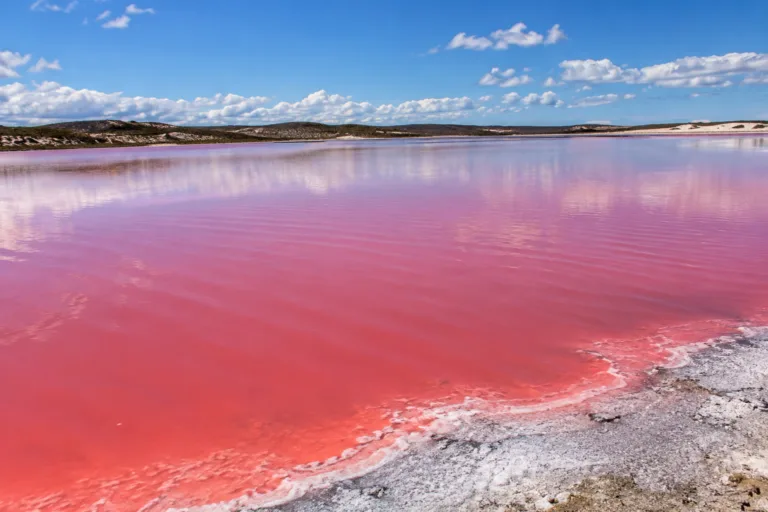
The timing can shift substantially. On July 19, 2026, Lake Tuz was again reported in a pronounced pink state after a period of comparatively abundant rainfall had left more water in the basin. High July evaporation then concentrated that remaining water. The contrast between these observations shows why “July is pink” or “July is white” should not be treated as a permanent rule. The balance between incoming water and evaporation determines whether July still contains colored brine or has already moved toward exposed salt.
Pink and White Can Appear in the Same View
Lake Tuz is large, shallow and spatially uneven. Water does not disappear from every part of the basin at the same rate. Official descriptions of the color phenomenon have specifically noted reddish conditions along parts of the southwestern shore rather than describing the entire lake as uniformly red.
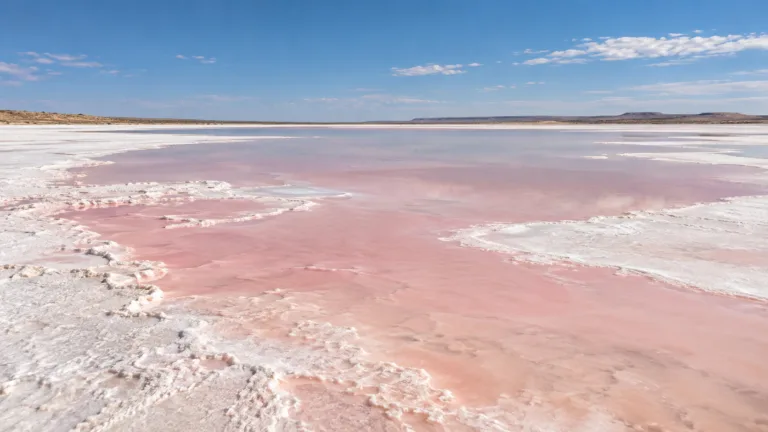
This produces one of Lake Tuz’s most characteristic color combinations: pink or crimson shallow water bordered by intensely white salt. The two colors can therefore represent adjacent stages of the same evaporation cycle. A wetter depression may still support pigmented brine while a slightly higher or more exposed neighboring flat has already lost its surface water.
This also explains why photographs taken on similar dates can look very different without either image being inaccurate. The photographed sector, recent rainfall, local water depth and the remaining distribution of shallow brine all affect which color dominates the frame.
The Dry Salt Flat Is Bright Enough to Serve as a Satellite Calibration Site
Lake Tuz’s white phase has scientific value beyond its appearance. The exposed summer surface is unusually bright, flat and spatially uniform. Those properties have made Tuz Gölü an important radiometric calibration site for Earth-observation instruments, including work coordinated through international calibration programs and supported by satellite and field measurements.
This calibration role helps define what the late dry-season white actually represents. It is not simply a pale reflection from shallow water. Large areas become exposed salt crust with a highly reflective surface. In color terms, Lake Tuz therefore passes between two fundamentally different visual mechanisms: pigment-colored hypersaline water and a mineral-dominated white lakebed.
Sources
- USGS ECCOE — Tuz Golu Test Site
- Aksaray Governorate — Tuz Gölü and Flamingos
- Turkish Journal of Fisheries and Aquatic Sciences — Dunaliella from Lake Tuz
- Anadolu Agency — Lake Tuz Red-and-White Seasonal Color
- Demirören News Agency — Lake Tuz Turns Pink, July 2026
- Remote Sensing — Spatio-Temporal Assessment of Tuz Gölü