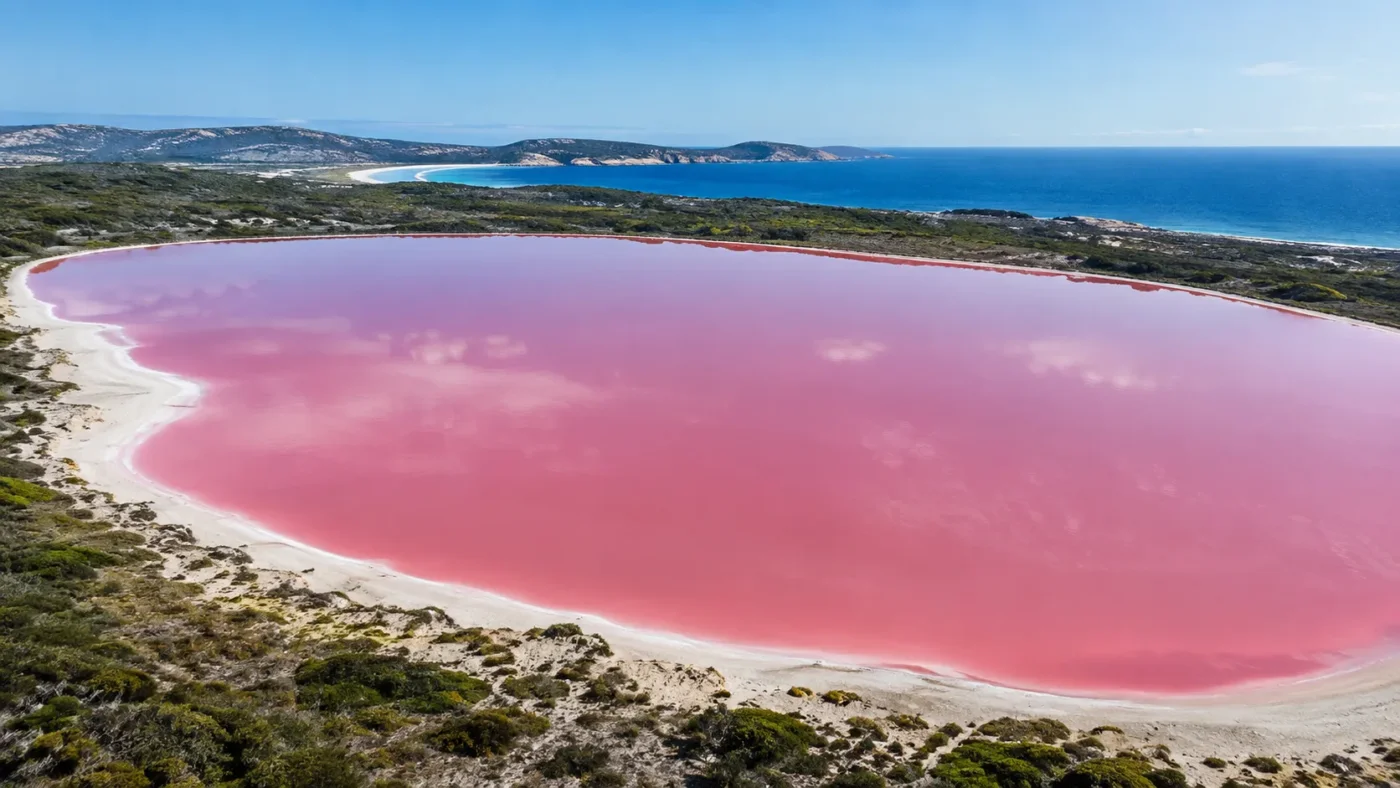
Pink
Primary visual colorWhere Is Lake Hillier?
Western Australia · Australia
Drag or zoom the real map. Verified shoreline geometry is highlighted with the lake’s LakeColors palette color when available.
Lake Hillier on the Globe
Rotate the world or focus directly on the lake.
The Pink Is a Microbial Community Effect
Metagenomic study published 2022Sequencing found a diverse hypersaline microbiome with multiple pigment-producing bacteria, archaea and algae rather than a single organism explaining the lake by itself.
Organism: Salinibacter ruber
Role: Abundant red-pigmented halophilic bacterium
Evidence: High
Organism: Dunaliella salina
Role: Pigment-producing halophilic alga detected in the lake
Evidence: High
Organism: Halorubrum and other halophiles
Role: Additional pigment-rich members of the hypersaline community
Evidence: High
How Hypersalinity Supports the Pink Water
The 2022 Rainfall Event and the Faded Color
Pink Is Characteristic, Not Guaranteed
Published Water and Microbial Measurements
Documented measurement dataHypersaline lake condition reported in the peer-reviewed study.
Single Lake Hillier sample in the regional water-quality review.
Single Lake Hillier sample in the regional water-quality review.
Single Lake Hillier sample reported in the regional comparison dataset.
Single Lake Hillier sample; this is not a year-round abundance estimate.
How the Lake Hillier Color Profile Is Supported
Claim-level supportMetagenomic sequencing identified multiple pigment-producing bacteria, archaea and algae in Lake Hillier.
Environmental Microbiome — Lake Hillier metagenomic studyEvidence: HighBoth sources connect the color loss with freshwater dilution of the lake's hypersaline water.
Tourism Western Australia — Pink and Rainbow LakesABC News — Lake Hillier colour loss after 2022 rainfallEvidence: HighThe review documents effects from sky reflection, time of day, water depth and salt crust on how pink lakes appear in photographs.
Shire of Esperance — Water Quality Review of Pink Lake and Associated LakesEvidence: HighLake Hillier’s famous pink water is produced by a hypersaline microbial ecosystem rather than by one pink alga acting alone. The lake’s very high salt concentration favors pigment-producing microorganisms, but that balance can be disrupted: exceptional rainfall in 2022 diluted the water enough for the familiar bright pink to fade. An official Western Australia update revised in April 2026 still described the lake’s color as naturally variable, with recovery expected as salinity rises but no reliable date for the pink to return.
Lake Hillier’s Pink Is a Community Effect, Not a Single-Alga Label
The older explanation for Lake Hillier often centered almost entirely on Dunaliella salina, a salt-tolerant alga that can accumulate orange-red carotenoid pigments under stressful hypersaline conditions. The alga is present in Lake Hillier, but DNA-based work has made the biological picture much broader.
A metagenomic study published in Environmental Microbiome identified bacteria, archaea, algae and viruses living in the lake, with several pigment-producing groups represented. The researchers reported Salinibacter, Halobacillus, Psychroflexus, Halorubrum and Dunaliella among the organisms capable of contributing pigments. Salinibacter ruber was especially prominent in the microbial data, while Dunaliella salina was the most abundant eukaryotic organism detected by the study’s sequencing approaches.
Calling Lake Hillier pink because of “pink algae” is too narrow. Current evidence supports a pigment-rich microbial consortium, with salt-loving bacteria and archaea contributing alongside algae.
This also explains why the lake should not be treated as a container of permanent dye. The visible color is an ecosystem property. If the physical conditions that favor those organisms change, the balance of pigments in the water can change with them.
Extreme Salt Creates the Conditions for the Pink Microbiome
The peer-reviewed Lake Hillier study describes the lake as having a salt concentration of about 28%, compared with roughly 3.5% dissolved salts in average ocean water. That degree of hypersalinity excludes many organisms that would thrive in ordinary freshwater or seawater while creating suitable conditions for highly salt-tolerant microbes.
Many of those organisms contain carotenoid or related pigments. These compounds are useful to microorganisms living under strong light, high salt and other environmental stresses, and collectively they can shift the appearance of a dense hypersaline community toward red, orange and pink tones.
Salt therefore matters in two connected ways. It changes the chemistry of the water, and it acts as an ecological filter. When Lake Hillier is concentrated enough, organisms adapted to extreme salinity can become a dominant part of the biological community. When large volumes of fresh water lower that salt concentration, the ecological advantage changes.
Why the 2022 Rainfall Event Was Able to Wash Out the Pink
Lake Hillier’s long reputation for persistent pink water was disrupted by an exceptional offshore rainfall event in April 2022. The extra fresh water raised the lake level and diluted the salt concentration. Environmental reporting also described nutrients and colored material entering from vegetation affected by the flooding.
That combination matters because the historical pink state depended on an extreme chemical environment. Lower salinity reduces the selective pressure that favors the salt-loving pigment producers associated with the lake’s characteristic color. At the same time, other microorganisms can become more competitive, while dissolved organic material can alter the visible appearance of the water.
By February 2025, the familiar bubble-gum appearance had still not returned. The lake was reported as discolored rather than vivid pink. Tourism Western Australia’s April 2026 revision continued to warn that Lake Hillier was subject to natural color fluctuation following the 2022 dilution event.
Lake Hillier was historically unusually persistent compared with many other pink lakes, but the 2022 event demonstrated that its color is conditional. A better description is that bright pink is the lake’s characteristic hypersaline state, not a color guaranteed under every hydrological condition.
A Faded Lake Is Not the Same as a Different Photograph
Lake color can change for two very different reasons. The water itself can undergo a biological or chemical shift, or the same water can look different because of illumination, reflection, depth and viewing conditions. Lake Hillier has evidence for both kinds of variation.
| Type of Change | What Changes | Lake Hillier Relevance |
|---|---|---|
| Freshwater dilution | Salinity, water level and microbial conditions | The 2022 rainfall event produced a genuine shift away from the lake’s established bright-pink state. |
| Sky and cloud reflection | Light reaching and leaving the water surface | Regional monitoring found that photographs of pink lakes can appear bluer or less pink than the water itself. |
| Time of day | Spectral balance of incoming sunlight | Late-afternoon light can strengthen red tones without requiring a biological change in the lake. |
| Water depth and salt crust | Background brightness and the optical path through the water | Shallower water over bright salt can appear more intensely pink than deeper water without the same visible crust. |
This distinction is useful when comparing historical photographs. A slightly different shade in two images does not prove that the lake’s microbial ecology changed between the photographs. The post-2022 loss of vivid pink is different because it was associated with a documented hydrological event, higher water levels and diluted salinity.
The 2019 Water Sample Is a Snapshot, Not a Permanent Formula
A regional water-quality investigation sampled Lake Hillier on 2 June 2019, before the later rainfall-driven color loss. The dataset recorded water density, pH, carotenoid concentration and counts of Dunaliella cells, providing a useful biochemical snapshot of the lake while it was still associated with its established pink condition.
Those measurements should not be treated as fixed values for every year or every part of the lake. A single sample cannot establish a month-by-month microbial cycle, and it cannot describe Lake Hillier’s condition after the 2022 dilution event. It does, however, confirm that pigment-associated microorganisms and measurable carotenoids were present in the hypersaline system before the recent change.
Lake Hillier does not currently have a source-backed January-to-December color schedule that would justify assigning a specific shade to every month. The strongest temporal evidence concerns the one-off 2022 dilution event and the subsequent recovery period, rather than a repeating annual pink-season calendar.
Why the Pink Can Return Without a Predictable Recovery Date
The expected recovery mechanism is straightforward in physical terms: evaporation removes water while leaving most dissolved salts behind. As the water level falls, salinity can rise again, recreating conditions that favor the lake’s salt-adapted microbial community.
The biological response is less predictable. Microbial populations need time to respond to changing chemistry, and the lake is not controlled like an evaporation pond. Rainfall, evaporation, organic inputs and the existing community all influence what happens next. A rise in salinity therefore points toward conditions associated with pink water, but it does not provide a calendar date for restoration.
This is why the current official description is cautious. Western Australia continues to recognize Lake Hillier as the famous pink lake of Middle Island while also stating that its vivid hue cannot presently be guaranteed. The color is an outcome of the lake’s salinity and living community, and those conditions can move away from — and potentially back toward — the state that produced its historic bubble-gum pink.
Sources
- Environmental Microbiome — Microbiome and Metagenomic Analysis of Lake Hillier Australia
- Tourism Western Australia — Pink and Rainbow Lakes of Western Australia
- ABC News — Lake Hillier Loses Iconic Pink Colour
- Shire of Esperance — Water Quality Review of Pink Lake and Associated Lakes
- Mapcarta — Lake Hillier Geographic Record
- ABC Science — Why Australia Has So Many Pink Lakes