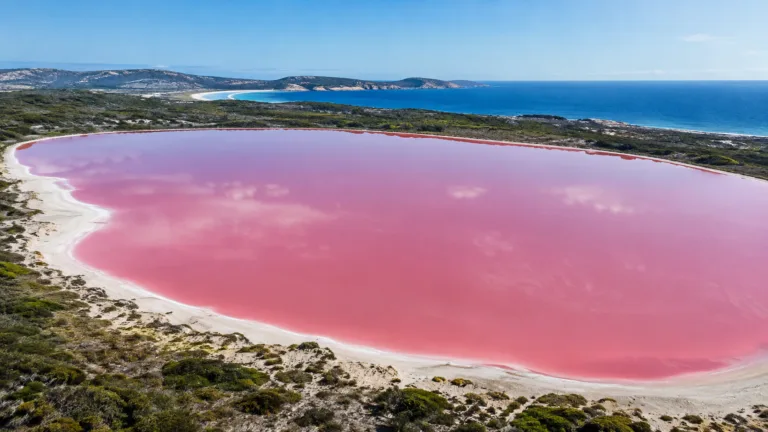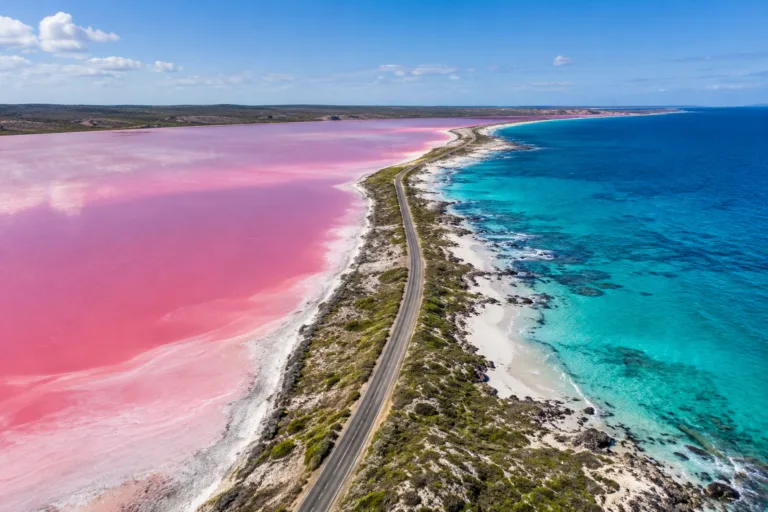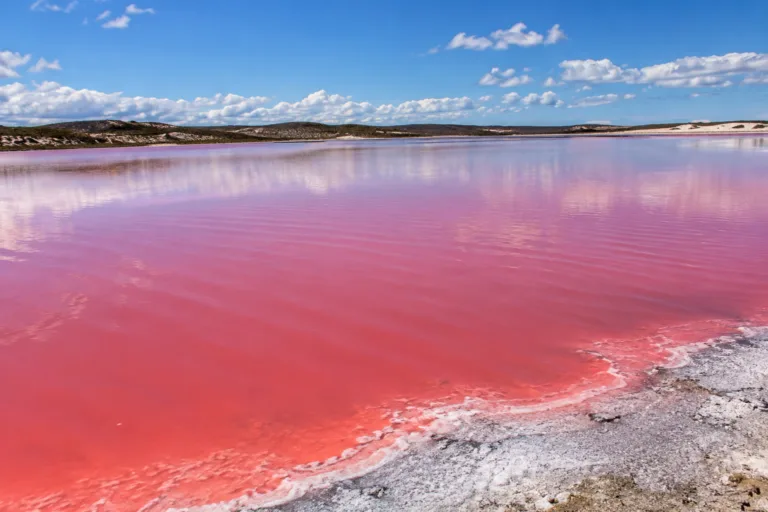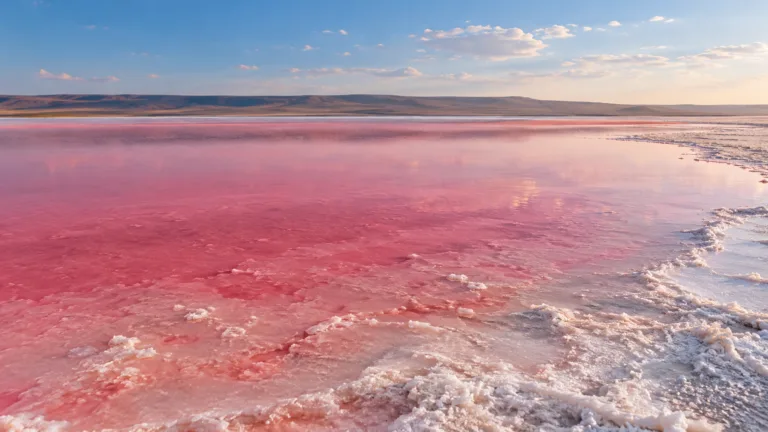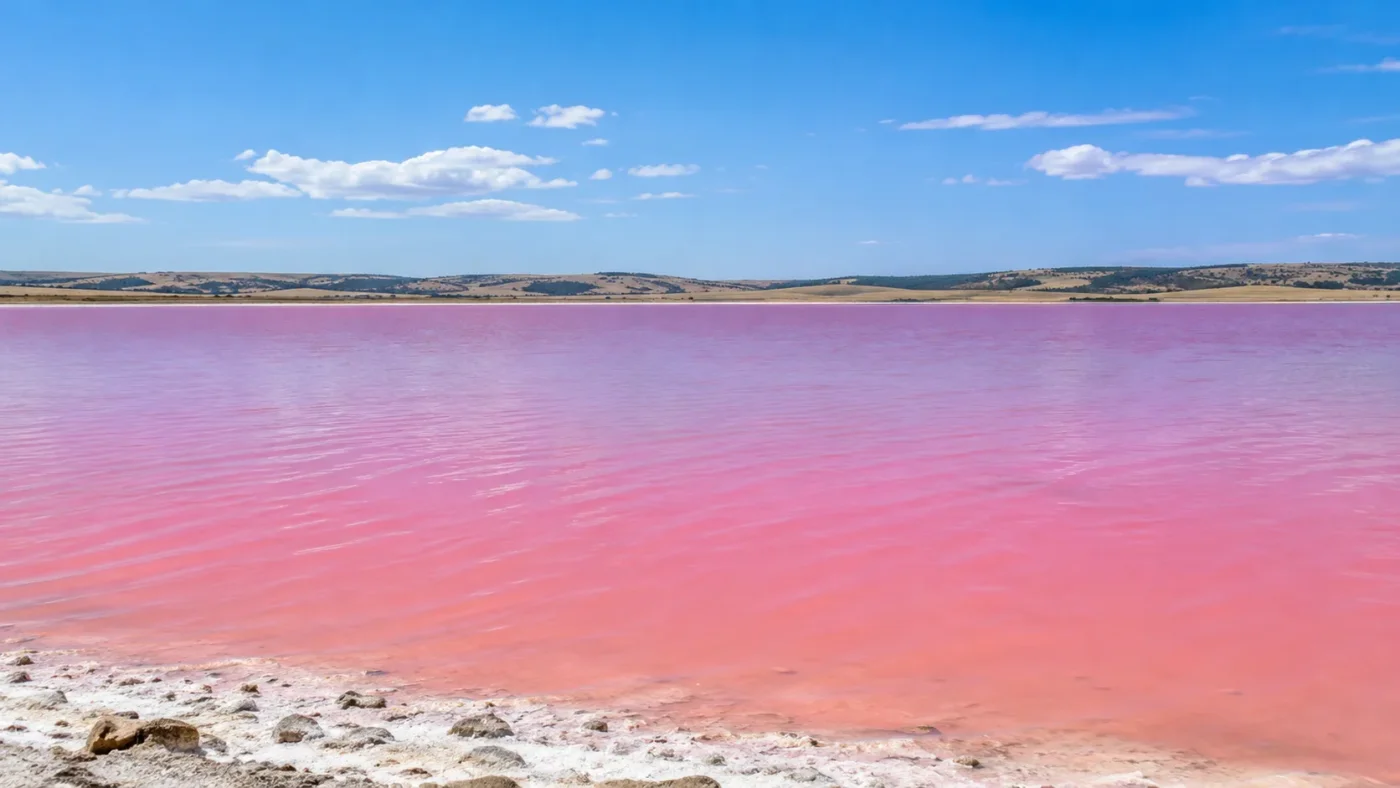
Pink
Primary visual colorWhere Is Lake Bumbunga?
South Australia · Australia
Drag or zoom the real map. Verified shoreline geometry is highlighted with the lake’s LakeColors palette color when available.
Lake Bumbunga on the Globe
Rotate the world or focus directly on the lake.
What Supports the Lake Bumbunga Color Profile
Claim-level supportSouth Australia's official Lake Bumbunga profile explicitly documents these color states and links them to salinity.
South Australia — Lake BumbungaEvidence: HighCurrent South Australian tourism guidance favors spring, while a University of Adelaide expert reported by ABC also identifies spring conditions as favorable.
South Australia — Things To Do in the Clare ValleyABC News — Why Lake Bumbunga Is PinkEvidence: HighPeer-reviewed hypersaline ecology documents carotenoid-rich Dunaliella and pink-red halophilic Archaea as established contributors to color in highly saline environments.
Oren — The Ecology of Dunaliella in High-Salt EnvironmentsEvidence: HighA South Australian Department of Mines report describes wet-winter inflow and groundwater seepage followed by summer evaporation and salt and gypsum deposition.
Department of Mines South Australia — Lake Bumbunga Gypsum DepositsEvidence: HighLake Bumbunga is not permanently pink. Pink is its signature appearance, but official South Australian information also documents white and blue states as water conditions and salinity change, while current regional guidance identifies spring as the strongest recurring opportunity to see the lake at its brightest.
Pink develops from a saline biological system, not from salt alone
Calling Lake Bumbunga pink simply because it contains salt leaves out the biological part of the process. High salinity limits which organisms can thrive in the water, allowing salt-tolerant microorganisms with strong pigments to become visually important. University of Adelaide geographer Associate Professor John Tibby has linked Lake Bumbunga’s pink appearance to pigmented algae and noted that changes in algal abundance can help explain why the lake looks different at different times.
Hypersaline ecology adds an important qualification. Peer-reviewed research on salt lakes and saltern brines shows that Dunaliella algae can accumulate large quantities of orange-red beta-carotene, while extremely halophilic Archaea can contain pink-red carotenoids such as bacterioruberin. In some hypersaline systems, the archaeal pigments can contribute more to the visible brine color than the algae themselves.
The hypersaline pigment mechanism is well established, but the sources used for this profile do not provide a Lake Bumbunga-specific pigment assay, microbial sequencing survey or direct measurement showing that one named species is solely responsible for its pink color. Dunaliella salina and halophilic Archaea therefore describe scientifically established possibilities for hypersaline pink brines rather than measured species attribution for Lake Bumbunga.
Winter water and summer evaporation repeatedly reset the lake
Lake Bumbunga’s color cannot be separated from its shallow-basin hydrology. A South Australian Department of Mines investigation documented surface drainage and groundwater seepage entering the lake during the wet winter months. The water was retained over an impervious layer, while summer evaporation produced salt and gypsum deposition.
This wetting-and-concentration cycle provides a physical route for large changes in appearance. Added water can deepen the lake and dilute its brine. Continued evaporation reduces water volume and raises salt concentration, while further drying can leave increasingly prominent pale mineral surfaces. The historical geological record also describes salt layers and gypsum-bearing mud within the lake bed.
The result is not a simple progression in which stronger evaporation always produces a stronger pink. A sufficiently saline environment can favor pigment-producing microorganisms, but a lake that loses too much water can become dominated visually by salt, sediment or exposed lake bed instead of pink water.
Spring has the clearest recurring pink signal
Recent South Australian tourism guidance says spring gives the best chance of seeing Lake Bumbunga at its brightest. That timing is also consistent with observations reported by ABC: the lake is generally pink in spring when water remains, and Associate Professor Tibby proposed that retained water can bring nutrients while increasing spring sunlight supports the organisms associated with the color.
This is why a calendar date cannot guarantee a particular shade. Rainfall determines how much water reaches the basin, evaporation changes its concentration, microbial abundance varies, and light changes the intensity perceived by an observer or camera. Two visits in the same season can therefore produce noticeably different views.
September through November is mapped as the strongest supported pink period because the source evidence explicitly identifies spring. It should not be interpreted as a claim that the lake remains pink throughout every spring or that other seasons cannot produce pink water.
White and blue belong to the documented color cycle too
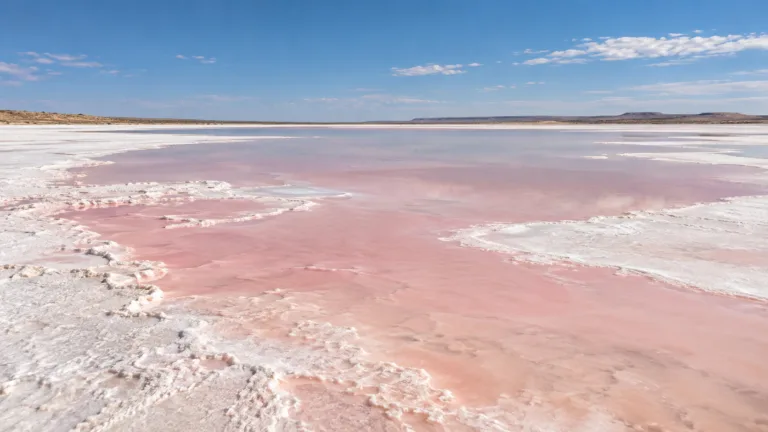
Official descriptions of Lake Bumbunga explicitly include pink, white and blue, so a pale or blue-looking lake is not evidence that the familiar pink color has somehow disappeared permanently. Water volume, salt concentration and biological activity can all change, and the current South Australian Clare Valley guidance also identifies rainfall, season and light as factors affecting what visitors see.
The mineral-rich setting helps explain why very pale surfaces can become prominent as water retreats: historical geological work records surface salt, gypsum crystals and gypseous sediments at the lake. However, the available color descriptions do not assign a single measured chemical cause to every white or blue phase. Blue should likewise be treated as a documented visual state rather than as evidence for one specific salinity value.
This distinction also matters when comparing photographs. A real change in brine chemistry or microbial abundance can alter the water itself, while sunlight, reflections and viewing conditions can alter how strongly that color is perceived. Lake Bumbunga can show both kinds of variation at once.
Sources