Pink
Primary visual colorWhere Is Lake Tyrrell?
Victoria · Australia
Drag or zoom the real map. Verified shoreline geometry is highlighted with the lake’s LakeColors palette color when available.
Lake Tyrrell on the Globe
Rotate the world or focus directly on the lake.
Seasonal Brine and Salt-Crust Measurements
Documented measurement dataTypical lake condition described in the Lake Tyrrell microbial study
Dunaliella Is More Concentrated in the Salt Crust Than the Water Column
Summer and winter sampling across multiple yearsLake Tyrrell's microbial study found Dunaliella in the water column without it being the dominant eukaryote overall, while Dunaliella dominated the analyzed salt-crust eukaryotic community. The lake's pink appearance is therefore more accurately described as a hypersaline microbial-pigment system than as a simple water-column algae bloom.
Value: Dunaliella present but not dominant overall
Value: Dunaliella dominated the analyzed eukaryotic community
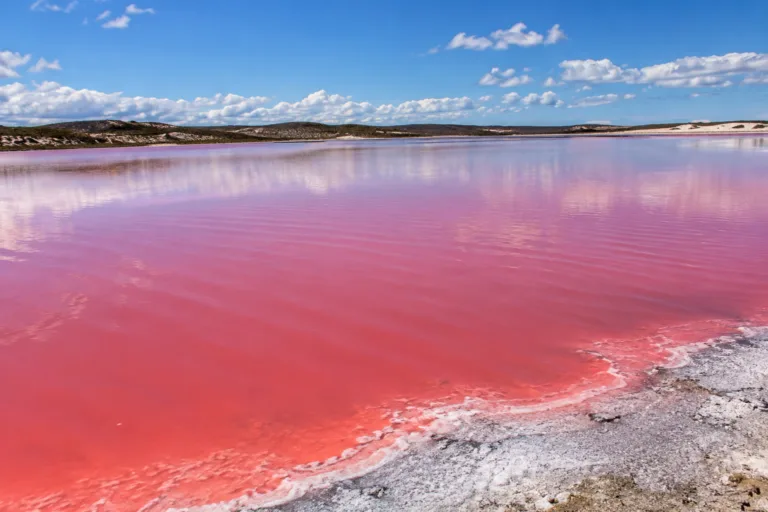
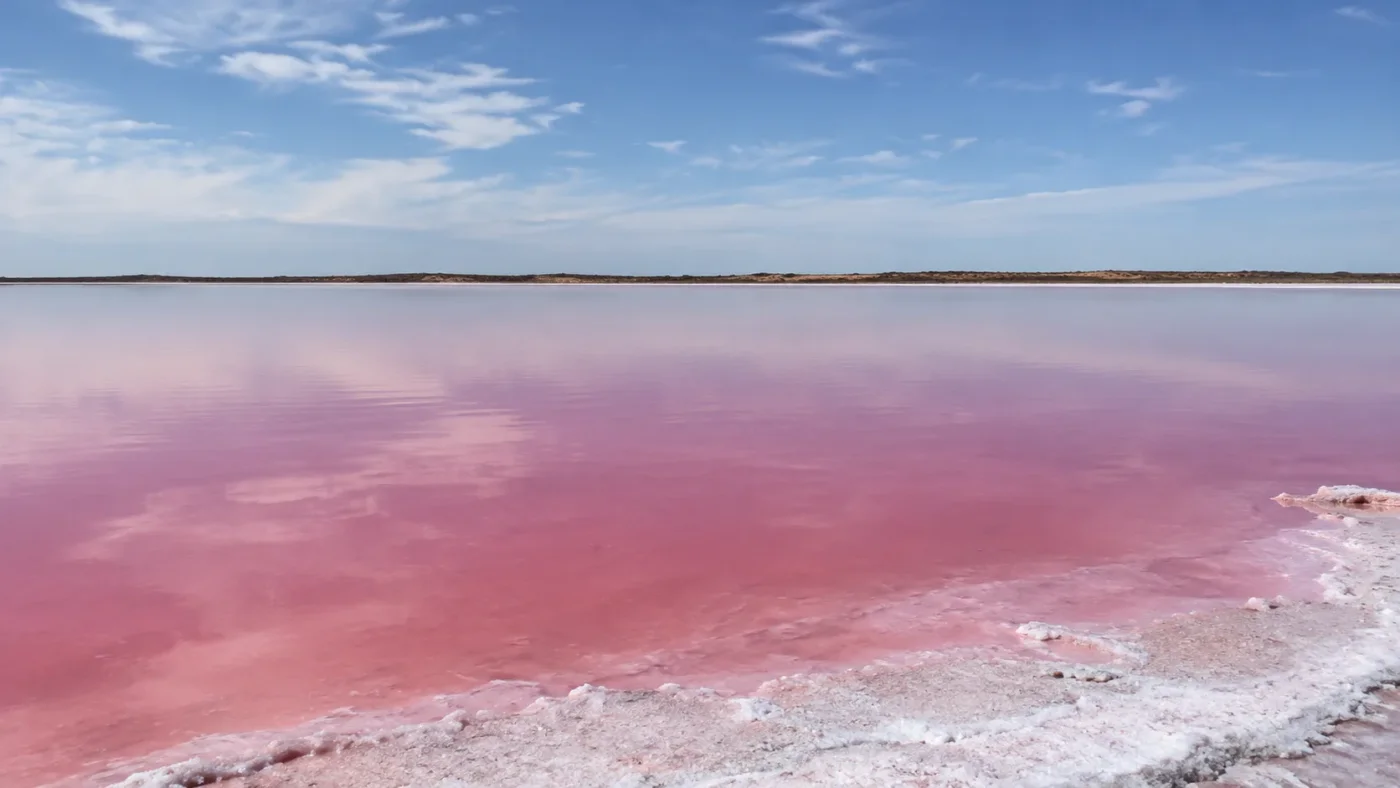
Lake Tyrrell is a condition-dependent pink salt lake rather than a permanently pink body of water. Its characteristic pink phase develops when extreme salinity and warm conditions favor carotenoid-rich microorganisms, while changing water depth, evaporation and sky reflection can make the same lake appear much less pink at other times.
Why Lake Tyrrell Turns Pink
The pink is biological. Lake Tyrrell is an ephemeral hypersaline system in north-western Victoria, and its brine can approach or exceed salt concentrations tolerated by most aquatic organisms. The microorganisms that remain under these conditions include strongly salt-adapted algae and archaea capable of producing red, orange and pink carotenoid pigments.
Dunaliella is one of the best-documented contributors. Lake Tyrrell samples contained carotenoid-rich red or orange Dunaliella cells, and the same organisms became greener when maintained under less saline and less stressful laboratory conditions. This fits the known response of some Dunaliella species, including D. salina, which accumulate large quantities of carotenoids under high salinity and intense irradiance.
Earlier work specifically examining pink saline lakes reported that Lake Tyrrell’s pink phase coincided with maximum salinity and the warmest summer temperatures. It attributed the coloration to carotenoid pigments produced by the small group of halophilic microorganisms able to remain active in near-saturated brine.
Pink Water and Pink Salt Are Not the Same Surface State
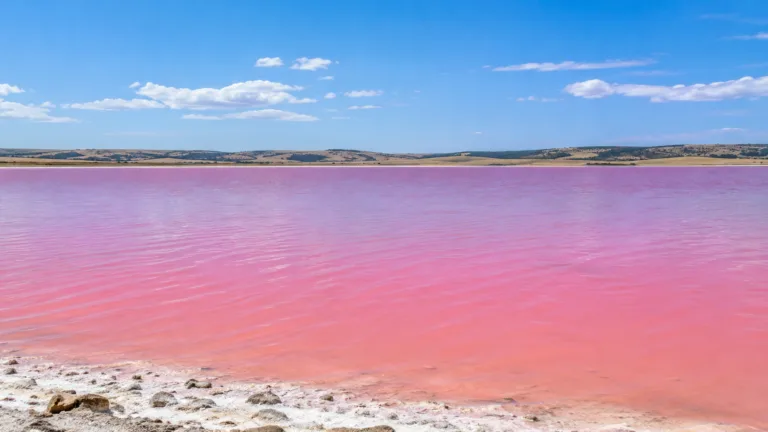
Water level determines how the color is expressed. Parks Victoria describes the most favorable conditions for seeing pink Lake Tyrrell as warm periods when shallow water is present. Scientific observations also show that the lake becomes progressively more concentrated as evaporation increases.
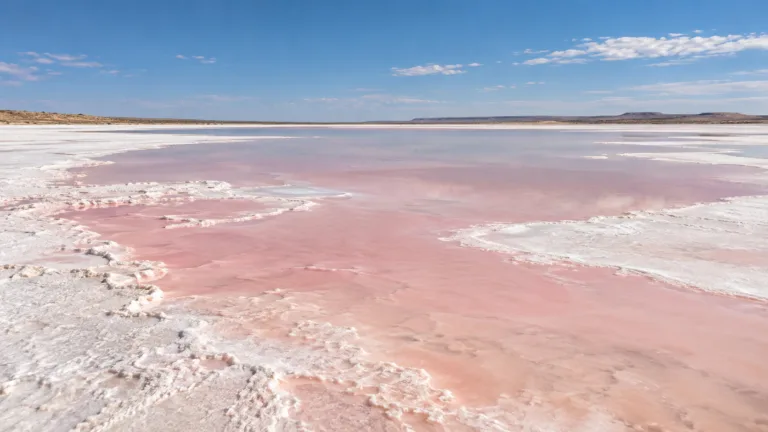
During winter, the lake can hold roughly half a metre of hypersaline water. In summer, much of that water evaporates, residual brines become still saltier, and a halite crust can develop across the lake bed. Pink pigmentation may therefore be visible in shallow brine, in microbial material associated with the salt crust, or across both at different stages of the drying cycle.
This distinction explains why apparently conflicting descriptions of the lake can both be accurate. Warm, shallow water can provide the most obvious pink-water view, while the highest salinity and strongest biological pigment stress occur as evaporation progresses toward the much drier summer state.
The Color Mechanism Is More Complex Than “Pink Algae”
Dunaliella is important at Lake Tyrrell, but describing the lake as pink simply because one alga colors the water leaves out much of the microbial evidence. A multiyear study of the lake found that Dunaliella did not dominate the eukaryotic water-column community overall. In contrast, the sampled salt crust contained a eukaryotic community strongly dominated by Dunaliella.
Lake Tyrrell also contains diverse extremely halophilic archaea. Separate metagenomic work showed that the composition of these microbial communities changes as concentrations of potassium, magnesium, sulfate and other chemical conditions shift through the seasonal brine cycle. Many organisms associated with hypersaline systems carry their own red or pink carotenoids, so the visible color is better understood as the product of a changing microbial ecosystem operating inside exceptionally concentrated salt water.
The pigment is also better described as being produced or accumulated within microbial cells rather than simply “secreted into the lake.” In Dunaliella, carotenoids function as part of the cell’s response to intense light and osmotic stress. Large numbers of pigmented cells can then change the visible color of the brine and salt surface.
Why Lake Tyrrell Is Not Always Pink
Pink depends on several conditions lining up at once. Salinity must be high enough to favor strongly halophilic organisms, pigment production must be substantial, and enough moisture generally needs to remain for the color to be conspicuous across the surface. Rainfall, groundwater input, evaporation, temperature and sunlight can all alter that balance.
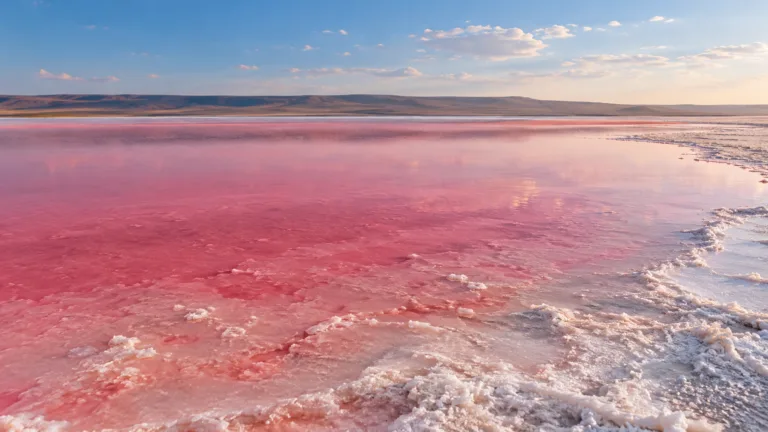
The lake’s appearance can also change without the underlying water or salt undergoing an equivalent biological color change. A thin, calm sheet of water creates Lake Tyrrell’s well-known mirror effect. Under those conditions the surface reflects the sky strongly, so blue, gray, purple or sunset tones can visually overlay the lake’s own microbial and salt coloration.
RACV has described the salt-encrusted surface as ranging from bright pink to lilac depending on conditions and time of day. These are visual states rather than evidence that the lake contains a permanent, uniformly colored pink water mass.
The Annual Color Cycle Follows the Brine Cycle
Lake Tyrrell’s strongest scientifically documented annual contrast is between its wetter winter state and its highly evaporated summer state. Winter water in the study description was around 250–300 g/L salt, already several times more concentrated than ordinary seawater. Summer evaporation produced residual brines generally above 330 g/L and a halite crust as much as 7 cm thick.
That seasonal concentration changes the habitat as well as the visual surface. Research on Lake Tyrrell found measurable seasonal succession among its hypersaline microbial populations as ionic conditions changed. Color therefore cannot be separated cleanly from the lake’s hydrology: the same evaporation that alters water depth also changes the chemical environment in which its pigment-producing microorganisms live.
There is no dependable calendar date on which Lake Tyrrell must be pink. Historical scientific literature connects strong pink coloration with summer maximum salinity, while current Parks Victoria guidance emphasizes warm, wet periods when shallow water remains over the lake. Weather from one year to the next determines where those conditions overlap.
Sources
- Parks Victoria — Victoria’s Pink Lakes
- Heidelberg et al. — Characterization of Eukaryotic Microbial Diversity in Hypersaline Lake Tyrrell
- Teller — The Pink Colour of Lakes, with an Example from Australia
- Podell et al. — Seasonal Fluctuations in Ionic Concentrations Drive Microbial Succession
- RACV — Lake Tyrrell: Victoria’s Mirror to the Sky
- United Nations Group of Experts on Geographical Names — Regional Gazetteer