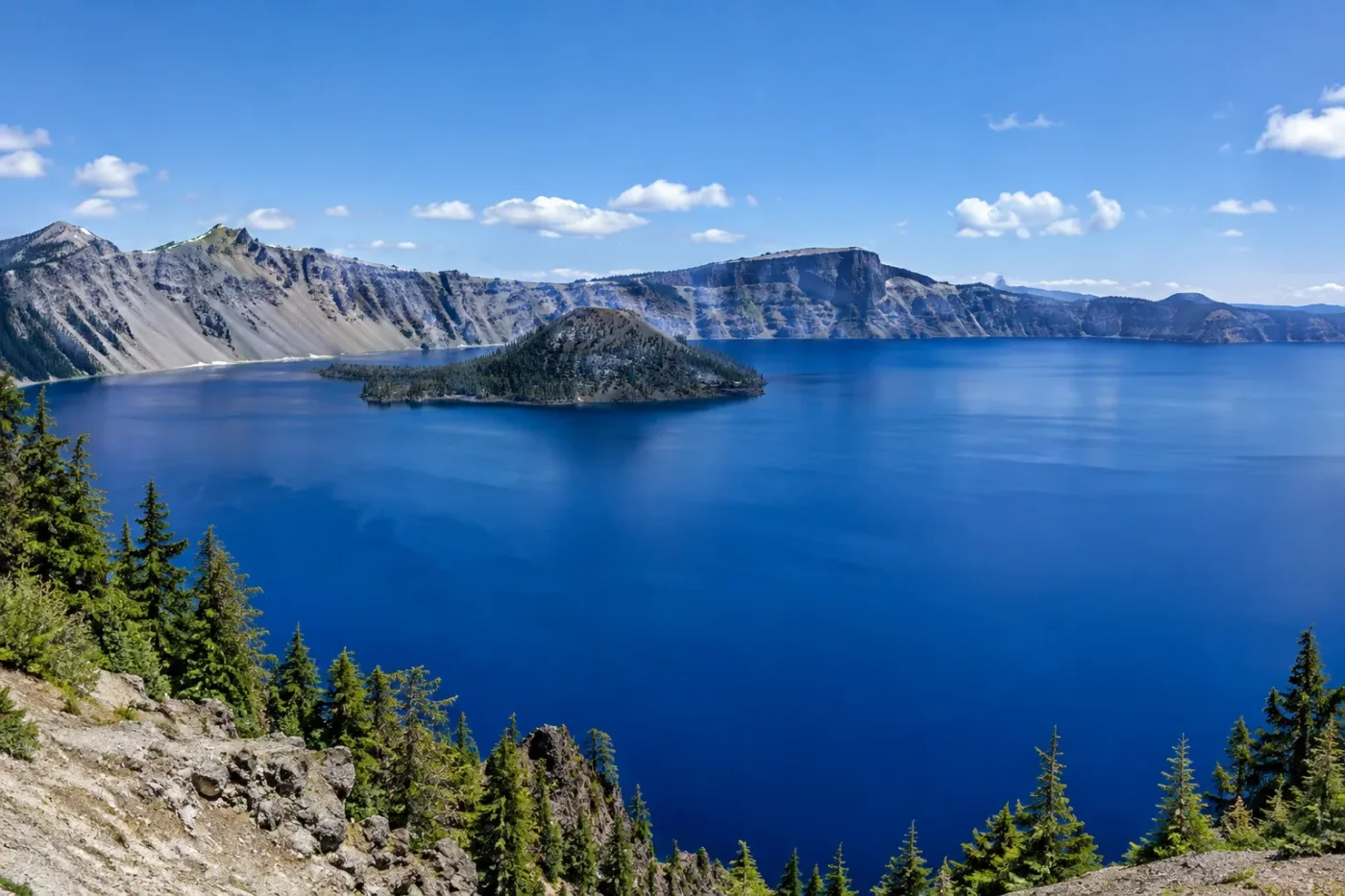
Deep Blue
Primary visual colorWhere Is Crater Lake?
Oregon · United States
Drag or zoom the real map. Verified shoreline geometry is highlighted with the lake’s LakeColors palette color when available.
Crater Lake on the Globe
Rotate the world or focus directly on the lake.
Pure Water Dominates the Optical Signal
June and September 2001Spectral measurements found that the optical properties of pure water are major contributors to Crater Lake's total optical properties and therefore to its color. Dissolved organic material and suspended particles still modify absorption and scattering, but they do not replace the deep-water optical basis of the lake's blue appearance.
Value: Pure-water absorption and scattering
Provenance: Peer Reviewed
Evidence: High
Value: Organic matter and particles alter absorption and scattering
Provenance: Peer Reviewed
Evidence: High
Measured Clarity and Light Penetration
Documented measurement dataClarity Through the Year
The 2016 Cleetwood Cove Bloom Briefly Broke the Blue Pattern
A phytoplankton bloom turned nearshore water around Cleetwood Cove greenish-yellow. The event was localized and short-lived rather than a lake-wide replacement of Crater Lake's usual deep-blue appearance.
Evidence Behind the Color Profile
Claim-level supportThe National Park Service directly describes Crater Lake as deep blue and connects the appearance to depth, purity, clarity and light behavior.
National Park Service — Crater Lake: Deep BlueEvidence: HighSecchi observations and light-penetration measurements document unusually transparent water.
National Park Service — Research and Monitoring EquipmentUSGS — Thermal, Chemical, and Optical Properties of Crater Lake, OregonEvidence: HighSpectral optical measurements identify pure-water properties as major contributors to the total optical signal and lake color.
USGS — Spectral Optical Properties of Crater LakeEvidence: HighLong-term monitoring links winter deep-water mixing and nutrient transport with near-surface algae abundance and summer clarity.
National Park Service — Monitoring Crater LakeEvidence: HighCrater Lake’s unusually dark blue color is produced by a combination of exceptional clarity and extraordinary depth. With little suspended material to cloud the water, sunlight can travel far into the lake; water absorbs longer visible wavelengths while blue light is more readily scattered back toward the surface. The result is a deep-blue basin whose appearance can shift with light and weather without losing its dominant color identity.
Clear Water Gives Sunlight a Much Longer Optical Path
The lake is filled by rain and snow rather than by rivers carrying large amounts of sediment into the basin. That matters for color because suspended mineral particles, organic debris and abundant plankton can shorten how far light travels through water. Crater Lake’s low particle load leaves a much longer optical path through the water column.
Depth then amplifies that effect. Crater Lake is the deepest lake in the United States, so light entering the central basin can interact with a very large volume of water. Red, orange and yellow wavelengths are absorbed more strongly as the light path lengthens. Blue wavelengths persist farther and are scattered back toward an observer, producing the intense blue for which the lake is known.
The lake’s blue color is not simply a mirror of the sky. Sky conditions can alter the shade seen from the rim, but NPS and USGS sources tie the underlying blue to the optical behavior of clear, deep water itself.
Pure Water Is a Major Part of the Lake’s Optical Signal
Spectral measurements published through the U.S. Geological Survey provide a more precise explanation than the common idea that the lake is blue merely because it is clean. Measurements made in June and September 2001 showed that the optical properties of pure water make a major contribution to Crater Lake’s total optical behavior and therefore to its color.
The lake is not optically empty. Researchers also measured absorption by colored dissolved organic material and scattering linked largely to organic particles, with changes across depth and between early and late summer. Those components can modify the light field, yet the unusually strong contribution from pure water remains central to the deep-blue baseline.
Measured Clarity Explains Why the Blue Can Look So Saturated
Secchi-disk measurements provide a direct record of how transparent the lake can be. The National Park Service reports an average Secchi reading of about 102 feet (31 meters) and a record reading of 143 feet (44 meters). A separate optical study found that during thermal stratification, about 1% of surface light could still be detected 80 to 100 meters below the surface.
These measurements do not assign a paint-like color value to the water. Instead, they show that light can penetrate far deeper than it can in a lake loaded with sediment or dense near-surface algae. That transparency allows absorption and scattering by the water itself to act over a long distance, strengthening the visual effect of blue wavelengths.
June and August Do Not Have the Same Clarity Pattern
Crater Lake’s color identity is stable, but its clarity is not perfectly constant through the year. Peer-reviewed monitoring summarized by USGS found Secchi clarity to be typically highest in June and lowest in August during the study period. The same research recorded substantial year-to-year variation rather than a single fixed summer value.
Current NPS monitoring connects part of that variability to winter deep-water mixing. When mixing brings more nutrients upward, near-surface algal abundance can rise later in the year and reduce summer clarity. This means a lake can remain recognizably deep blue while the amount of material in the upper water changes enough to alter transparency.
Shallow Water Can Carry More Green Than the Deep Basin
The deepest central water gives Crater Lake its strongest dark-blue appearance, but the color is not spatially uniform. The National Park Service notes that around shallower edges, some green light can return from the water before it is absorbed as completely as it is over a deeper optical path. That can produce a greener or blue-green appearance near parts of the shoreline compared with the central basin.
This difference should not be treated as a separate seasonal color phase. It is mainly a depth-related optical contrast: less water between the surface and bottom means a shorter path for selective absorption, so more of the green portion of the spectrum can remain visible.
A Greenish-Yellow Bloom in 2016 Was a Local Exception
Crater Lake’s normal color story has one documented biological exception worth separating from its everyday blue appearance. In fall 2016, a phytoplankton bloom turned nearshore water around Cleetwood Cove greenish-yellow. NPS monitoring identified the bloom as a concentration of motile dinoflagellates after calm conditions allowed them to gather near the surface.
The event did not represent a lake-wide shift away from blue. It was a localized nearshore bloom, and it shows how biological material can temporarily override the optical clarity that normally lets the deep basin appear intensely blue. Monitoring of nearshore algae has continued because such events can reveal changes in the lake’s ecology even when long-term whole-lake clarity remains high.
Weather Changes the Shade Seen From the Rim, Not the Basic Mechanism
Wind, cloud cover and solar angle can change how the lake looks from one day to another. A smooth surface can reflect more of the sky and surrounding rim, while waves alter surface reflection and the direction from which light reaches the eye. The sun’s position also changes the balance between reflected surface light and light emerging from within the water.
Those viewing effects explain why photographs taken from the same overlook can show different blues. They should not be confused with a measured change in the lake’s underlying water color. The deeper basin remains dominated by the same combination of transparent water, long optical path length and wavelength-selective absorption and scattering.