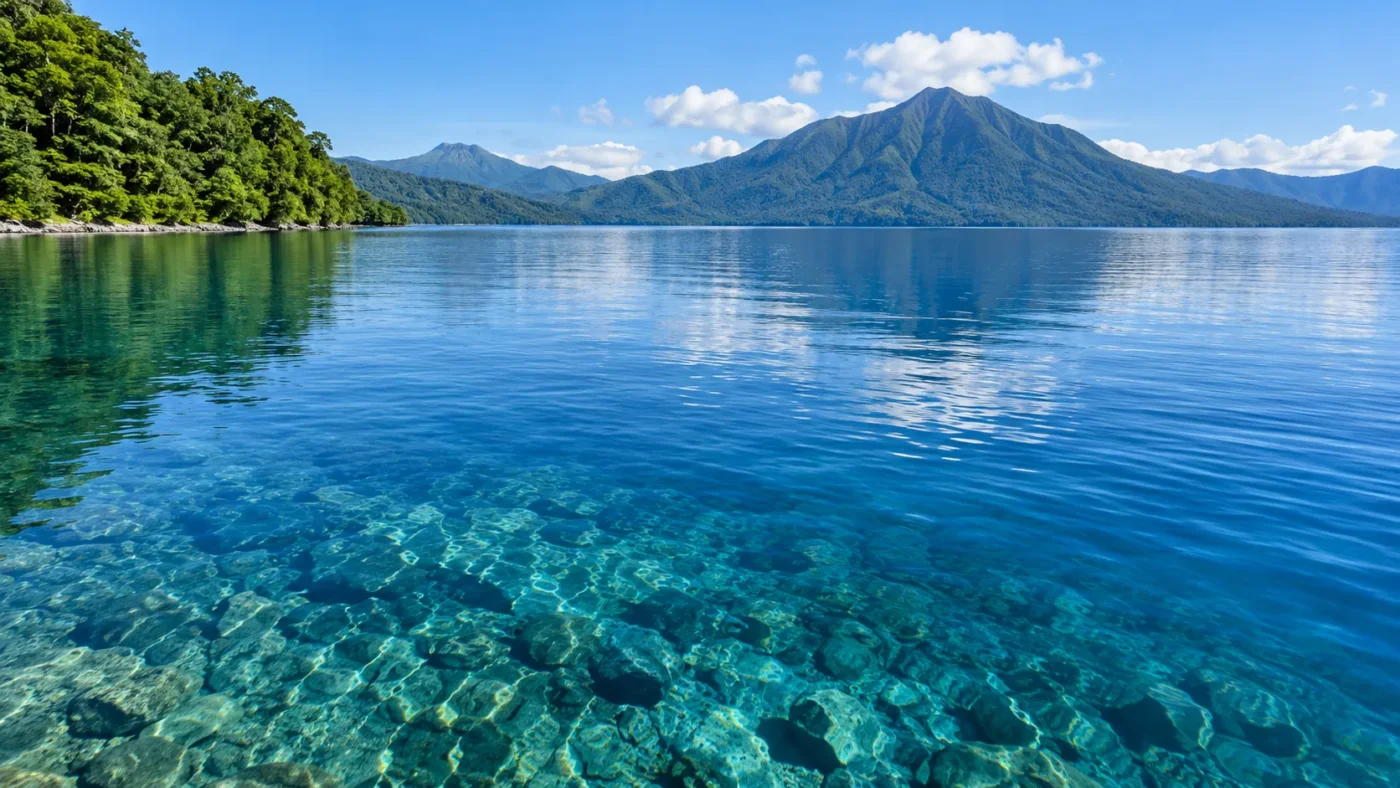
Shikotsu Blue
Primary visual colorWhere Is Lake Shikotsu?
Hokkaido · Japan
Drag or zoom the real map. Verified shoreline geometry is highlighted with the lake’s LakeColors palette color when available.
Lake Shikotsu on the Globe
Rotate the world or focus directly on the lake.
Transparency Measurements Behind the Blue
Documented measurement dataListed for Lake Shikotsu in the Ministry of the Environment's Japanese lake comparison.
Historical average reported by ILEC.
Historical maximum reported by ILEC.
The ILEC series contains values for May, June, August, October, November and December; it is not a complete 12-month series.
September 2014: Blue Shifted Toward Emerald Green
A Ministry of the Environment ranger report records a temporary change from the usual clear Shikotsu Blue toward emerald green after record rainfall and sediment inflow. This was a disturbance event, not a normal seasonal color phase.
Color Year: What Is Actually Documented
Seasonal Chlorophyll Changes Do Not Equal a Proven Color Cycle
Published 2018A remote-sensing study found chlorophyll-a concentrations were low across the lake in winter, increased in April, peaked in May and June, then declined from July and returned near winter-low levels by October. The study documents biological seasonality, but it does not establish a month-by-month visible hue sequence.
Value: Lower chlorophyll-a levels across the lake
Value: Seasonal increase begins
Value: Peak chlorophyll-a period
Value: Decline begins
Value: Near winter-low levels
Why Exceptional Clarity Supports Shikotsu Blue
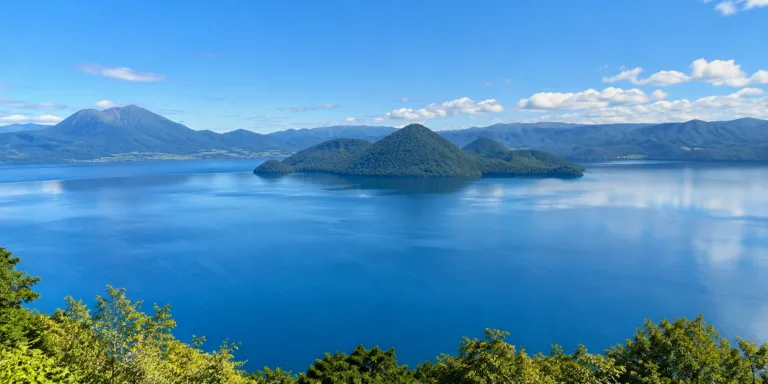
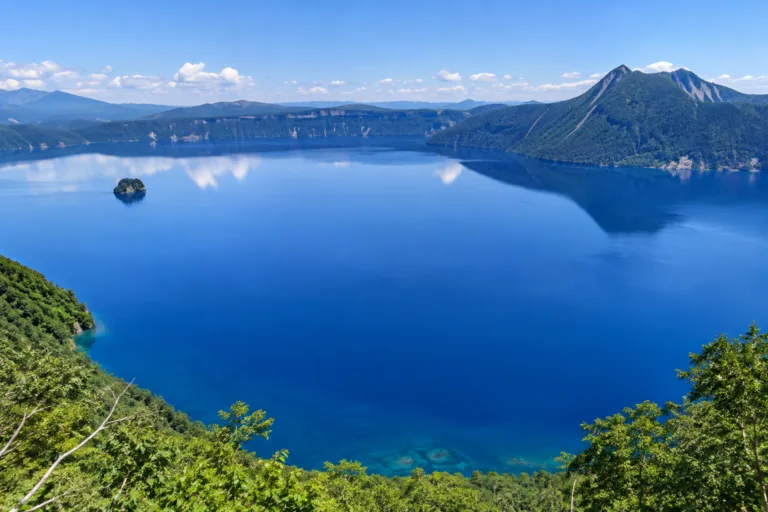
Lake Shikotsu is best known for the deep, exceptionally clear blue appearance called “Shikotsu Blue.” The term describes a characteristic visual impression rather than a standardized color value: the strongest measurable feature behind it is the lake’s unusually high transparency, associated with oligotrophic water, low plankton abundance and limited suspended material. The lake can also depart sharply from its usual blue when transparency changes, as a sediment pulse demonstrated in 2014.
“Shikotsu Blue” Is a Visual Name, Not a Fixed Shade
Chitose City uses “Shikotsu Blue” for the blue brilliance produced when light interacts with Lake Shikotsu’s clear water. That wording is useful because it does not imply that the lake has one permanent RGB, HEX or laboratory-defined color. No such standardized Shikotsu Blue color value is established in the sources used for this profile.
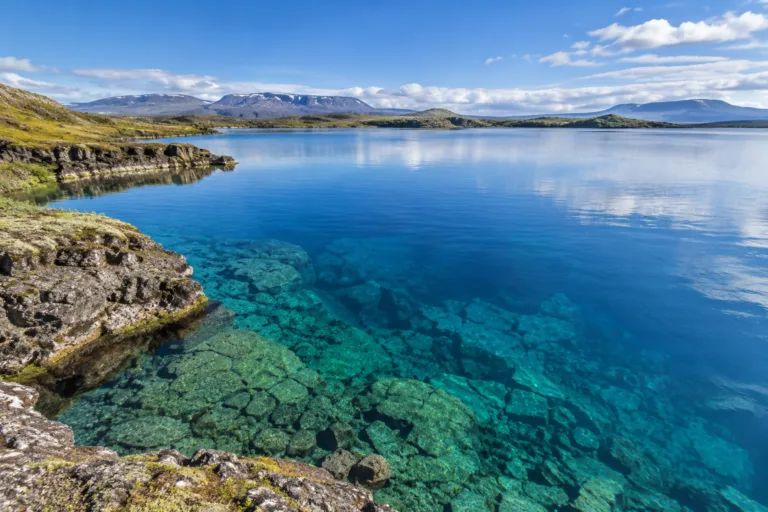
The visible result changes with the optical path through the water. Where the water column is deep, the lake can present a much darker blue than it does close to shore. In shallow transparent water, the lake bottom can remain visible and contribute to a lighter blue-green appearance. Surface reflection, cloud cover, sun angle and viewing direction can further alter what the eye or camera records without representing a fundamental change in water chemistry.
This distinction matters at Lake Shikotsu because exceptional transparency allows both effects to be strong: clear shallow water can reveal the substrate, while the deep basin provides a long path through the water column and a much darker blue field.
Transparency Is the Measurable Backbone of the Color
Lake Shikotsu’s clarity is not supported by a single timeless transparency number. Different datasets describe different periods and measurement series. Japan’s Ministry of the Environment lists a transparency value of 18.0 m for Lake Shikotsu in its comparison of Japanese lakes. The International Lake Environment Committee reports a historical average of 20 m and a maximum of 38.5 m for 1973–1979, while its 1981–1983 monthly-average dataset ranges from 12.8 m to 21.3 m among the months for which measurements are reported.
Those figures should not be merged into one supposed “normal transparency.” Secchi-type transparency responds to suspended particles, plankton, weather conditions and sampling circumstances, and the cited measurements come from different periods. Their shared significance is the scale of the clarity: Lake Shikotsu has repeatedly supported visibility through many metres of water.
The lake’s oligotrophic character helps explain that pattern. Low nutrient availability limits biological production compared with nutrient-rich lakes, while the national park setting and relatively limited sediment input help reduce the material that would otherwise scatter light and make the water appear turbid. High transparency therefore supports the clean blue visual identity without requiring a blue pigment or dissolved blue mineral.
The 2014 Emerald-Green Episode Was a Sediment Disturbance
One of the clearest demonstrations that Lake Shikotsu’s color depends on transparency occurred after record rainfall in September 2014. A Ministry of the Environment ranger account states that landslides and sediment inflow temporarily clouded the lake and changed its appearance from the familiar clear Shikotsu Blue toward emerald green.
This event should not be treated as a normal September color phase. The green appearance followed an unusual hydrological disturbance that introduced material from the surrounding slopes and reduced transparency. It is therefore evidence of a real water-appearance change caused by suspended sediment, rather than the ordinary shift in apparent color produced by reflections or viewing angle.
The episode also provides a useful test of the usual explanation for Shikotsu Blue. When the normally clear water became more turbid, the characteristic blue weakened and the visible color changed. As the suspended material settled and clarity recovered, the lake returned toward its established blue appearance.
Seasonal Biology Changes Without Establishing a Monthly Hue Cycle
Lake Shikotsu is not biologically identical in every month. A Landsat-based study of chlorophyll-a found lower concentrations across the lake in winter, an increase beginning in April, a peak in May and June, and a decline from July, with levels returning close to winter lows by October.
That result is relevant to a color database because phytoplankton can influence water optics, but the study does not demonstrate that Lake Shikotsu follows a verified sequence such as “spring green, summer blue, autumn cobalt.” Chlorophyll seasonality and visible hue seasonality are different claims. The available evidence supports a seasonal biological cycle while the named visual identity remains Shikotsu Blue.
The same caution applies to historical transparency measurements. The 1981–1983 series contains monthly averages for May, June, August, October, November and December, but not for every month. Those measurements are useful temporal anchors for the Color Year display; missing months are not a basis for inventing color states.
Deep Water and Clear Shallows Can Look Like Different Lakes
Lake Shikotsu combines unusual depth with unusually clear water. Its maximum depth is about 360 m, yet near the shore the transparency can make stones and underwater structure visible through the surface. Those two settings create very different visual conditions within the same body of water.
In shallow areas, light can reach the bottom and return carrying the influence of the substrate, while surface reflections can add blue from the sky or green from nearby vegetation. Over the deep basin, bottom influence disappears and the much longer optical path through water favors a darker blue appearance. A photograph showing pale aqua or greenish shallows beside deep blue water therefore does not by itself demonstrate a chemical or seasonal color change.
Lake Shikotsu’s distinctive color story is the combination of these optical effects with measured exceptional transparency. “Shikotsu Blue” is best understood as a clear-water blue identity whose exact visible shade changes with depth and observation conditions, while major departures such as the 2014 emerald-green episode require a separate physical cause.
Sources