Deep Blue
Primary visual colorWhere Is Lake Mashu?
Hokkaido · Japan
Drag or zoom the real map. Verified shoreline geometry is highlighted with the lake’s LakeColors palette color when available.
Lake Mashu on the Globe
Rotate the world or focus directly on the lake.
Why Summer Water Can Look Slightly Greener
NIES observations show that phytoplankton increases during the warmer season, reducing transparency and shifting the characteristic blue water slightly toward green. Underwater spectral observations confirmed this color tendency.
A Century of Transparency Measurements
Documented measurement dataThe exceptional historical measurement associated with Lake Mashu's reputation for extraordinary clarity.
NIES reports that average transparency has remained broadly within this range despite being lower than the historic maximum.
Reported by NIES as the highest transparency observed in the preceding 25 years at that time.
What Supports the Mashu Blue Profile
Claim-level supportJapan's Ministry of the Environment and NIES both explicitly describe the lake's distinctive blue water and connect it with exceptional transparency.
Ministry of the Environment — Akan-Mashu National ParkNational Institute for Environmental Studies — Lake Mashu Color and TransparencyEvidence: HighLong-term monitoring records lower transparency during the late-summer phytoplankton increase, while wavelength-resolved underwater observations documented a slight shift toward green.
NIES Lake Mashu Database — Transparency ResultsNational Institute for Environmental Studies — Lake Mashu Color and TransparencyEvidence: HighMore than a century of transparency records show the 1931 maximum alongside substantially lower modern values averaging roughly 20–25 m since the late 1980s.
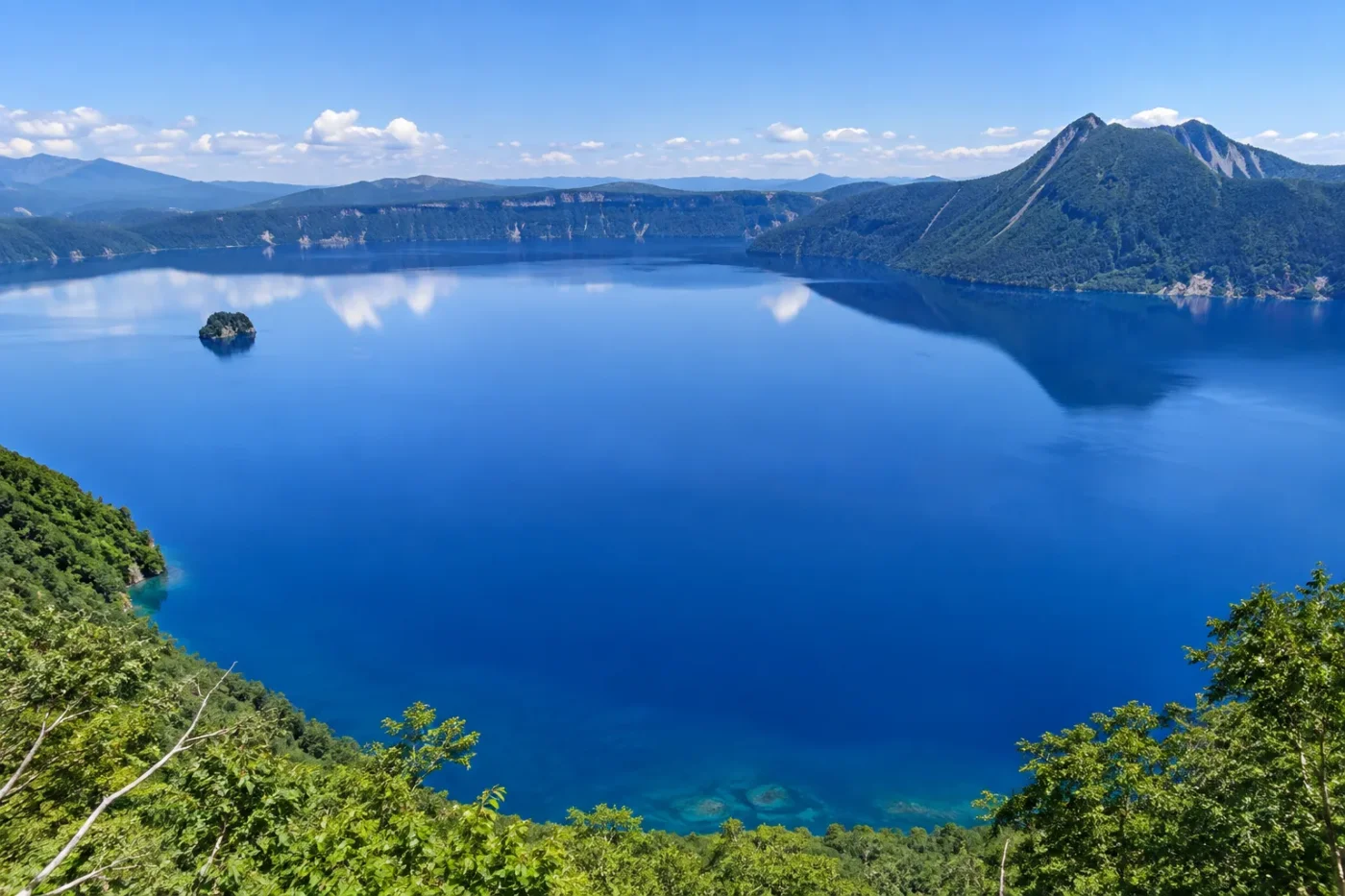
NIES Lake Mashu Database — Transparency ResultsEvidence: HighLake Mashu is best known for an unusually deep blue appearance called Mashu Blue. The color is closely tied to exceptionally clear, low-particle water with very little phytoplankton to absorb or scatter light. It is not completely fixed, however: scientific observations show that increased phytoplankton during summer can reduce transparency and shift the water slightly toward green.
Why Mashu Blue Looks So Unusually Deep
Lake Mashu’s color story begins with what is largely missing from its water. The lake has no inflowing or outflowing rivers, so it receives far less river-borne soil, organic matter and suspended sediment than many lakes. Its nutrient concentrations are also very low, helping keep phytoplankton abundance small.
That combination produces unusually transparent water. With comparatively little suspended material interfering with the underwater light field, the lake develops the strong blue appearance for which it is famous. Japan’s Ministry of the Environment explicitly associates Lake Mashu’s exceptional transparency with the color known as Mashu Blue.
This is more specific than saying the lake is blue simply because it is clean. NIES monitoring includes transparency, chlorophyll, underwater light, optical absorption and scattering, and water-color measurements, allowing changes in clarity and biological activity to be compared with changes in the light passing through the lake.
Summer Can Shift the Water Slightly Toward Green
Mashu Blue is dominant, but the lake is not optically identical throughout the year. NIES observations found that transparency tends to decrease during summer as phytoplankton becomes more abundant. The additional biological material absorbs more light, weakening the conditions that produce the clearest blue appearance.
Researchers reported something more important than a simple drop in Secchi depth: the blue water itself became slightly greener. The change was supported by underwater measurements across different wavelengths, making it a documented optical response rather than an interpretation based only on photographs.
Long-term records provide a more precise seasonal anchor. Transparency tends to be lower in August and September, with increased phytoplankton identified as the main reason. By contrast, transparency tends to rise during lake-mixing periods in May–June and December–January, when clearer deep water reaches the upper part of the lake.
The 41.6-Meter Record Does Not Describe Lake Mashu Today
The number most closely associated with Lake Mashu is 41.6 meters, the extraordinary transparency measured in 1931. It helped establish the lake’s international reputation for exceptionally clear water, but treating 41.6 m as a normal present-day value would be misleading.
The NIES Lake Mashu record contains more than a century of observations. Transparency declined from its exceptional early measurements, and since the late 1980s it has generally averaged about 20–25 meters. That is substantially below the historic maximum while still representing extremely clear lake water.
Individual observations can rise well above the recent average. In May 2009, for example, researchers measured 32.5 meters of transparency, which NIES described at the time as the highest value recorded in the previous 25 years.
Clearer and Bluer Are Related, but They Are Not Identical Measurements
Transparency and color describe different properties. A Secchi-disc measurement records how deeply a target remains visible, while water color concerns the spectral character of light leaving or passing through the water. Lake Mashu is particularly useful because researchers have monitored both kinds of information rather than assuming one directly substitutes for the other.
The observations nevertheless show a meaningful connection. Low phytoplankton abundance reduces biological light absorption and supports the lake’s distinctive blue appearance. When phytoplankton increases in summer, transparency falls and the water shifts somewhat toward green. That measured relationship is more informative than assigning a single permanent color to the lake.
Sky Reflections Can Intensify the View Without Explaining Mashu Blue
Surface appearance also depends on viewing conditions. The Ministry of the Environment notes that on calm days Lake Mashu can act like a mirror, reflecting the sky and surrounding caldera rim. Those reflections can strongly affect what a visitor or camera records at the surface.
They should not be confused with the underlying lake-water color. Mashu Blue is documented in connection with the lake’s water transparency and underwater optical properties, while reflections are a separate surface effect. The two can occur simultaneously, which is one reason photographs of the lake can vary even when its underlying water conditions have changed little.
Fog adds another viewing complication. Lake Mashu is famous for frequent fog, particularly during the warmer part of the year. Fog can hide or flatten the visible color from viewpoints without representing a change in the water itself.
The Monthly Record Is Strongest for a Few Specific Windows
Lake Mashu has unusually detailed long-term monitoring, but that does not mean there is a scientifically measured color label for every month of the year. The strongest explicit month-level evidence concerns the transparency cycle: higher transparency around May–June and December–January, and lower transparency around August–September.
The annual color profile therefore separates those supported periods from months for which no equally specific month-level color statement is available. This avoids turning broad seasonal observations into invented monthly colors while still showing the documented relationship between lake mixing, phytoplankton, transparency and the appearance of Mashu Blue.
Sources