Crystal Blue
Primary visual colorWhere Is Lake Toya?
Hokkaido · Japan
Drag or zoom the real map. Verified shoreline geometry is highlighted with the lake’s LakeColors palette color when available.
Lake Toya on the Globe
Rotate the world or focus directly on the lake.
Clarity Changes with Plankton
1992–1997A five-year Lake Toya study recorded substantial changes in water transparency and found that transparency was negatively related to chlorophyll-a concentration in the euphotic zone.
Value: 6–24 m
Value: Higher chlorophyll-a was associated with lower transparency
Annual Open-Water Color Context
2023 Water-Clarity Measurements
Documented measurement dataMeasured at the deepest part of the lake
Surface-water measurement
Low phosphorus concentration
Near-neutral to mildly alkaline at the survey site
Why Lake Toya Reads as Blue
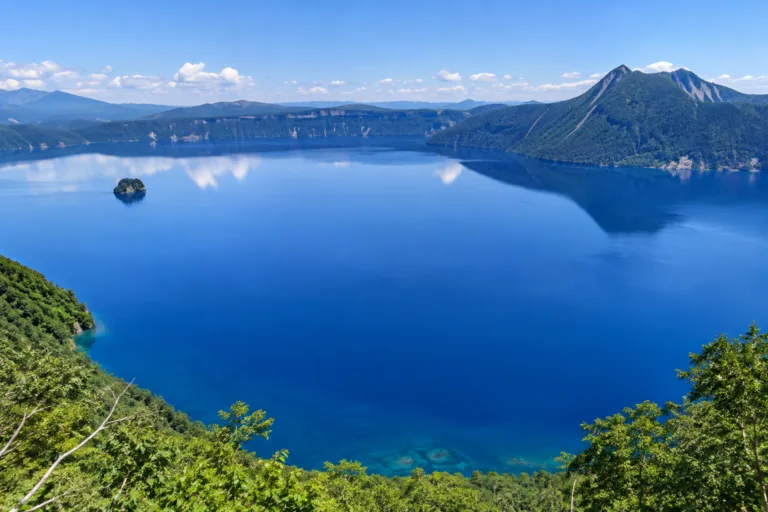
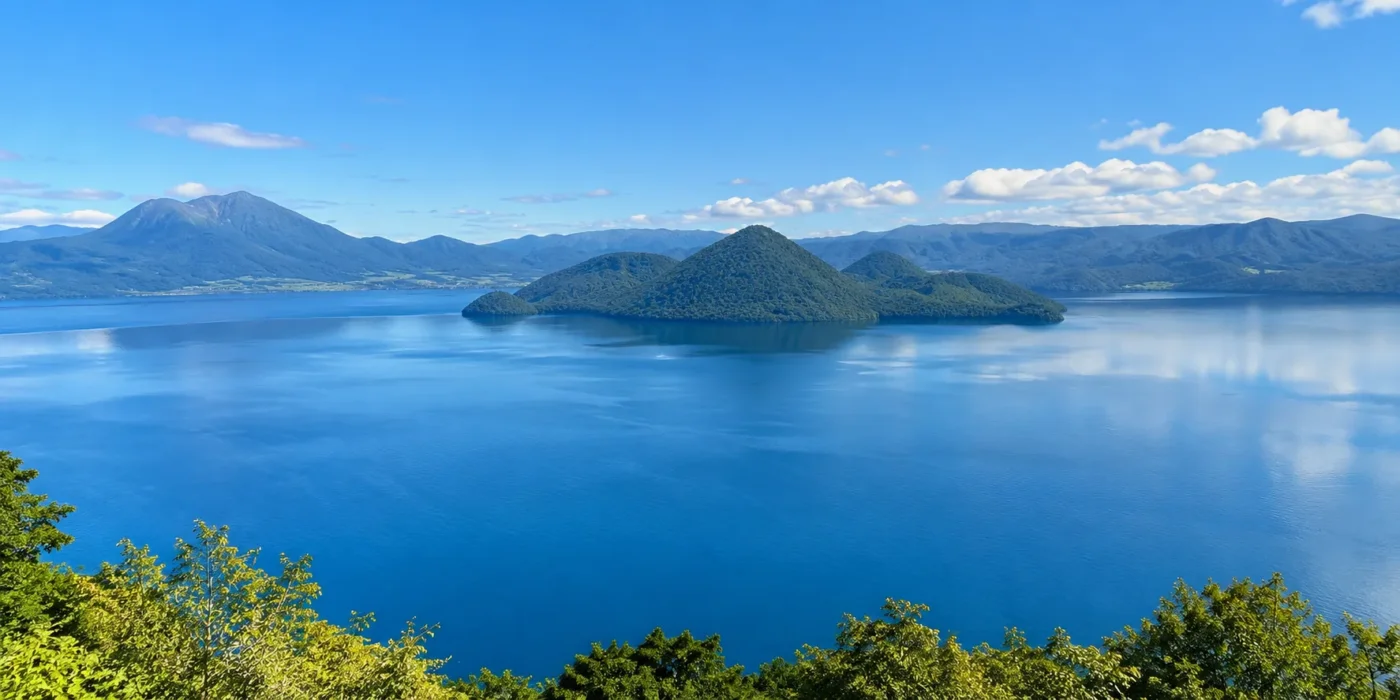
Lake Toya is best described as a clear blue lake. Hokkaido’s official tourism material describes its waters as crystal blue, while lake measurements show conditions that support that appearance: high transparency and very low chlorophyll-a. The shade is not known to follow a fixed month-by-month color cycle; the stronger scientific evidence concerns changes in clarity and plankton that can make the same blue-water system look more or less clear and saturated.
A volcanic lake, but not a sulfur-colored crater pool
Lake Toya occupies a large volcanic caldera, yet its present blue appearance should not be explained simply as a mineral color caused by volcanic activity. The lake is an oligotrophic freshwater system with a deep basin and relatively clear water. Those properties are more directly relevant to its visible blue surface.
The distinction matters because Lake Toya also has an unusual chemical history. Water diverted for hydroelectric generation carried acidic drainage from a sulfur mine into the lake beginning in the twentieth century. Hokkaido University records that the lake reached about pH 5 around 1970 before neutralization treatment restored the water to around neutral conditions. A Hokkaido Research Organization survey in June 2023 measured a surface pH of 7.5 at the deepest part of the lake.
The eruption that formed the Toya caldera explains the lake’s deep basin and geology. The available Lake Toya measurements do not support treating its modern blue water as a sulfurous or mineral-pigmented volcanic color phenomenon.
Clear water and low chlorophyll help preserve the blue appearance
The June 2023 survey recorded 13 m of Secchi transparency at Lake Toya’s deepest point. Chlorophyll-a was only 0.80 µg/L, while total phosphorus was 0.003 mg/L. Hokkaido Research Organization also reports that chlorophyll-a has generally remained below 1 µg/L since 2010.
That combination matters optically. Algae commonly push lake color toward greener tones, while suspended sediment and dissolved material can introduce brown, yellow or gray components. When these influences are limited, the optical behavior of the water itself becomes more visible. USGS explains that clear water appears blue because water absorbs red wavelengths more strongly, an effect that becomes easier to see through a long path of clear water.
Lake Toya reaches almost 180 m at maximum depth. Depth alone does not guarantee blue water, but deep clear water provides a much longer light path than a shallow shoreline pool, allowing the natural blue response of water to become more pronounced.
Clarity moves more than the named color
A five-year study covering 1992–1997 gives a more useful picture of Lake Toya’s variability than assigning a different color to every season. Secchi transparency ranged from about 6 to 24 m during the study. Transparency was negatively correlated with chlorophyll-a in the euphotic zone: as phytoplankton concentration rose, the water became less transparent.
The same study found year-to-year differences large enough to matter visually. During the June–November growing period, mean transparency exceeded 13 m in 1992 and 1993 but fell to roughly 10–11 m during several later years. This is a real change in optical clarity, but the study did not establish a repeating shift from blue to another named hue.
A clearer month can make Lake Toya look deeper and more intensely blue, while lower transparency can soften that appearance. Secchi measurements do not by themselves prove that the lake becomes turquoise, green or another specific color during a particular month.
Why Lake Toya can look different in separate photographs
The documented color identity and the exact color captured by a camera are not the same measurement. Deep clear water can appear dark blue, while shallower water permits more light to return from the lakebed. Algae, suspended material and other substances can also change the light leaving the water. Surface illumination adds another layer to what a photograph records.
For Lake Toya, the defensible baseline is therefore clear blue, supported by official visual description and by measured water clarity. More specific labels should be tied to direct observations or optical measurements rather than inferred from photographs alone.
The lake’s year-round open surface is also relevant to its visual identity. Hokkaido University states that Lake Toya does not freeze in winter, so the water itself remains visible during a season when many northern lakes may be hidden beneath ice. Historical measurements describe a winter-to-spring mixing period followed by summer and autumn stratification, but no reliable evidence establishes a separate recurring winter color.
Sources
- Hokkaido Official Tourism Site — Lake Toya
- Hokkaido Research Organization — Lake Toya
- Hokkaido University — Toya Lake Station
- Ban et al. — Annual Variation in Biomass and the Community Structure of Crustacean Zooplankton over 5 Years in Lake Toya
- World Lake Database — Lake Toya
- USGS Water Science School — Water Color