Blue-Indigo
Primary visual colorWhere Is Lake Towada?
Aomori / Akita Prefectures · Japan
Drag or zoom the real map. Verified shoreline geometry is highlighted with the lake’s LakeColors palette color when available.
Lake Towada on the Globe
Rotate the world or focus directly on the lake.
Blue Surface, Colorless Water Samples
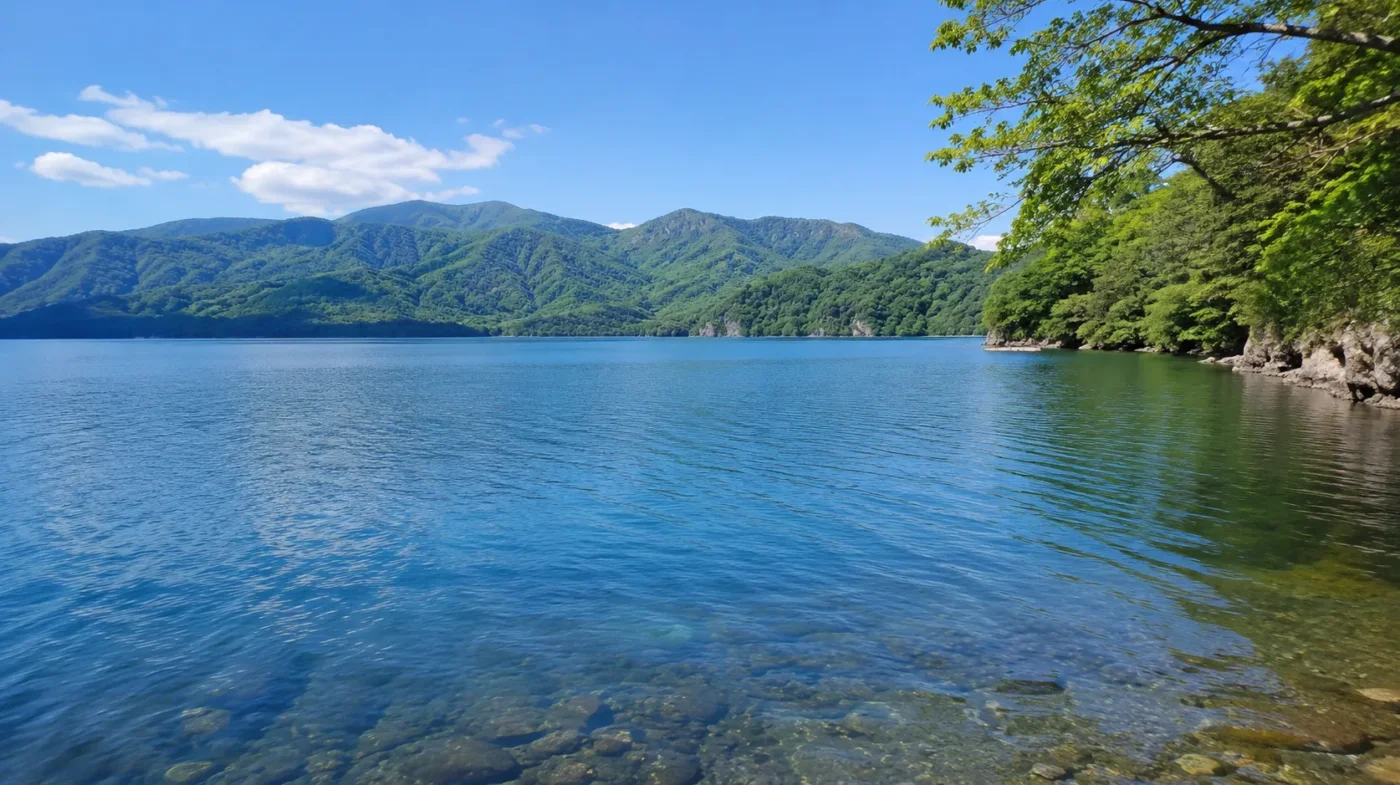
Deep lake water can appear blue when viewed across a long optical path, even when a small collected sample is classified as colorless.
Value: Blue-indigo to deep blue
Provenance: Official Description
Evidence: High
Value: Colorless at all eight sampled depths; 10.5 m transparency
Provenance: Measured
Evidence: High
Value: Colorless at all eight sampled depths; 13.0 m transparency
Provenance: Measured
Evidence: High
Value: A small water sample can appear colorless while the lake appears deep blue
Provenance: Derived
Evidence: Moderate
Lake Towada Color Profile
Documented Color Evidence Across the Year
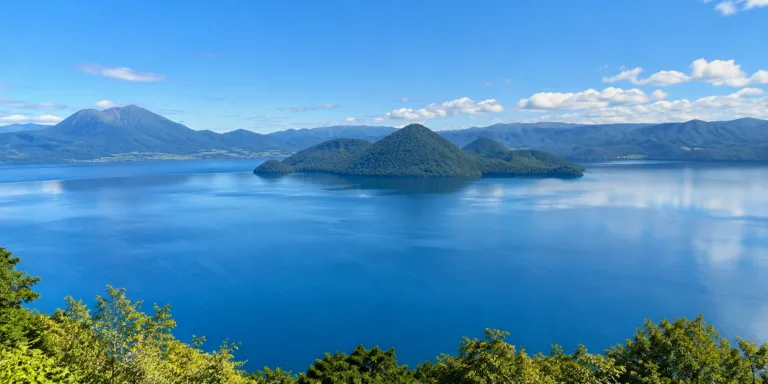
Lake Towada’s established visual identity is deep blue to blue-indigo. Japanese national park documentation describes the lake as holding deep blue water and also records a blue-indigo color reference. Yet 2024 field sampling classified water collected at eight depths as colorless in both May and September. These observations are compatible: water that appears colorless in a small sample can show a pronounced blue tint when viewed across a much greater depth.
Towada’s Blue Develops Across a Long Optical Path
The U.S. Geological Survey explains that a small quantity of water can look colorless even though a long column shows a blue tint. Water molecules absorb longer red wavelengths of visible light more strongly than blue wavelengths. As light travels farther through clear water, the red component diminishes, making blue more apparent in the light returning toward an observer.
Lake Towada reaches a maximum depth of 327 m within its volcanic double-caldera basin, and FY2024 monitoring reported an annual mean transparency of 11.8 m. Its depth and relatively clear water help produce the conditions under which this blue appearance becomes prominent. Transparency describes how far a Secchi disk remains visible; it is not itself a measurement of the water’s hue or the distance light travels through the lake.
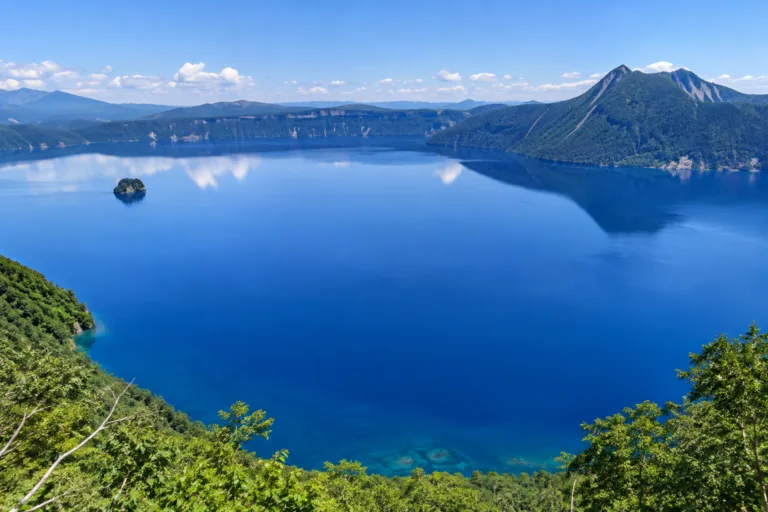
A related optical effect can be seen in the deep blue of Lake Mashu, another volcanic caldera lake in Japan. Lake Mashu, in Hokkaido, is known for exceptionally clear water supplied mainly by precipitation, with no rivers flowing into or out of the lake. Its low suspended-particle content and depth support the appearance commonly called Mashu Blue. Lake Towada also displays deep blue water, although its measured transparency is not identical to Mashu’s. Both lakes demonstrate how deep, relatively clear water can appear intensely blue without requiring dissolved blue pigments.
Lake Towada’s blue-indigo appearance is visible across the larger water body. In the 2024 surveys, water collected from depths between the surface and 85 m was classified as colorless. A small sample provides a much shorter path for light to travel than the water viewed across the lake, so the absence of visible color in the sample does not mean the entire lake appears colorless.
May and September Changed in Transparency Without Changing Sampled Hue
Aomori’s 2024 layered survey measured 10.5 m transparency on May 15 and 13.0 m on September 4. On both survey dates, samples collected at all eight depths, from 0 to 85 m, were recorded as colorless. Transparency increased by 2.5 m between the two observations, but the recorded color category of the collected water remained unchanged.
The difference does not mean that the lake’s blue surface became a different color between May and September. Secchi transparency responds to the amount and optical properties of suspended material, while the perceived blue of the whole lake also depends on the distance light travels through water, illumination and viewing conditions.
Older national park background material records seasonal transparency variation of 10–20.5 m, while the FY2024 annual mean was 11.8 m. The older range provides historical context for changes in water clarity. Neither those values nor the two 2024 sampling dates establish a repeating sequence of distinct surface colors for every month.
Lake Towada can remain visually deep blue while transparency changes between seasons. The May and September 2024 samples were both classified as colorless despite their different transparency readings. Those measurements show changes in clarity, not a documented seasonal change from blue water to colorless water.
Forel No. 3 Is a Categorical Reference, Not an Exact Digital Swatch
The national park documentation pairs Lake Towada’s blue-indigo description with Forel No. 3. The Forel scale classifies water color by comparison with reference colors. Its numbered categories describe visible color but are not equivalent to exact spectral measurements, dominant wavelengths, RGB values or HEX codes.
Lake Towada’s deep blue appearance is therefore consistent with its historical Forel classification. The 2024 water samples, meanwhile, were recorded as colorless at each tested depth. The distinction reflects the appearance of a large body of water compared with a much smaller volume collected for examination.
Forel No. 3 identifies a historical blue color category, while the 2024 sample records describe the appearance of collected water. Neither measurement supplies an exact digital shade for Lake Towada. The lake can appear blue-indigo or deep blue from a distance even when individual samples are visually colorless.
Sources
- Ministry of the Environment — Towada-Hachimantai National Park Plan
- Akita Prefecture — 2025 Environmental White Paper Summary
- Aomori Environmental Management Office — FY2024 Lake Towada Water Quality Survey
- U.S. Geological Survey — Water Color
- International Lake Environment Committee — World Lake Database: Lake Towada
- Wikimedia Commons — Lake Towada Geodata
- Japan Tourism Agency — Peer into the Transparent Depths of Lake Mashu