Turquoise Blue
Primary visual colorWhere Is Blausee?
Canton of Bern · Switzerland
Drag or zoom the real map. Verified shoreline geometry is highlighted with the lake’s LakeColors palette color when available.
Blausee on the Globe
Rotate the world or focus directly on the lake.
Strong Kander Floods Can Temporarily Cloud Blausee
The cantonal lake survey reports that spring discharge depends on Kander flow and that strong flooding can temporarily make Blausee turbid. The report does not assign a separate color to this event.
Evidence Behind the Color Profile
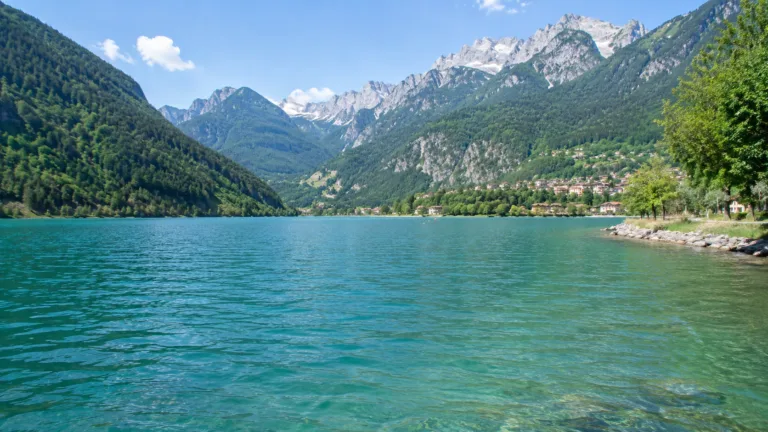
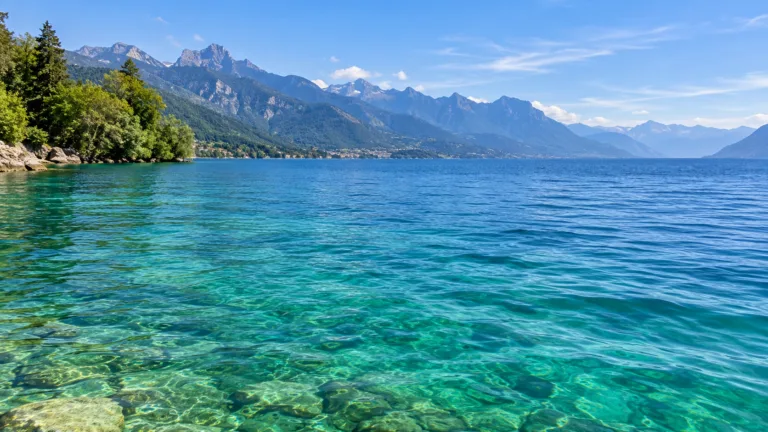
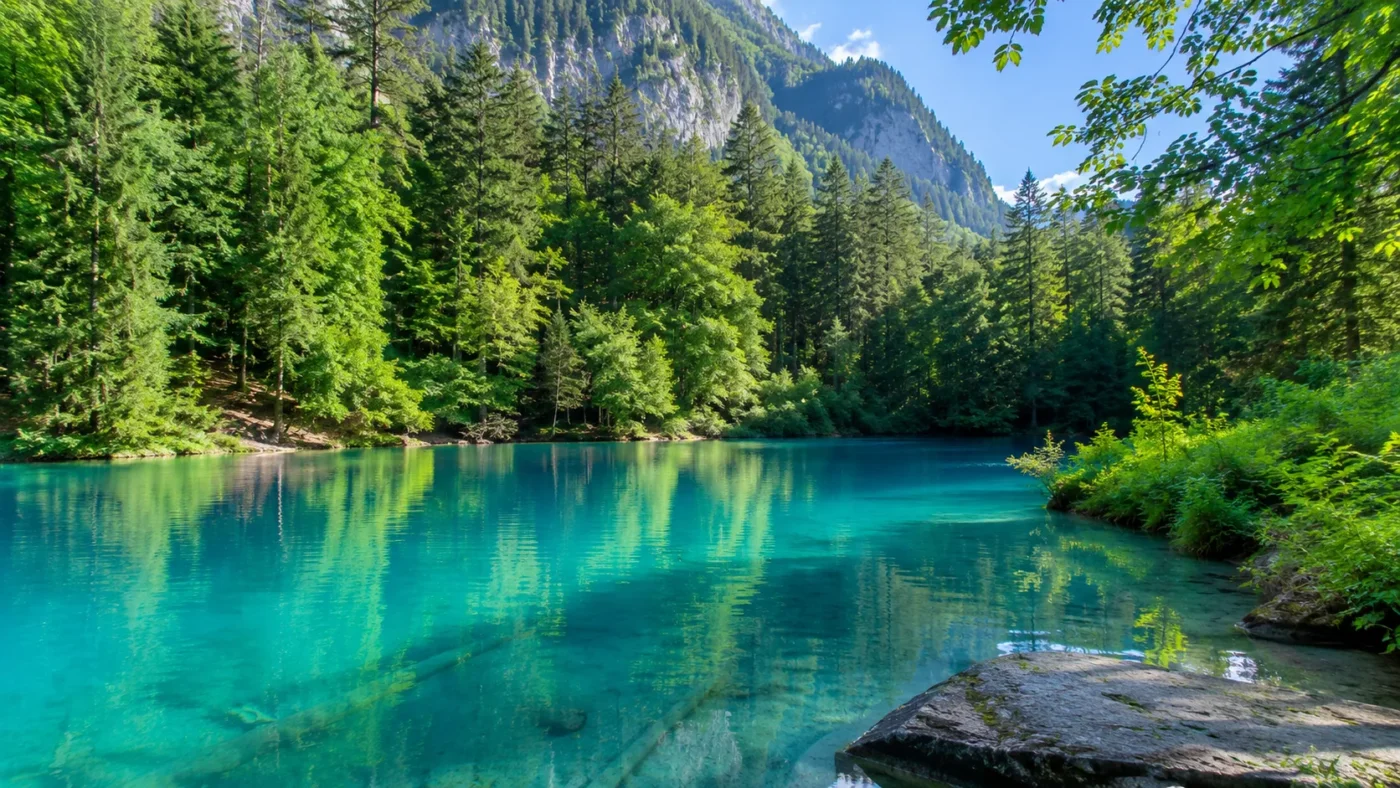
Claim-level supportThe official Blausee nature-park page describes the lake as turquoise-blue and exceptionally clear.
Blausee AG — Nature ParkEvidence: HighThe cantonal survey reports about 8,000 L/min of spring inflow and a lake volume near 21,500 m³, yielding an estimated renewal time of about 45 hours.
Canton of Bern — Small Lakes in the Canton of Bern (1999)Evidence: HighThe cantonal report cites sediment sampling that rejected the earlier blue-sediment hypothesis.
Canton of Bern — Small Lakes in the Canton of Bern (1999)Evidence: HighBlausee-specific clarity and hydrology are combined with established clear-water optics; no Blausee-specific visible-spectrum measurement is reported in these references.
Blausee AG — Nature ParkCanton of Bern — Small Lakes in the Canton of Bern (1999)U.S. Geological Survey — Introduction to Aquatic Remote SensingEvidence: ModerateBlausee is reliably described as turquoise-blue to blue. Its color is tied to exceptional water clarity and a spring-fed groundwater system rather than a blue sediment on the lakebed. A Bern cantonal survey rejected the sediment explanation, while established water optics show how clear water preferentially absorbs longer red wavelengths and leaves a stronger blue signal. Strong Kander floods can temporarily increase turbidity and weaken that clear-water appearance.
Blausee’s Blue Is a Clarity-and-Light Effect
The official Blausee nature-park description identifies the lake as turquoise-blue and exceptionally clear. For the optical mechanism, clear water absorbs longer wavelengths such as red more strongly than shorter blue wavelengths. As light travels through a sufficiently long path of clear water, blue remains relatively more visible. Suspended sediment, plankton and dissolved material can alter that appearance by changing absorption and scattering.
Blausee also has a useful piece of local evidence against a common shortcut explanation. The Canton of Bern report records that an earlier hypothesis attributed the lake’s blue color to blue sediment, but sediment sampling cited in the report rejected that idea. The lake therefore should not be described simply as blue because its bed contains a blue mineral layer.
“Turquoise-blue” is a verified visual description, not a calibrated Blausee-specific spectral measurement. The cited lake material does not report a dominant wavelength, Lab value or standardized water-color index for Blausee.
Rapid Groundwater Renewal Helps Preserve Clarity
The cantonal lake survey describes Blausee as having no surface inflow. Water moves through permeable rockfall debris and emerges through several productive springs. Their combined discharge was reported at about 8,000 litres per minute. With a lake volume of roughly 21,500 cubic metres, the survey calculated a water-renewal time of about 45 hours.
That short residence time is relevant to color because the same survey found that dense plankton has little time to build up before being flushed onward. Its phytoplankton observations were made in the 1990s, so they should not be presented as a current biological inventory. They do, however, document a physical mechanism that can help maintain clear water.
The groundwater connection is also confirmed in a Swiss Federal Supreme Court judgment dated 29 April 2026, which states that Blausee is fed by the groundwater flow of the Kandertal. This current official description supports the spring-fed hydrologic identity without turning the historical chemistry measurements into present-day values.
The 10.1 m maximum depth, 0.64 ha surface area, spring-discharge estimate and 45-hour renewal estimate come from the Bern cantonal lake survey. They are useful documented measurements and calculations, but the older water-chemistry classification should not be assumed to describe the lake unchanged in 2026.
Kander Floods Can Temporarily Mute the Usual Blue Appearance
Blausee is not optically identical under every hydrologic condition. The Bern report states that spring discharge depends on the Kander and that strong river floods can temporarily make the lake turbid. Increased turbidity reduces the exceptional transparency that normally supports its blue-to-turquoise appearance.
The report documents temporary turbidity, but it does not record a calibrated alternate color for those events. Calling the flood state brown, gray, green or another specific color would go beyond the available evidence.
This flood response is more useful than an invented month-by-month color calendar. The available evidence supports a dominant turquoise-blue identity plus event-driven turbidity, but not a verified January-to-December sequence of distinct Blausee colors.
Sources