Deep Blue
Primary visual colorWhere Is Lake Molveno?
Trentino, Autonomous Province of Trento · Italy
Drag or zoom the real map. Verified shoreline geometry is highlighted with the lake’s LakeColors palette color when available.
Lake Molveno on the Globe
Rotate the world or focus directly on the lake.
Molveno's Blue Changed After Hydroelectric Regulation
What Controls the Water's Appearance
Driver: Water clarity and phytoplankton
Effect: High transparency and low phytoplankton supported Molveno's historic intense blue appearance.
Provenance: Official Historical Record
Evidence: High
Driver: Hydroelectric inflows
Effect: Cold, turbid water introduced through the hydroelectric system altered the lake's former clarity regime.
Provenance: Official Environmental Record
Evidence: High
Driver: Suspended glacial silt
Effect: Inorganic particles can lower transparency without the reduction being caused by an algal bloom.
Provenance: Official Monitoring Interpretation
Evidence: High
Rust-Brown Surface Streaks Can Arrive from Lake Bior
Provincial analysis confirmed a surface bloom in Lake Molveno containing 10,343 algal cells per millilitre and chlorophyll a of 301.5 micrograms per litre. The same authority reported that rust-brown streaks had occurred before when blooms developing in neighboring Lake Bior spread into Molveno.
Molveno's Documented Color Year
Measured Clarity and Color Evidence
Documented measurement dataRecorded for Molveno's former intense azure-blue appearance.
Associated with very high transparency and low phytoplankton.
Reported in the LTLeco assessment used in the 2022–2027 Water Protection Plan.
Reported alongside transparency and oxygen data in the lake assessment.
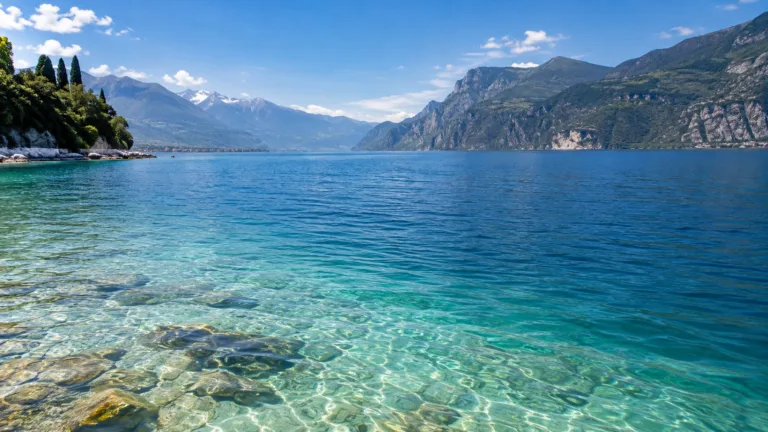
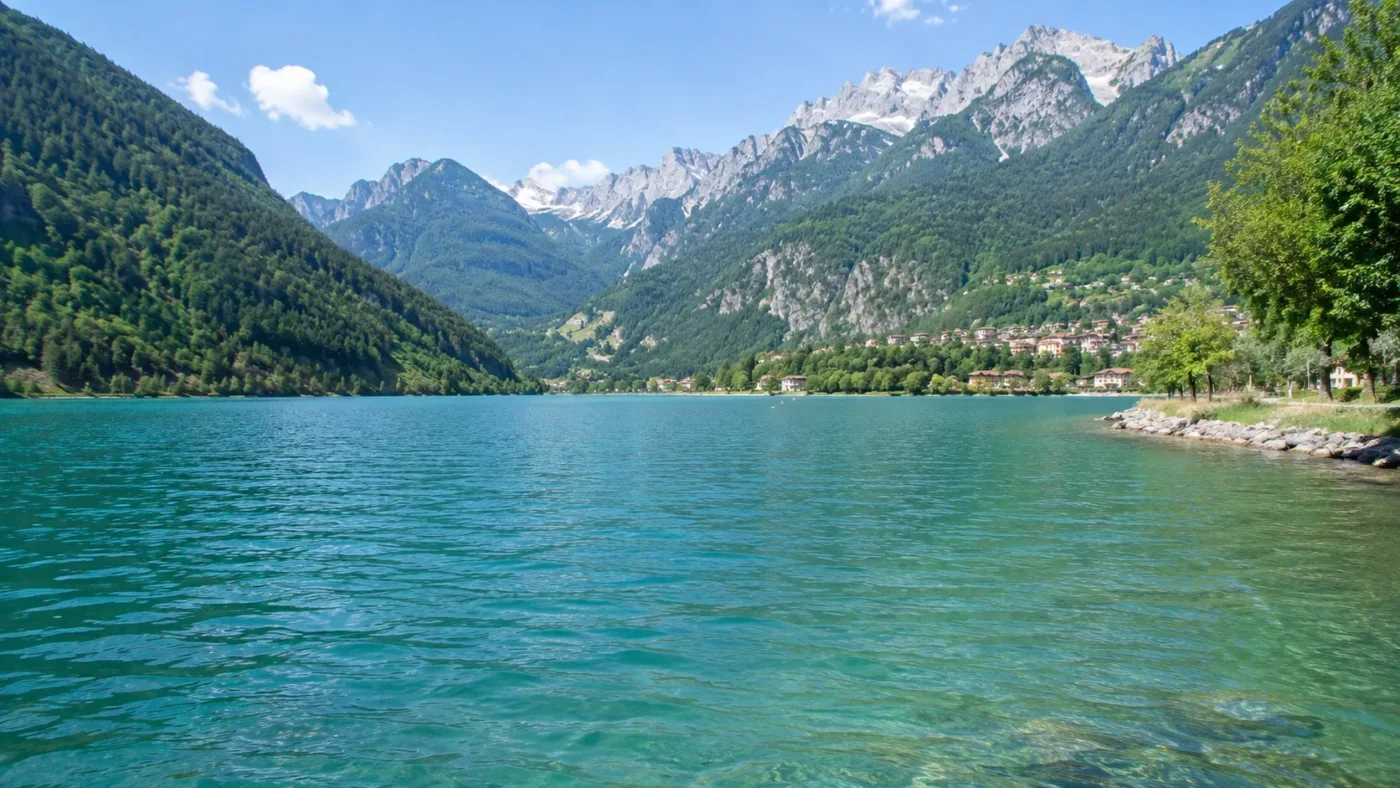
Lake Molveno’s dominant visual identity is deep blue, with exceptional clarity forming the historical basis of that color. Its modern appearance is more complicated: hydroelectric regulation introduced turbid water from the upper Sarca system, while environmental monitoring identifies suspended glacial silt as an important control on transparency. This means Molveno can retain a strong blue identity while showing less optical clarity than its historical baseline.
A Blue Lake Whose Transparency Was Altered by Hydropower
Older provincial documentation gives an unusually precise description of Molveno’s former color. The lake was recorded at degree 2 on the Forel color scale, an intense blue state associated with very clear water. A Secchi disk could reportedly remain visible to a depth of about 14 metres, while low phytoplankton abundance helped preserve the clarity of the water column. Green gradations were linked to submerged vegetation rather than being described as the lake’s dominant open-water color.
That historical condition should not be treated as a measurement of today’s lake. Molveno later became part of a hydroelectric system connected with the Santa Massenza power complex. Provincial records state that colder, turbid water from the upper Sarca and its tributaries altered the previous transparency and color characteristics of the lake.
The newer environmental assessment gives a useful comparison without implying that the two periods form a continuous monitoring series. For the 2017–2019 classification period, the Water Protection Plan reports a transparency value of 4.5 metres and total phosphorus of 9.3 µg/L for Lake Molveno. The same assessment places its LTLeco condition in the good class.
Glacial Silt Can Reduce Clarity Without an Algal Cause
Molveno has an optical complication that makes simple statements such as “clear water equals blue water” incomplete. APPA identifies suspended inorganic glacial silt in Lake Molveno and Lake Cavedine during much of the year, linked to the extensive hydroelectric system connecting these waters.
This matters because reduced transparency can have several causes. In many lakes, poor Secchi visibility may point toward abundant phytoplankton or other biological material. At Molveno, APPA specifically warns that lower transparency can instead result from suspended inorganic particles. A visually less transparent period therefore does not automatically mean that the lake has undergone an algal-driven color change.
The distinction also explains why historical and modern descriptions can both be valid. Molveno still receives official descriptions emphasizing blue water, yet the physical material suspended in the water column is different from the extremely clear historical condition documented before the hydroelectric transformation.
The 14-Metre and 4.5-Metre Transparency Records Describe Different Eras
The historical Secchi figure of up to 14 metres and the 2017–2019 transparency value of 4.5 metres should not be converted into a simple percentage decline. They come from different periods and monitoring contexts, and the older provincial account describes the lake before the optical effects of hydroelectric regulation became part of its modern condition.
What can be stated directly is that Molveno once supported exceptionally transparent blue water, while later monitoring documents a substantially different transparency regime. The modern assessment also supplies a mechanism for at least part of that difference: suspended glacial silt can remain in the water without being a biological bloom.
Rust-Brown Streaks Are a Separate Color Event
Deep blue is not the only scientifically documented color associated with Lake Molveno. Provincial investigators examined unusual rust-brown surface streaks and identified the dinoflagellate Peridiniopsis penardii. In the Molveno sample, the bloom reached 10,343 cells per millilitre and chlorophyll a measured 301.5 µg/L.
The event was connected to nearby Lake Bior, where the bloom had already been observed before appearing in Molveno. Provincial reporting states that similar rust-colored streaks had occurred repeatedly in the past when blooms from Bior extended into the main lake.
This is a conditional surface phenomenon rather than an alternative normal color for Lake Molveno. It also differs from the inorganic turbidity described in the water-protection assessment: one involves concentrated algal cells and chlorophyll, while the other involves suspended mineral particles.
Winter Blue Is Documented, but a Monthly Color Cycle Is Not
Official tourism material describes Lake Molveno in winter as having clear, deep-blue water, while provincial fisheries documentation states that the lake does not freeze during winter. Together, these records support a winter deep-blue open-water state rather than an assumed ice-covered color phase.
There is not comparable source support for assigning a distinct recurring color to every spring, summer and autumn month. The documented summer algal episode is an event record, not evidence that Molveno follows the same rust-brown phase each year. For that reason, months without a reliable recurring color state remain unassigned rather than being filled with colors inferred from photographs or seasonal scenery.
Sources
- APPA Trento — Water Protection Plan 2022–2027: Lake Classification
- Autonomous Province of Trento — Sarca and Chiese Fisheries Management Plan
- Municipality of Molveno — Environmental Declaration 2023–2026
- Visit Trentino — Lakes in Winter
- Autonomous Province of Trento — Algae in Lake Molveno
- Mapcarta / OpenStreetMap Feature Record for Lake Molveno