Deep Blue
Primary visual colorWhere Is Lake Huron?
Ontario / Michigan · Canada / United States
Drag or zoom the real map. Verified shoreline geometry is highlighted with the lake’s LakeColors palette color when available.
Lake Huron on the Globe
Rotate the world or focus directly on the lake.
Where Lake Huron's Colors Diverge
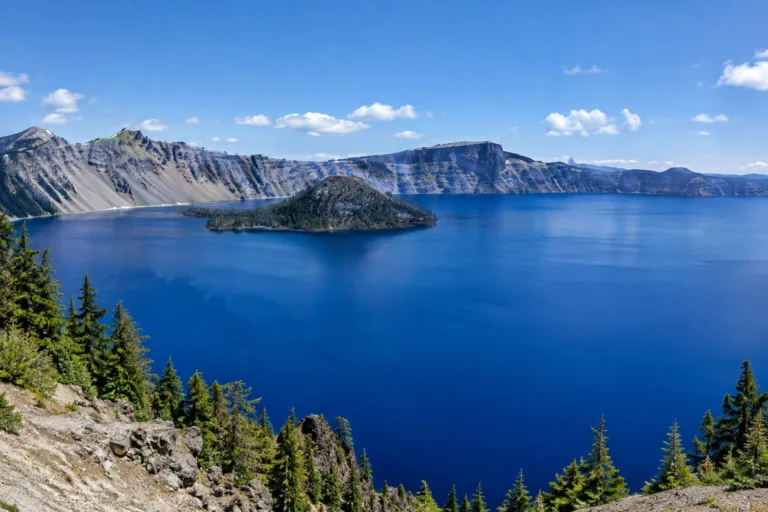
Deep water minimizes direct bottom influence, while relatively clear offshore water supports a darker blue visual field.
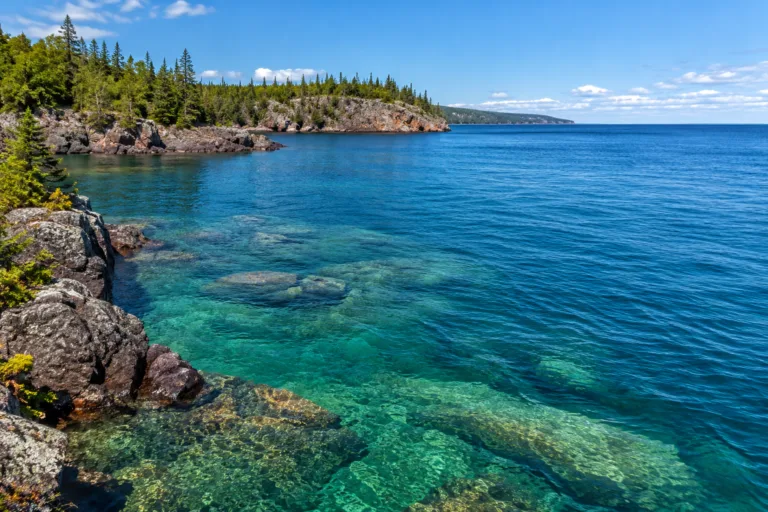
Parks Canada directly describes cobalt-colored water in Georgian Bay Islands National Park.
Clear water over pale shallow substrates and carbonate-rich coastal geology can produce much lighter blue-green visual tones.
Satellite observations show localized algal color that differs sharply from the clearer offshore basin.
Color Through the Year
Lake Huron's Whiting Record Changes with the Observation Period
1972–1975 and 2000–2005The historical record does not support treating calcium-carbonate whiting as a permanent Lake Huron feature. Earlier Great Lakes surveys did not detect the regular whiting seen in several other Great Lakes, while a later satellite-based analysis linked part of Lake Huron's early-2000s August turbidity variability to diminishing whiting events.
Value: Regular whiting reported in Michigan, Erie and Ontario, but not Huron
Provenance: Peer Reviewed
Evidence: High
Value: August variability was linked to diminishing whiting events in Michigan and Huron
Provenance: Peer Reviewed
Evidence: High
How Stable Is Lake Huron's Blue Appearance?
Lake Huron is most often read visually as a deep blue freshwater lake, but that description misses the sharp color boundaries around its shoals, islands and bays. Clear shallow water can shift into turquoise or cobalt, Saginaw Bay can turn yellow-green with algae, and suspended mineral particles can temporarily brighten parts of the lake. Great Lakes whiting adds another pale-water mechanism, although Lake Huron’s own whiting record is intermittent rather than continuous.
Why Deep Blue Water Can Become Turquoise Around Lake Huron’s Shoals
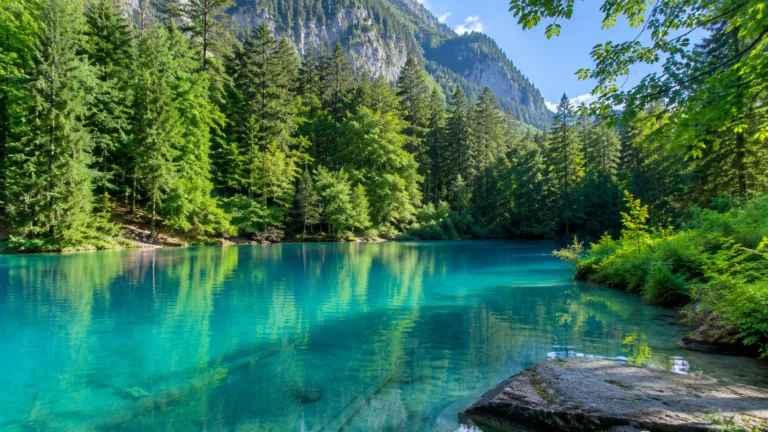
The contrast between offshore blue and coastal turquoise is partly an optical depth effect. In deep water, little light returns directly from the lakebed. The visible field is dominated by light interacting with the water column, producing the darker blue appearance associated with the open lake.
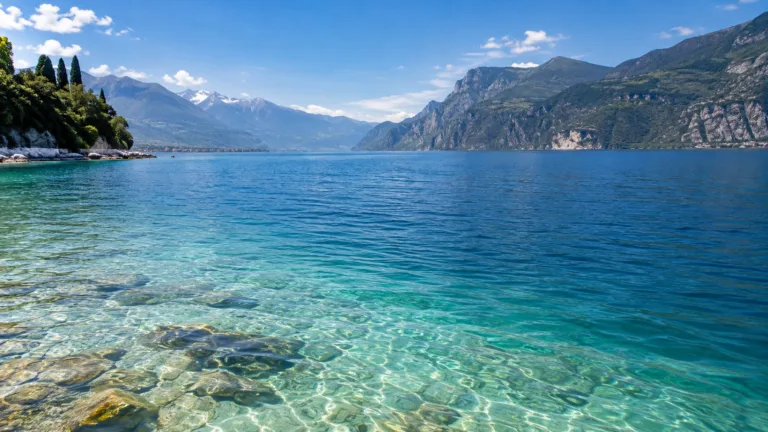
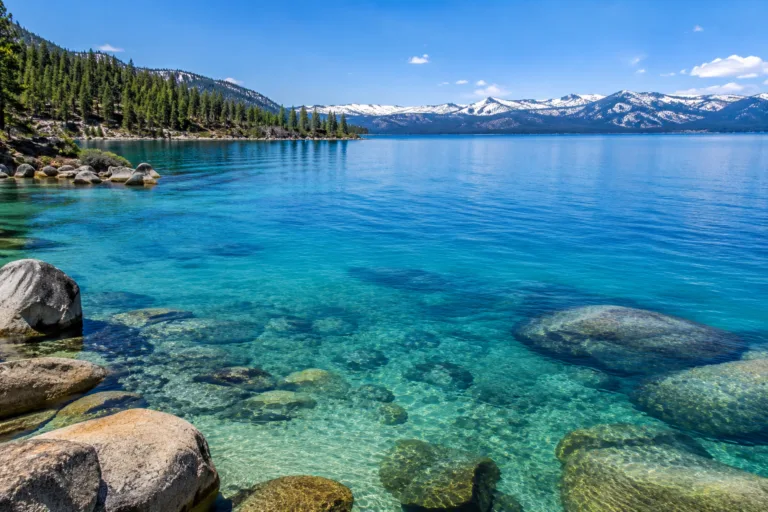
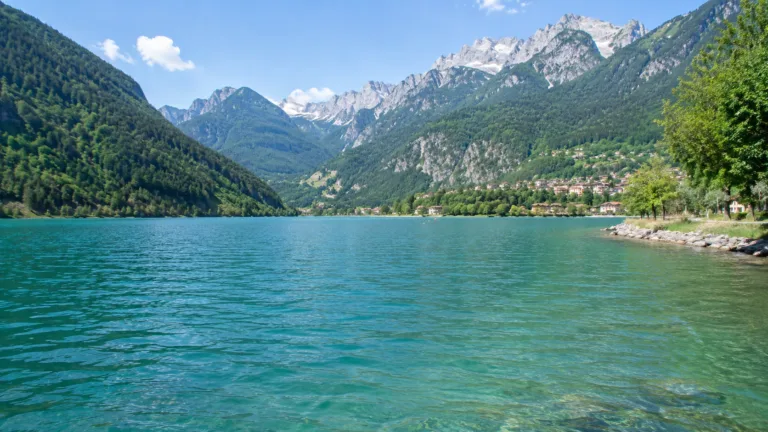
Shallow clear water behaves differently. Light can reach rock, sand or other pale bottom material and return through the water column, making blue-green wavelengths much more conspicuous. The result can be turquoise, aqua or a much brighter blue even when the water itself has not undergone a chemical color change.
Lake Huron provides unusually clear examples because large sections of its shoreline combine transparent water with shoals, islands and exposed carbonate geology. Parks Canada describes crystal-clear turquoise water along the Georgian Bay side of the Bruce Peninsula, while Georgian Bay Islands National Park describes the bay’s water as cobalt. These are regional visual descriptions rather than laboratory color measurements, but they establish that the lake system supports more than one repeatable blue state.
A bright turquoise shoal can be produced by clear shallow water, bottom reflectance and illumination geometry. It should not automatically be interpreted as evidence of unusual dissolved minerals, an algal bloom or a chemical event.
Saginaw Bay Can Look Like a Different Lake
Saginaw Bay breaks the simple offshore-blue pattern. NASA’s Aqua satellite captured the bay filled with yellowish-green swirls in April 2024 and identified the color as algae. NASA also notes that algal growth in the bay recurs in summer.
This spatial difference matters when describing “Lake Huron color.” The large open basin and the nutrient-influenced waters of Saginaw Bay do not always share the same optical conditions. A lakewide photograph can therefore contain deep blue offshore water, pale sediment along a coast and yellow-green water in the bay at the same time.
Color alone does not identify the algae involved or show whether a bloom contains toxins. Satellite imagery is useful for revealing the scale and shape of discoloration, but biological identification requires direct sampling.
Storms Can Produce Pale Blue Water Without a Whiting Event
Another source of confusion is suspended sediment. After two days of wind and rain in April 2024, NASA imagery showed sediment along the southern coasts of both Lake Michigan and Lake Huron. Waves and currents can lift bottom material into the water column, changing reflectance and making coastal water lighter or cloudier than nearby offshore water.
That process should be separated from calcium-carbonate whiting. Both can create unusually pale water in imagery, but they are not the same mechanism. Storm resuspension moves existing bottom particles into the water. A true whiting involves the formation or accumulation of fine carbonate particles within the water column.
Pale blue, gray or whitish water should not be labeled “whiting” from appearance alone. Sediment resuspension, carbonate particles and other suspended material can overlap visually.
Lake Huron’s Whiting History Is More Complicated Than the Name Suggests
Whiting is the milky-water phenomenon associated with suspended calcium-carbonate particles in hard-water lakes. In Great Lakes research, it has been connected with carbonate supersaturation, warm stratified water and biological processes that can favor calcite precipitation.
Lake Huron does not have a simple record of persistent summer whiting. A NOAA summary of Great Lakes observations from 1972 through 1975 reported regular summer and fall whitings in Lakes Ontario, Erie and Michigan, but not in Huron or Superior. That older field record argues against presenting whiting as an automatic annual Lake Huron color phase.
Later observations add an important qualification. A 2022 study using a satellite-derived water clarity-turbidity index detected falling turbidity in Lakes Michigan and Huron from 2000 to 2005. The authors reported that August variability initially increased and then declined, most likely because whiting events were diminishing.
The two records are separated by decades and use different observation methods. Taken together, they indicate that Lake Huron whiting is better treated as a period-dependent optical and carbonate event, not as the source of every turquoise shoal or every pale patch visible on the lake.
Deep Blue, Turquoise and Milky Water Represent Different Processes
Lake Huron’s most useful color distinction is therefore not simply a list of shades. The colors belong to different spatial and physical regimes.
- Deep blue and cobalt: most closely associated with the open lake and clear-water views where bottom reflection is weak.
- Turquoise and bright blue: especially characteristic of clear shallow areas where shoals, pale substrates and coastal geology influence the returning light.
- Yellow-green: a localized biological color documented in Saginaw Bay during algal activity.
- Pale blue or cloudy water after storms: may come from suspended sediment rather than a biological or carbonate color event.
- Milky white whiting: linked to fine calcium-carbonate particles, but the Lake Huron record varies with period and observation method.
This also explains why a single RGB, HEX value or permanent “official” lake color would be misleading. Lake Huron’s appearance changes across tens to hundreds of kilometres of water, from deep offshore basins to carbonate-fringed shoals and nutrient-influenced embayments. Lighting and weather alter the photograph, while sediment, algae, depth and carbonate particles can alter what is actually returning light from the water.
Why Satellite Color Needs Ground Evidence
Satellite imagery is especially useful on a lake this large because it can reveal simultaneous color zones that would be difficult to recognize from a single shoreline location. It can show a sediment plume extending along the coast or a yellow-green patch occupying much of Saginaw Bay.
It cannot always identify the particles responsible from color alone. The whiting record illustrates the problem well: a pale patch can resemble carbonate precipitation while actually being resuspended mineral sediment, and green water can indicate biological growth without identifying the organisms or their toxicity.
Cobalt and turquoise are directly documented regional descriptions within the Lake Huron–Georgian Bay system. Saginaw Bay’s yellow-green color and storm-driven sediment are supported by satellite observations. Whiting has scientific support, but its occurrence in Lake Huron is temporally variable and should not be generalized to the entire lake or every year.
Sources
- Canadian Geographical Names Database — Lake Huron
- Parks Canada — Bruce Peninsula National Park
- Parks Canada — Georgian Bay Islands National Park
- NASA MODIS — Lakes Michigan and Huron, April 2024
- NOAA — A Simple Water Clarity-Turbidity Index for the Great Lakes
- NOAA Great Lakes Environmental Research Laboratory — Great Lakes Whiting Observations