Emerald
Primary visual colorWhere Is Emerald Lake?
British Columbia — Yoho National Park · Canada
Drag or zoom the real map. Verified shoreline geometry is highlighted with the lake’s LakeColors palette color when available.
Emerald Lake on the Globe
Rotate the world or focus directly on the lake.
Why the Lake Is Called Emerald
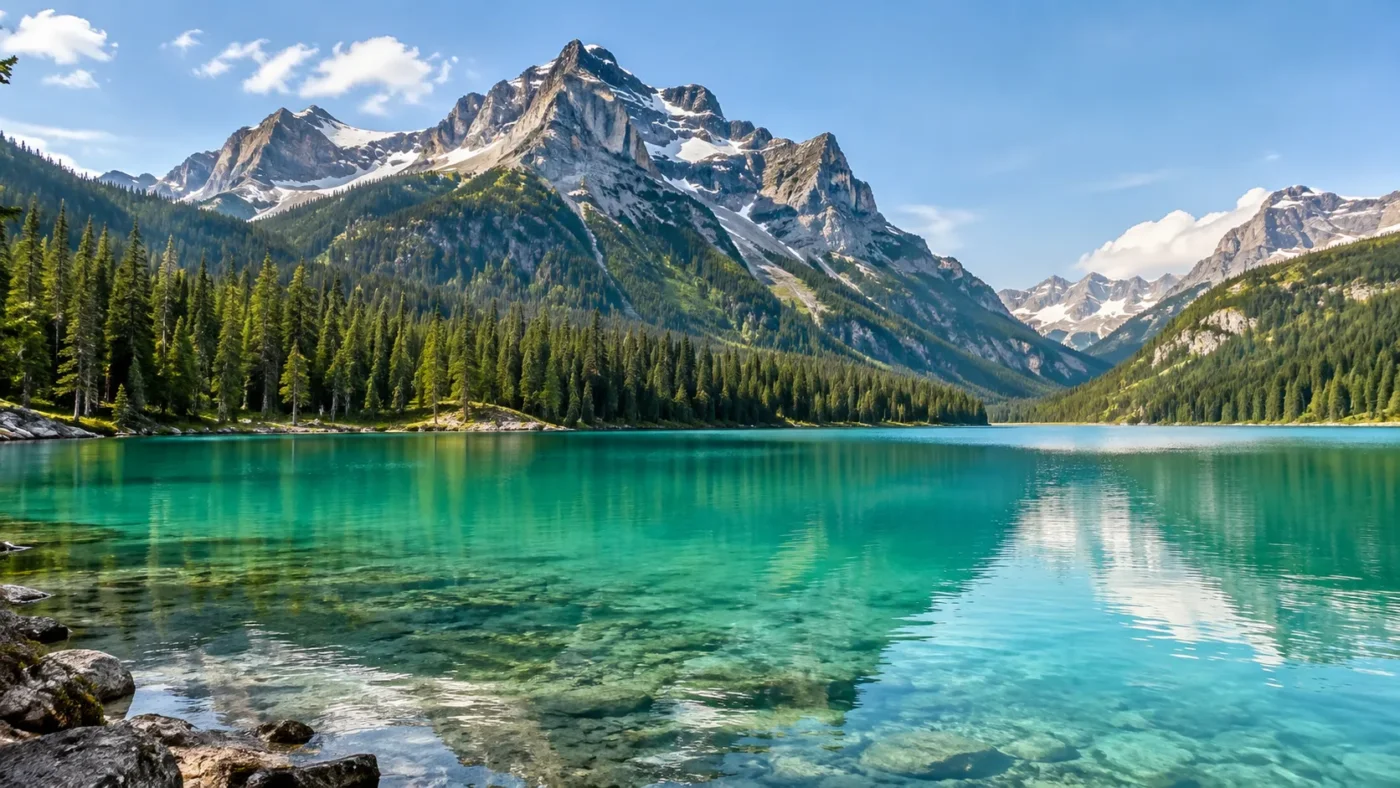
The official British Columbia place-name record says the lake was named because of its extraordinary colour. The same record attributes the green or turquoise appearance to finely ground rock flour suspended in the water.
Color Profile at a Glance
From Glacial Grinding to Emerald Water
What the Sources Support Through the Year
How the Color Story Is Supported
Claim-level supportThe provincial geographic-name record states that the lake was named for its extraordinary colour.
BC Geographical Names — Emerald LakeEvidence: HighBoth the provincial place-name record and the Geological Survey of Canada describe fine suspended glacial sediment and its light-scattering effect.
BC Geographical Names — Emerald LakeGeological Survey of Canada — Yoho National Park: The Mountains, the Rocks, the SceneryEvidence: HighThe lake-side lodge's visitor FAQ identifies July and August as the most vivid period under bright conditions.
Emerald Lake Lodge — FAQEvidence: ModerateParks Canada winter-trail guidance explicitly treats the lake surface as frozen once winter conditions are established.
Parks Canada — Recommended Winter Trails in Yoho National ParkEvidence: HighEmerald Lake in Yoho National Park was named for the extraordinary colour of its water. British Columbia’s official place-name record links that green-to-turquoise appearance to finely ground glacial rock flour suspended in the lake, so the relationship is a two-step one: the lake was named for its colour, and glacial sediment helps create that colour.
The Name Came From the Color That Rock Flour Creates
The official British Columbia geographic record is unusually useful for understanding Emerald Lake because it connects the name and the physical color mechanism in the same entry. The name was officially adopted on June 30, 1900, and the origin notes state that the lake was named by early mountaineering guides because of its extraordinary colour.
The same record explains why that colour exists. Glaciation ground surrounding rock into extremely fine sediment. Meltwater transported this material into glacier-water lakes, and the smallest particles remained suspended rather than immediately settling. Their interaction with light produces the green, turquoise and blue-green appearance associated with Emerald Lake.
That distinction matters when explaining how Emerald Lake received its name. Rock flour was not itself the naming term. The visible water colour was the basis of the name; rock flour is the physical link that helps explain why observers saw a colour worth calling “Emerald.”
Fine Sediment Stays in the Water After Larger Debris Settles
A Geological Survey of Canada description of Emerald Lake gives a more detailed account of the sediment pathway. Moving ice erodes and grinds rock, while meltwater transports the resulting material downstream. Large fragments, gravel and other coarse particles are deposited comparatively quickly. Progressively finer sediment can travel farther.
When sediment-bearing water enters the quieter lake basin, settling continues. The finest material can remain suspended in the water column after much of the heavier debris has dropped out. This exceptionally fine material is what is commonly called rock flour or glacial flour.
The color-producing mechanism therefore depends on particle size as well as the presence of sediment. A lake filled only with rapidly settling coarse material would not produce the same optical effect. Emerald Lake’s characteristic appearance is associated with particles fine enough to remain suspended and interact with incoming light.
Why Emerald Lake Can Look Green, Turquoise or Blue-Green
“Emerald” is the defining name, but the documented visual palette is wider than one fixed green. The British Columbia place-name record describes the water as green or turquoise and refers to its remarkable blue-green colour. The Geological Survey of Canada historically described the lake as pale blue-green and also as pale green or turquoise.
These descriptions are compatible rather than contradictory. Suspended sediment changes how light is scattered through and back out of the water, while illumination and reflection affect what reaches an observer’s eye. The result can occupy a range between green and blue-green instead of behaving like a painted surface with one permanent shade.
This is also why the LakeColors palette should be read as a set of documented visual descriptions, not as an instrumental color measurement. The cited Emerald Lake sources do not provide a standardized HEX value, CIE color coordinate or measured dominant wavelength for the lake. Assigning an exact digital colour would imply a level of measurement that the available evidence does not support.
Bright Summer Conditions Can Make the Emerald Appearance More Vivid
The seasonal evidence is less precise than the evidence for the underlying color mechanism. Emerald Lake Lodge’s visitor information identifies July and August on bright days as the period when the lake’s colours can appear most vivid. This is useful observational context, but it is not a continuous scientific record of water colour for every month of the year.
Winter changes the visible surface in a more fundamental way. Parks Canada’s current winter-trail guidance describes routes that move onto Emerald Lake once its surface is frozen. During a frozen-surface state, the open-water emerald appearance is no longer the only visual signal because ice and winter surface conditions intervene between the water column and the observer.
Exact freeze-up, thaw and month-by-month colour intensity should not be treated as fixed dates without stronger monitoring data. The annual profile therefore distinguishes the supported summer vividness and winter frozen state from months for which the cited sources do not provide sufficiently specific color evidence.
The Basin and the Color Share the Same Glacial History
Glaciation did more than supply fine sediment. The Geological Survey of Canada describes Emerald Lake as occupying a bowl-shaped depression modified by former glaciers. As the ice retreated, glacial debris formed a shallow barrier across the valley and meltwater accumulated behind it, producing the lake basin.
The surrounding landscape also sorts sediment before it reaches and within the lake. Coarse eroded material contributes to outwash and delta deposits, while finer particles remain transportable for longer distances. That sorting process helps explain why rock flour can stay in suspension after larger pieces of the same eroded mountain material have already been deposited.
Emerald Lake’s name, basin and water colour are therefore connected by the same glacial system at different scales: ice shaped the depression, deposited material that helped impound the water, ground rock into fine sediment, and established the sediment pathway responsible for the lake’s characteristic green-to-turquoise appearance.
Sources