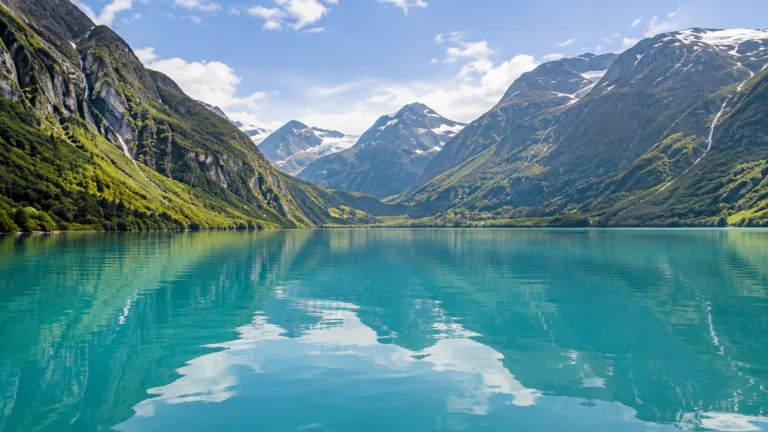
Turquoise Blue
Primary visual colorWhere Is Upper Joffre Lake?
British Columbia · Canada
Drag or zoom the real map. Verified shoreline geometry is highlighted with the lake’s LakeColors palette color when available.
Upper Joffre Lake on the Globe
Rotate the world or focus directly on the lake.
The Three-Lake Turquoise Sequence
Lake: Lower Joffre Lake
Part of the officially described three-lake saturated blue system; no separate official shade ranking is assigned.
Provenance: Official Description
Evidence: High
Lake: Middle Joffre Lake
BC Parks explicitly describes the water here as pristine turquoise.
Provenance: Official Description
Evidence: High
Lake: Upper Joffre Lake
The largest of the three lakes, beneath the Matier Glacier setting described by BC Parks.
Provenance: Official Description
Evidence: High
Joffre Lakes Color Profile
How the Turquoise Color Is Produced
How Stable Is the Three-Lake Gradient?
Evidence Behind the Gradient Claim
Lower, Middle and Upper Joffre Lakes belong to the same glacial color system, but they should not be treated as three steps on a permanent, measured turquoise scale. BC Parks describes all three lakes as having striking, saturated blue water produced by suspended glacial rock flour, while Middle Joffre Lake is specifically described as turquoise. The apparent gradient between the three basins is therefore best understood as a variable visual progression within one turquoise-blue color family, rather than a fixed Lower-to-Upper ranking.
One Color Mechanism Connects All Three Joffre Lakes
The defining color of Joffre Lakes comes from extremely fine sediment produced by glacial erosion. Moving ice grinds rock into particles small enough to remain suspended after meltwater carries them into lakes and streams. This material is commonly called rock flour or glacial flour.
BC Parks directly identifies suspended rock flour as the cause of the saturated blue color in Lower, Middle and Upper Joffre Lakes. Its description of the park also explains that the fine material returns green and blue wavelengths of sunlight strongly enough to create the characteristic blue-green appearance.
This distinguishes Joffre Lakes from lakes whose unusual colors are primarily associated with algae, dissolved salts or strongly colored dissolved organic matter. Here, suspended mineral sediment and the way light interacts with it are central to the visible color.
Lower, Middle and Upper Do Not Have an Official Fixed Shade Ranking
The three lake names encourage a simple comparison: Lower first, Middle second and Upper third. The color evidence is less rigid. Official descriptions establish the turquoise-blue identity of the complete three-lake group, but they do not assign each lake a standardized RGB value, dominant wavelength, reflectance spectrum or permanent position on a light-to-dark turquoise scale.
Lower Joffre Lake
Lower Joffre Lake belongs to the same saturated blue glacial-water system as the other two lakes. BC Parks does not give Lower Joffre a separate official color category or state that it is consistently darker, greener or less turquoise than the lakes above it.
This matters when comparing photographs. A darker-looking Lower Joffre image cannot by itself establish a permanent physical gradient. Reflections, cloud cover, illumination, viewing angle and the amount of suspended material visible along the light path can all change the apparent shade.
Middle Joffre Lake
Middle Joffre Lake has the strongest lake-specific turquoise wording in the official park description. BC Parks explicitly refers to its pristine turquoise waters. That makes turquoise a directly supported color description for this particular basin rather than a label inferred only from photographs.
The lake is also surrounded by subalpine forest. Dark vegetation around a bright mineral-rich water surface can increase visual contrast, making the turquoise appear especially intense from common viewpoints without proving that the water contains more glacial sediment than either neighboring lake.
Upper Joffre Lake
Upper Joffre Lake is the largest of the three and sits in the most visibly glacial setting. BC Parks places visitors here beneath the frozen cascade of Matier Glacier. The official geographical record also identifies Upper Joffre Lake as an expansion of Joffre Creek and gives an approximate central position for the lake.
That direct glacier backdrop makes the origin of the rock-flour color especially easy to understand, but proximity to the glacier should not be converted into an unsupported claim that Upper Joffre Lake must always be the brightest, palest or most sediment-rich of the three. Such a ranking would require lake-by-lake optical or suspended-sediment measurements.
Why Rock Flour Creates Blue-Green Water
Glacial flour consists of very fine mineral particles generated as moving ice abrades bedrock. Because the particles are much smaller than ordinary sand, a portion can remain suspended in water instead of immediately settling onto the lake bed.
Suspended particles change how incoming sunlight travels through the water. Water itself absorbs some wavelengths, while the mineral particles scatter light. BC Parks describes green and blue wavelengths as responsible for the conspicuous color at Joffre Lakes. Broader glacial-lake guidance from the U.S. National Park Service likewise explains that sunlight scattering from suspended glacial sediment can produce cloudy, milky, blue or turquoise water.
The important point is that “turquoise” is not a pigment dissolved in Joffre Lakes. It is an optical result produced by water, suspended mineral particles and light.
Why the Three Lakes Can Look Like a Turquoise Gradient
A photograph showing three somewhat different shades does not conflict with their shared rock-flour mechanism. Turquoise glacial water is visually sensitive to several variables. The concentration and size distribution of suspended particles can affect scattering, while water depth changes the distance light travels through the water. Sun angle, cloud cover, surface reflection and the colors surrounding the lake can further change what reaches an observer or camera.
The result is a system in which all three lakes can remain recognizably turquoise-blue while one appears more blue, another more green-blue and another paler or more saturated under a particular set of conditions.
Those differences should be treated as changing appearances unless direct measurements establish something more permanent. The cited official Joffre Lakes material does not provide separate sediment concentrations, spectral reflectance measurements or quantitative color coordinates for Lower, Middle and Upper Joffre Lakes.
What the “Turquoise Gradient” Means at Joffre Lakes
The strongest evidence supports a shared color family rather than three scientifically fixed shades. Lower Joffre Lake is part of the officially documented saturated-blue group; Middle Joffre Lake is specifically described as turquoise; and Upper Joffre Lake occupies the largest basin beneath the Matier Glacier setting. Together they create a natural three-basin comparison in which the intensity and balance of blue and green can appear to change along the route.
A permanent rule such as “Lower is always darkest, Middle is always brightest and Upper is always milkiest” is not supported by the cited official evidence. Likewise, there is no source-backed peak month in these sources when all three lakes can be assigned a guaranteed maximum turquoise intensity. The defensible color identity is broader and more useful: three neighboring glacial lakes, one rock-flour mechanism, and a turquoise-blue appearance that can vary between basins and viewing conditions.
Sources
- BC Parks — Joffre Lakes Park
- BC Parks Blog — While You Were Away
- BC Geographical Names — Upper Joffre Lake
- U.S. National Park Service — Glacial Till and Glacial Flour