Emerald Green
Primary visual colorWhere Is Gjende?
Jotunheimen, Innlandet · Norway
Drag or zoom the real map. Verified shoreline geometry is highlighted with the lake’s LakeColors palette color when available.
Gjende on the Globe
Rotate the world or focus directly on the lake.
Across Besseggen: Green Gjende and Blue Bessvatnet
Gjende's Color Year
From Glacial Abrasion to Emerald Water
Visibility Tracks the Glacier-Sediment Pulse
Documented measurement dataMeasured just after ice break-up, before glacier melt intensified.
Measured when glacier-fed inflows were at their highest.
The 2016 monitoring maximum after a summer-long rise in glacier-particle input.
Reported during an exceptionally warm, dry summer with strong glacier melt.
Visually Green, Yet Very Low in Humic Water Color
2013NIVA measured Gjende's mean laboratory water-color value at below 2 mg Pt/L and described the lake as having very low humus influence. This separates the visible emerald-green appearance from brown humic staining: Gjende's characteristic color is driven mainly by suspended glacier particles.
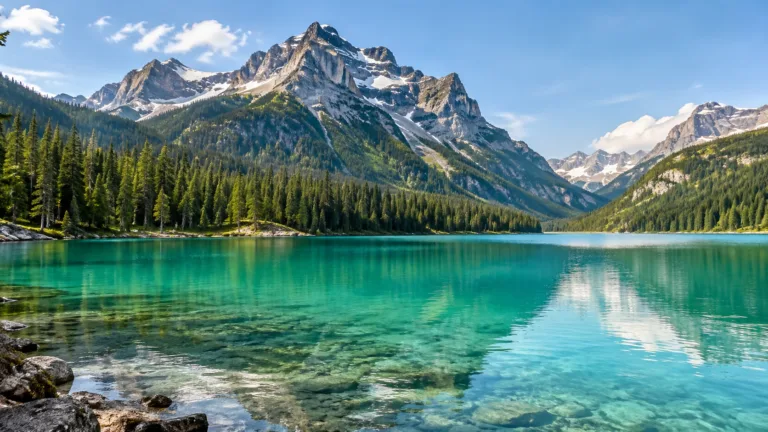
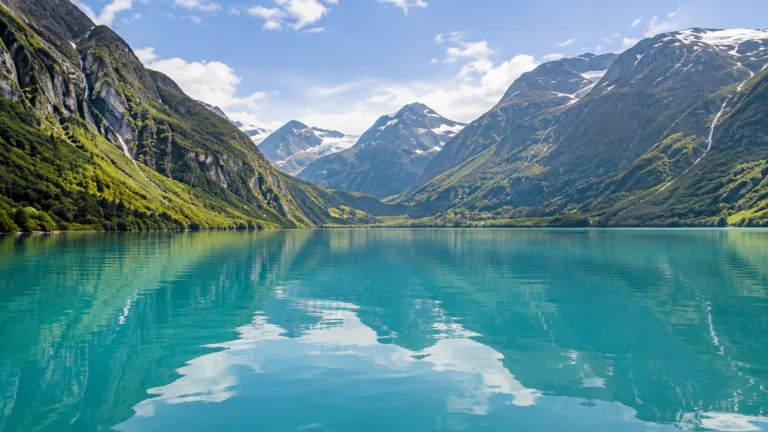
Gjende is characteristically emerald green to blue-green, with the strongest documented green expression occurring during the glacier-melt season. Its color is produced mainly by fine mineral particles delivered by glacial meltwater rather than by dissolved green compounds or a dense algal population. As summer melt increases the particle load, the water becomes less transparent and the glacier-green signal becomes more pronounced.
The Green Comes from Suspended Glacier Particles
Gjende receives meltwater carrying finely ground rock produced where moving ice abrades the underlying bedrock. Much of this material is clay- and silt-sized, small enough to remain suspended instead of immediately settling to the lake bottom. Monitoring describes Gjende as a strongly glacier-influenced lake and identifies these particles as the source of its characteristic blue-green appearance.
The optical effect depends on more than the presence of pale sediment. Research on Norwegian glacier-fed water shows that fine suspended particles alter the balance between light absorption and backscattering. For clay- and silt-rich suspensions, that balance can favor the green part of the visible spectrum, while coarser sediment close to glacier fronts is more likely to produce a milkier appearance.
“Glacial flour” is not a single optical material. Fine particles can remain suspended and produce a green return, while a greater share of coarse particles can make glacier water look pale or milky. Gjende’s familiar emerald color reflects both the amount and size distribution of suspended sediment.
The Lake Is Clearest Before Summer Melt Builds
Gjende does not maintain the same clarity through the open-water season. Monitoring shows a pronounced progression from unusually clear water immediately after ice break-up to much more turbid conditions as glacier melt intensifies. By late summer, glacier particles can affect the entire water column and substantially reduce how deeply light penetrates.
This seasonal change explains why “Gjende is green” is only part of the color story. The lake retains its glacier-influenced identity, but the strength of the visible green and the opacity of the water depend on how much sediment is being supplied at the time. Official information from Jotunheimen specifically associates the emerald-green appearance with late summer, matching the monitoring record of maximum glacier influence around August.
Late summer provides the strongest documented combination of glacier input and emerald appearance, but there is no single permanent “Gjende green.” Sediment concentration, weather, illumination and viewing geometry can all alter how saturated or pale the water looks on a particular day.
Why the Besseggen View Shows Two Very Different Blues and Greens
The neighboring lakes on either side of Besseggen provide an unusually clear visual comparison. Gjende is officially described as emerald green, while Bessvatnet is described as deep blue despite lying only a short distance away and roughly 400 metres higher. The contrast makes the effect of Gjende’s glacier-derived sediment visible at landscape scale: nearby mountain lakes do not automatically share the same color simply because they occupy the same high-alpine setting.
The comparison is also useful for separating sediment-driven water color from sky reflection. Reflected sky and cloud conditions can modify both lakes in photographs, but the persistent difference between glacier-green Gjende and deep-blue Bessvatnet has a physical basis in the waters themselves.
“Water Color” in the Laboratory Is Not the Same as Gjende’s Visible Green
A particularly useful distinction appears in water-quality monitoring. Gjende can look strongly green while laboratory measurements classify its conventional water-color value as extremely low. In the 2013 monitoring data, the lake was described as very low in humus influence.
This is not a contradiction. The laboratory parameter is useful for identifying dissolved humic coloration, which commonly produces yellow-brown or tea-colored water. Gjende’s dominant visual signal comes instead from inorganic particles suspended in otherwise humus-poor water. A lake can therefore register very little humic “color” chemically while still displaying an intense green appearance to an observer.
Gjende’s emerald appearance should not be interpreted as evidence of unusually high dissolved organic color. Monitoring supports the opposite: humus influence is very low, while glacier sediment strongly affects turbidity and visible appearance.
Warm, High-Melt Summers Can Intensify the Sediment Signal
The annual pattern is not identical from one year to the next. During the exceptionally warm and dry summer of 2018, NIVA recorded a major rise in Gjende’s turbidity compared with the preceding year as glacier melt increased. This demonstrates that the lake’s visual state responds not only to the normal progression from ice break-up into summer, but also to the strength of glacier melting in a particular year.
That relationship matters when comparing photographs taken in different years. A clearer early-season Gjende, a strongly opaque late-summer Gjende and an unusually sediment-rich warm-year Gjende can all be authentic expressions of the same lake. The underlying mechanism remains glacier-derived mineral particles, while their concentration controls how strongly the effect is displayed.
Sources
- Jotunheimen National Park — About the Protected Area
- NIVA — Gjende as a Sentinel for Climate Change
- Norwegian Environment Agency / NIVA & NINA — Surveillance Monitoring of Large Lakes 2016
- Aas & Bogen — Colors of Glacier Water
- Wikidata — Gjende Structured Geographic Record
- NIVA — Monitoring Lakes in the Sjoa and Vinstra Watercourses 2013