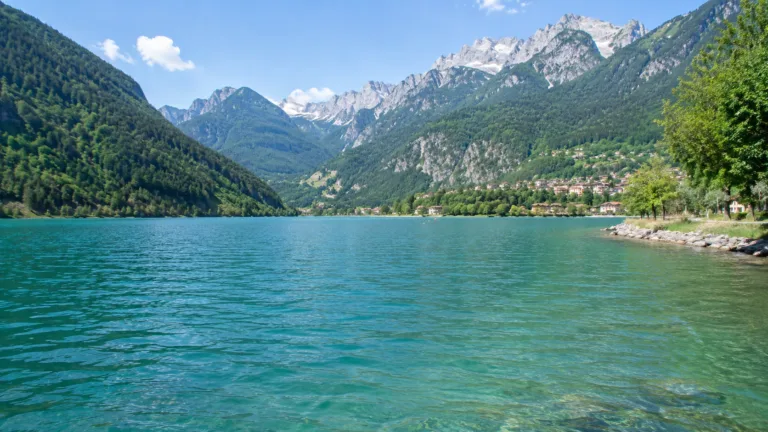
Emerald Green
Primary visual colorWhere Is Lake Carezza (Karersee / Lago di Carezza)?
South Tyrol · Italy
Drag or zoom the real map. Verified shoreline geometry is highlighted with the lake’s LakeColors palette color when available.
Lake Carezza (Karersee / Lago di Carezza) on the Globe
Rotate the world or focus directly on the lake.
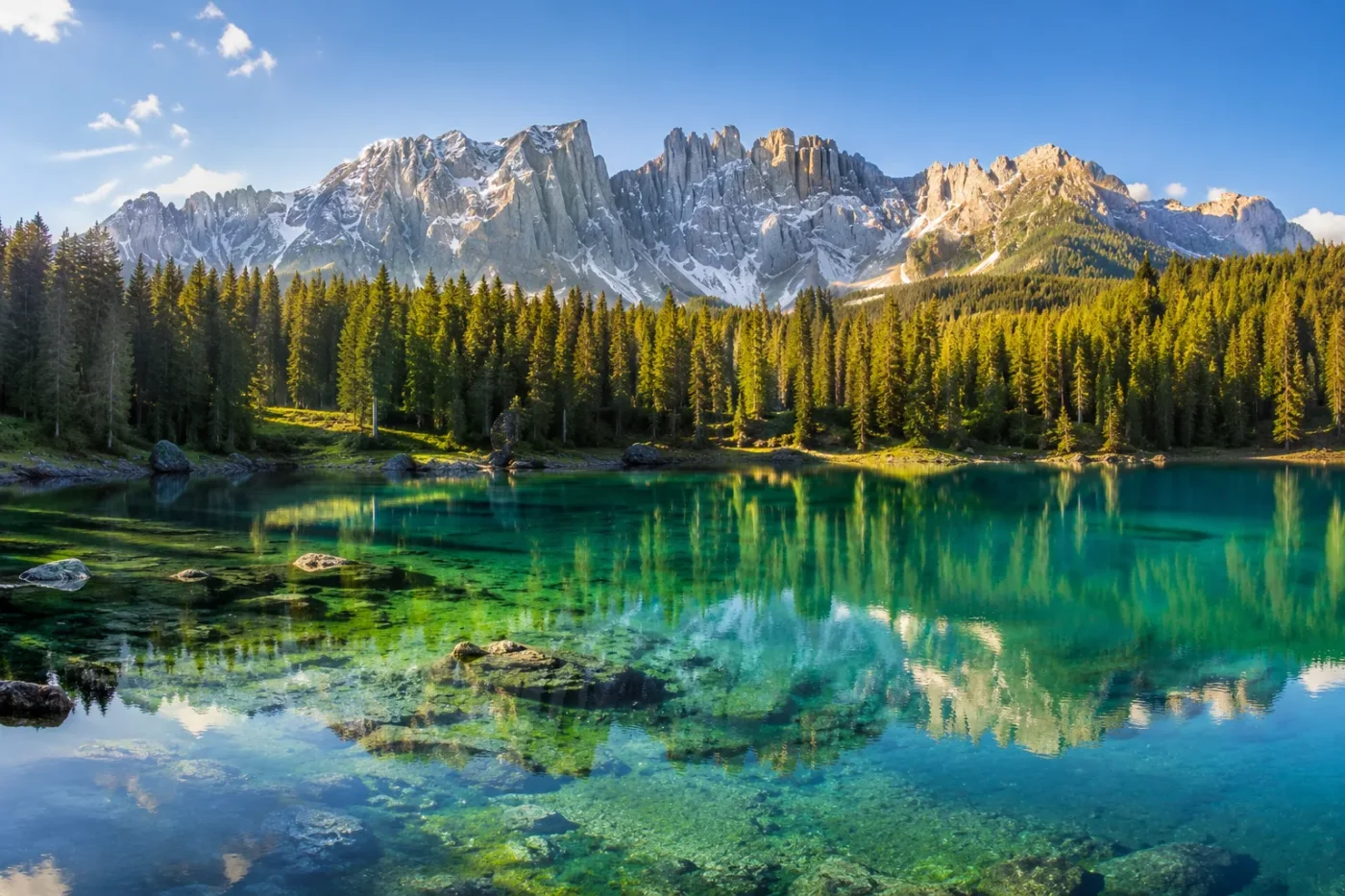
Dolomite and Forest Reflections
Feature: Latemar massif
Visual Role: A defining mountain reflection in the lake's clear surface; official descriptions emphasize morning and evening views.
Provenance: Official Description
Evidence: High
Feature: Rosengarten / Catinaccio
Visual Role: Also reflected in the clear water and part of the lake's changing surface appearance.
Provenance: Official Description
Evidence: High
Feature: Latemar spruce forest
Visual Role: The evergreen forest surrounds the lake and contributes a changing green reflected field around the water.
Provenance: Interpreted
Evidence: Moderate
Color-Relevant Lake Profile
Color and Surface State Through the Year
Conditions Behind the Clear, Changeable Color
How the Color Profile Is Supported
Claim-level supportThe provincial environmental agency identifies the lake as oligotrophic, notes low algal growth and pale Dolomite rock, and reports light penetration to 17 m.
Autonomous Province of Bolzano – South Tyrol: Karersee lake profileEvidence: HighSouth Tyrol's official tourism site explicitly describes these shades and says the color changes during the day.
South Tyrol: Winter wonderland at Karersee lakeEvidence: HighEggental Tourism describes the water as shifting through emerald-green and yellow shades, but does not assign the yellow appearance to a specific pigment or chemical event.
Eggental Tourism: Lake Carezza – The Rainbow LakeEvidence: ModerateThe provincial lake profile gives a May refill phase, a June high-water phase and an October low-water phase.
Autonomous Province of Bolzano – South Tyrol: Karersee lake profileEvidence: HighLake Carezza is best described as an emerald-green alpine lake with a shifting visual palette rather than one fixed hue. Official South Tyrol sources document turquoise, blue-gray and yellow variants, while the provincial environmental agency links the lake’s unusual clarity to oligotrophic water, low algal growth and a pale Dolomite lakebed. The result is a surface appearance that can change with light, reflections and water level even when there is no evidence of a separate chemical color event.
Why emerald can shift toward turquoise or blue-gray within the same day
The clearest scientific clue is not a special emerald pigment. South Tyrol’s environmental agency classifies Karersee as oligotrophic and describes very clear water with high visibility. It also identifies two physical features that help preserve that transparency: limited algal growth and pale Dolomite rock on the lakebed. The agency reports that light can still penetrate to a depth of 17 metres.
That clarity matters because the eye is not seeing only the top skin of the lake. Light can interact with a transparent water column, a bright substrate and the reflected sky and mountains at the same time. South Tyrol’s tourism authority separately describes the visible range as emerald green, turquoise and blue-gray, with the shade changing during the day. Those descriptions fit a lake whose apparent hue is strongly influenced by illumination and reflection as well as the water itself.
A turquoise view beside a blue-gray view does not, by itself, show that the lake’s chemistry changed. Lake Carezza can look different because the balance between water-column color, the pale bottom, sky light and reflected scenery has changed.
Latemar and Rosengarten can become part of the visible lake color
Official descriptions repeatedly treat reflection as one of Lake Carezza’s defining visual features. The Latemar massif is reflected in the clear water, while South Tyrol’s lake listing also names Rosengarten/Catinaccio and the green Karerwald forest as reflected elements. Morning and evening are specifically noted for strong mountain reflections.
This helps explain why photographs from the same lake can carry very different color balances. A frame dominated by the evergreen forest can look greener; a frame carrying more sky and pale rock reflection can move toward cooler blue-gray or turquoise tones. In autumn, South Tyrol’s seasonal description adds golden and reddish foliage reflections. Those colors belong to the reflected landscape layer, not necessarily to a change in the lake’s dissolved chemistry.
The annual water-level swing changes the visible mix of water and lakebed
Karersee has a clearly documented hydrological rhythm. The provincial lake profile says snowmelt begins refilling the basin in May, the lake can reach a high-water depth of about 17 metres in June, and the level can fall to about 5 metres in October. Underground Latemar springs supply the lake, while the permeable lakebed allows water to drain away; only the deepest central basin is sealed by an impermeable clay layer.
That cycle changes the geometry of what the eye sees. At higher water, a larger water column and broader reflecting surface dominate the view. At low water, more of the shallow margin, pale substrate and exposed basin structure can enter the scene. The official environmental source does not assign a fixed emerald, turquoise or yellow hue to each water level, so water level is best treated as a context for the changing appearance rather than as a simple “high water equals one color” rule.
The provincial environmental profile lists a maximum depth of 17 m, while official tourism pages cite roughly 22 m as a greatest recorded depth. The lake is strongly water-level dependent, so different measurement conditions may be involved, but the published pages do not explicitly reconcile the two figures. The structured profile above therefore uses the provincial environmental value for hydrology and keeps the tourism figure out of the core measurement set.
“Rainbow Lake” describes a range of appearances, not seven separate water pigments
Lake Carezza is also known by the Ladin name “Lec de ergobando,” or Rainbow Lake. The name is culturally linked to the water-nymph legend, but the observable color record is more specific: official sources describe emerald green, turquoise, blue-gray and, in Eggental’s account, yellow shades.
The yellow description should not be turned into a mineral or biological claim without evidence. Eggental Tourism documents yellow as part of the visible palette, but the provincial environmental profile does not identify a yellow-producing pigment, bloom or chemical event. The safest interpretation is that “rainbow” refers to a broad, changing visual range created by clear water, a pale Dolomite bottom, varying water level and reflected surroundings.
Sources