Emerald Green
Primary visual colorWhere Is Laguna Verde?
Sur Lípez, Potosí Department · Bolivia
Drag or zoom the real map. Verified shoreline geometry is highlighted with the lake’s LakeColors palette color when available.
Laguna Verde on the Globe
Rotate the world or focus directly on the lake.
From Turquoise to Emerald When Wind Disturbs the Shallows
What Wind Changes in the Water Column
Measured Lake Conditions
Documented measurement dataColor Stability
How the Color Explanation Is Supported
Claim-level supportThe High-Lakes Project reports depth, pH, total dissolved solids and other limnological measurements.
Cabrol et al. (2009), The High-Lakes ProjectEvidence: HighEarth Science Picture of the Day attributes the very green appearance to suspended mineral-rich sediment.
Earth Science Picture of the Day — Laguna VerdeEvidence: ModerateField-oriented descriptions report a stronger green appearance when wind agitates the water and sediment.
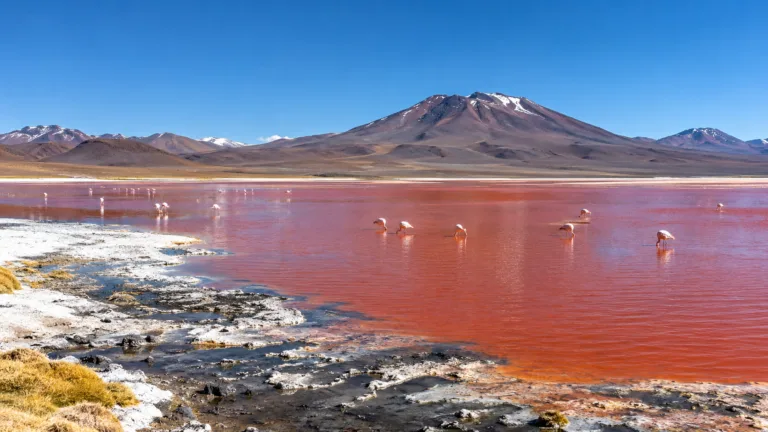
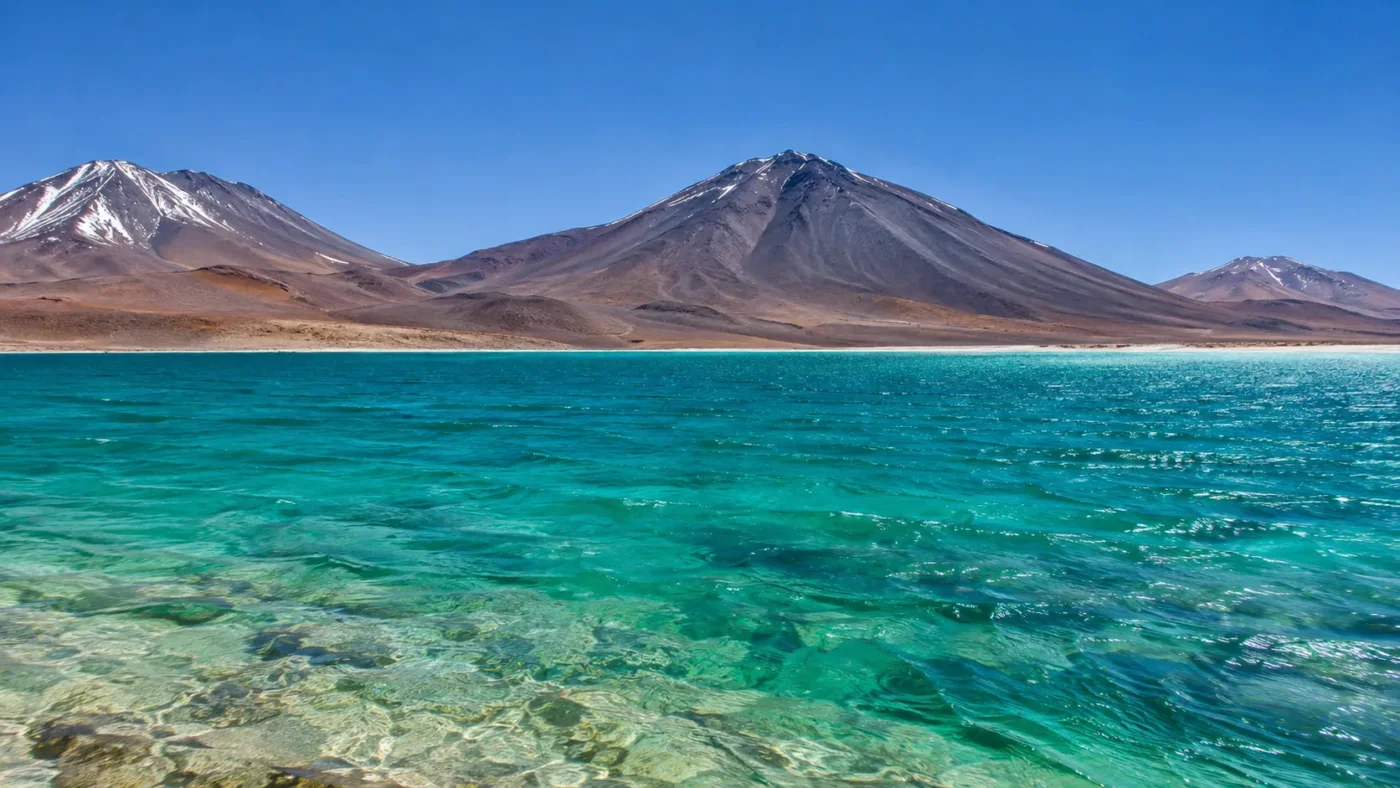
Lonely Planet — Laguna VerdeEvidence: ModerateBolivia’s Laguna Verde can appear turquoise, blue-green or much deeper emerald green without undergoing an instant change in its underlying chemistry. The key short-term control is wind: agitation of this shallow, highly mineralized lake can resuspend bottom material and change how particles, the roughened surface and sunlight interact, making the green appearance substantially stronger.
Wind Changes the Particle Load, Not the Basic Chemistry
The familiar description that Laguna Verde simply “turns green because of minerals” leaves out the most useful part of the process. Its water is already an unusually concentrated chemical environment. The High-Lakes Project measured total dissolved solids between 117,500 and 199,000 mg/L and recorded alkaline pH values ranging from 8.19 to 9.0 during measurements made in the early 2000s.
Wind does not need to create a new chemical solution for the lake to look different. Instead, it can physically mix the shallow water and disturb fine material on the bed. Mineral-rich particles that had been concentrated near or on the bottom can then become more abundant in the illuminated water column. The resulting change in suspended-particle concentration alters the optical path of incoming and reflected light.
This distinction matters because a rapid turquoise-to-emerald shift is primarily an appearance change associated with physical mixing, rather than evidence that the lake suddenly acquires a different dissolved chemical composition whenever the wind rises.
A 5.4-Meter Maximum Depth Makes Sediment Disturbance Relevant
Laguna Verde is not a deep mountain lake with most of its bottom isolated far below wind-driven surface motion. The peer-reviewed High-Lakes Project reports a surface area of about 7.5 km² and a maximum depth of 5.4 m. Its shallow geometry gives wind-driven mixing a direct route for affecting sediment and suspended material over substantial parts of the water body.
That helps explain why descriptions of Laguna Verde repeatedly connect stronger winds with a more intense green surface. Earth Science Picture of the Day identifies suspended, mineral-rich sediment as the source of the conspicuously green appearance, while field-oriented descriptions report that wind agitation makes the color especially vivid.
Surface roughness contributes another optical variable. A calm surface can preserve stronger reflections of sky and surrounding terrain, whereas a wind-roughened surface breaks those reflections into many changing angles. At the same time, resuspended particles alter scattering within the water itself. Both effects can influence whether an observer reads the lake as pale turquoise, blue-green or saturated emerald.
There Is No Single Measured “Emerald Chemical Formula”
Descriptions of Laguna Verde often name arsenic, lead, sulfur compounds, carbonates, magnesium or copper when explaining its color. The lake is unquestionably chemically extreme: the High-Lakes Project reports very high dissolved-solids concentrations and notes elevated arsenic and lead in its chemical environment. That evidence does not, however, establish a laboratory-tested equation in which one named element alone produces a specific emerald wavelength.
The more defensible explanation separates two findings. First, Laguna Verde contains highly concentrated dissolved material and mineral-rich sediment. Second, its visible intensity changes when wind disturbs that sediment and the water surface. The exact contribution of each dissolved ion, mineral particle size and optical condition to the observed turquoise-to-emerald range has not been resolved by a published lake-specific reflectance study in the sources used for this profile.
For that reason, statements such as “arsenic makes the lake green” or “copper alone causes the emerald color” are too specific unless they are supported by direct mineralogical and optical measurements. Arsenic is important to Laguna Verde’s chemistry, but the cited limnological work does not demonstrate that dissolved arsenic itself is the lake’s single green pigment.
Turquoise and Emerald Describe Appearance, Not Fixed Water States
“Turquoise” and “emerald” are useful visual categories for Laguna Verde, but they should not be interpreted as two sharply separated chemical phases. The transition can be gradual, and different portions of the same surface may look different at the same moment because wind, wave texture, suspended material, illumination and viewing direction are not uniform across the lake.
Photographs also add variables that do not belong to the water itself. Camera exposure, white balance, saturation processing, polarizing filters and the angle between the camera, sun and surface can all make the same lake appear more blue or more green. No lake-specific dataset located for this profile assigns exact RGB, HEX, dominant-wavelength or Forel-Ule values to Laguna Verde’s turquoise and emerald states, so numerical color values would imply a level of measurement that is not available.
Laguna Verde and Laguna Blanca Show Why Chemistry Still Matters
Laguna Verde lies beside Laguna Blanca at the foot of Licancabur, and the two water bodies are connected by a small channel. They are therefore exposed to much of the same high-altitude weather, yet the High-Lakes Project describes them as physically, chemically and biologically distinct lakes.
The contrast is useful for interpreting the green color. Wind is an important trigger for short-term changes in Laguna Verde’s appearance, but wind alone cannot explain why this lake has its particular palette. The underlying saline chemistry, mineral and sediment inventory, shallow basin and optical conditions provide the material that wind redistributes. Weather controls how strongly that material is expressed at the surface.
The Lake Has Strong Chemistry but Limited Color-Time Data
Laguna Verde has been studied as part of the extreme high-altitude lake system around Licancabur. Scientific work provides measurements of depth, dissolved solids, pH, water temperature, ultraviolet exposure and biological conditions. It also characterizes ice cover as rare.
What is missing is a continuous month-by-month instrumental record of visible water color. There is therefore no sound basis for assigning emerald to one month, turquoise to another, or defining a yearly “peak color season” from scientific color measurements. The strongest documented variability for this topic is shorter-term and condition-dependent: changes in wind and sediment disturbance can alter what the lake looks like over a much shorter interval than a seasonal calendar.
Sources