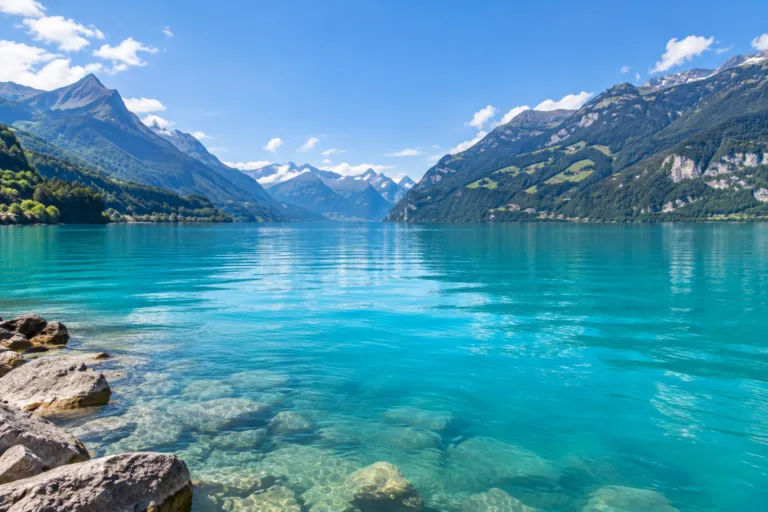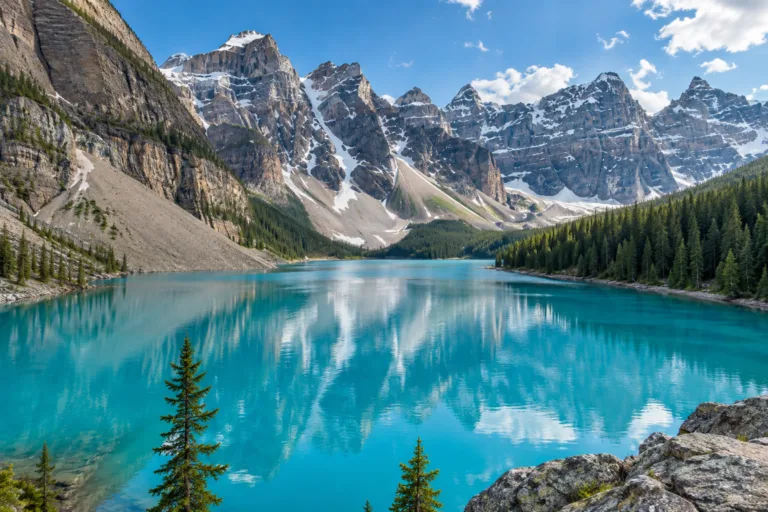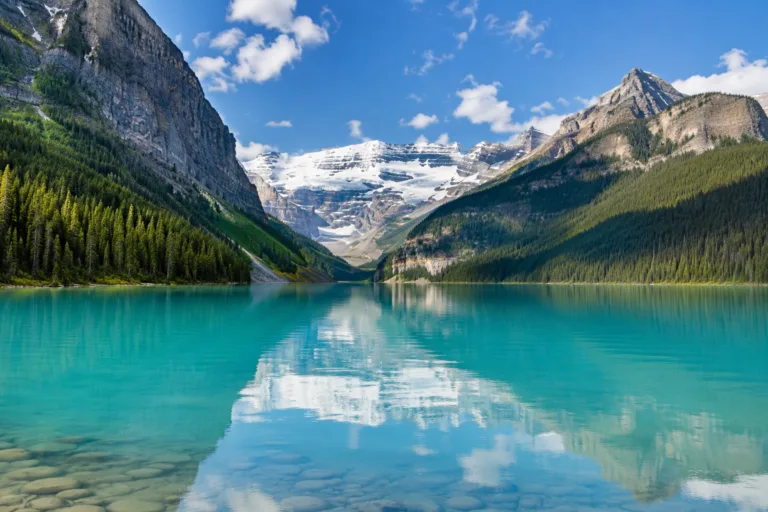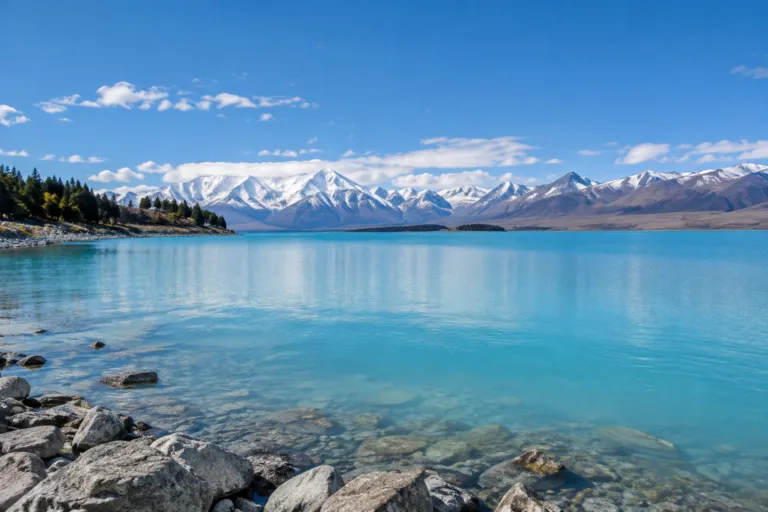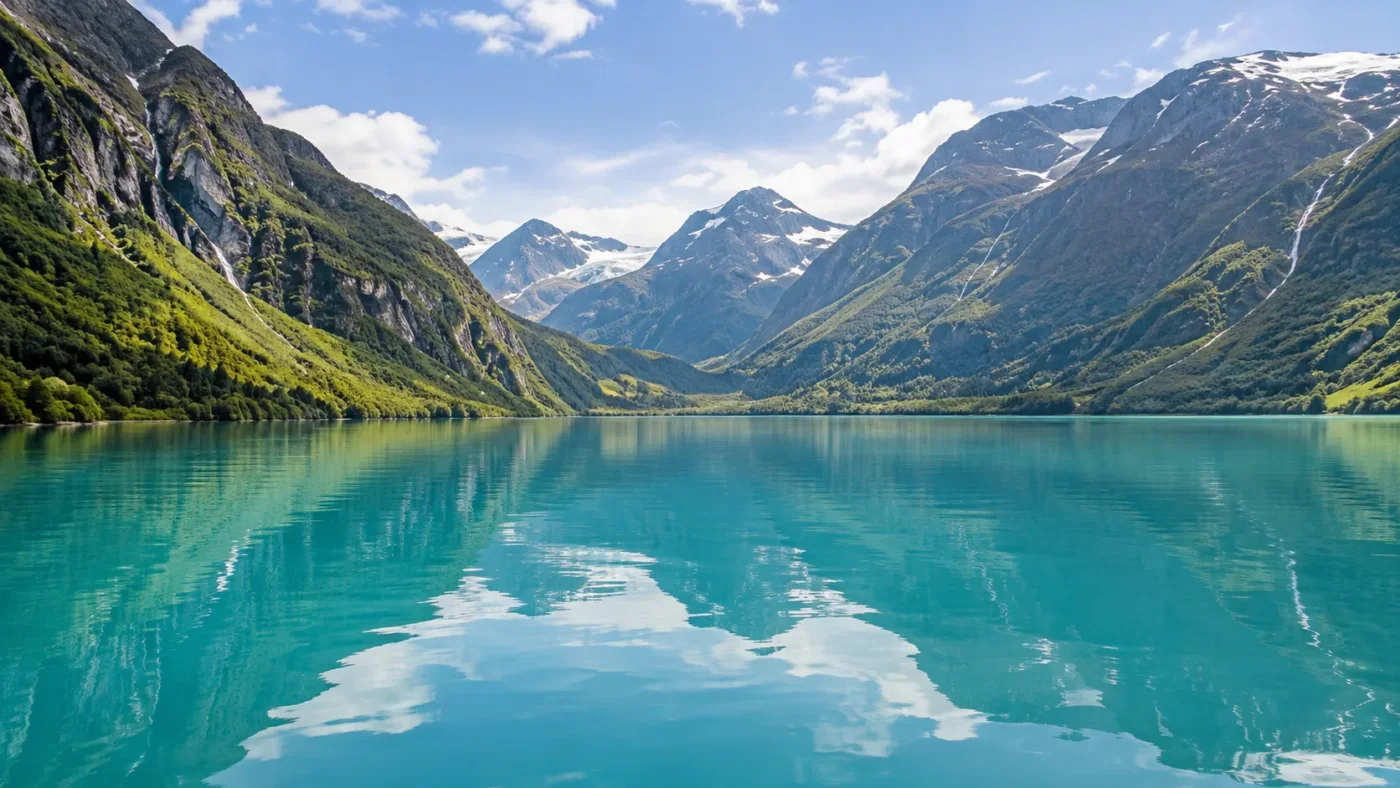
Turquoise
Primary visual colorWhere Is Oldevatnet?
Vestland · Norway
Drag or zoom the real map. Verified shoreline geometry is highlighted with the lake’s LakeColors palette color when available.
Oldevatnet on the Globe
Rotate the world or focus directly on the lake.
Glacial Inputs Differ Between the Two Basins
Value: Receives large glacial meltwater inputs from the Jostedalsbreen and Myklebustbreen sides of the catchment
Provenance: Scientific Study
Evidence: High
Value: Receives meltwater mainly from smaller local glaciers
Provenance: Scientific Study
Evidence: High
Snowmelt Strengthens the Turquoise Appearance
An official destination listing notes that Oldevatnet changes to a distinctive turquoise color when the snow melts. The source does not define a fixed month or an annual peak date.
Color Through the Year
From Glacier Erosion to Turquoise Water
Oldevatnet is most accurately described as a turquoise-to-emerald glacial lake rather than a body of water with one fixed shade. Its color is tied to fine glacier-derived sediment carried into Oldedalen by meltwater, while the visible balance between blue and green can change with particle concentration, illumination, reflections and viewing conditions. The lake also has two connected basins whose glacial water inputs are not identical.
Rock Flour Gives Oldevatnet Its Turquoise-Green Water
The color does not come from a dissolved turquoise pigment. Glaciers moving across bedrock grind rock into extremely fine mineral material, including silt- and clay-sized particles often called glacial flour or rock flour. Meltwater then transports those particles away from the ice and into rivers and lakes.
This mechanism is described directly for the inner Nordfjord lakes, including Oldevatnet. Visit Nordfjord explains that finely ground rock produced beneath glaciers is washed into glacier rivers and lakes, where suspended particles interact with sunlight and give large lakes in the region their characteristic green appearance.
The optical effect depends on more than the mere presence of sediment. Research on Norwegian waters influenced by glacial meltwater shows that particle size and concentration affect how strongly light is scattered back out of the water. Coarser material can produce a paler or milkier appearance when concentrations are high, while finer suspended particles can contribute to turquoise or green water after larger grains have settled.
Oldevatnet’s turquoise appearance is best understood as an optical response to suspended glacial sediment. The particles themselves do not need to be turquoise; they change the way incoming light is scattered and returned from the water.
The Southern and Northern Basins Receive Different Glacier Inputs
Oldevatnet is a two-part lake connected through a narrow section. NVE describes the combined lake system as about 12 km long and lying at roughly 33 metres above sea level. Its position on the floor of Oldedalen places it below a catchment strongly shaped by glaciers, steep tributary valleys and glacier-fed rivers.
A scientific study of Oldevatnet’s sediments gives a more detailed picture of that hydrology. The Oldedalen catchment is bordered by Jostedalsbreen to the south and east and by Myklebustbreen to the west. The study describes large amounts of glacial meltwater entering the southern lake basin from these glacier-covered parts of the catchment, while the northern basin receives meltwater mainly from smaller local glaciers.
The different glacier inputs provide a physical reason for suspended-sediment conditions to vary across the lake, but the cited research does not establish a permanent measured color boundary between the northern and southern basins. A stronger glacial inflow should not be converted into an exact basin-by-basin color claim without direct water-color observations or measurements.
Why Both “Turquoise” and “Emerald Green” Describe Oldevatnet
Reliable regional sources do not use only one color word for Oldevatnet. Visit Norway describes the lake as developing a distinctive turquoise color when snow melts, while Visit Nordfjord describes Oldevatnet among the glacier-influenced lakes whose suspended rock flour produces an emerald-green appearance.
Those descriptions are not competing scientific classifications. Turquoise and emerald green are visual terms covering neighboring parts of a blue-green range, and the apparent shade can move within that range as suspended particle concentrations, particle sizes, surface reflections, cloud cover and illumination change.
A photograph can therefore make Oldevatnet look more blue, greener or more saturated without proving that its water chemistry underwent a corresponding change. Conversely, a real increase in suspended glacial sediment can also alter the optical properties of the water. Separating those two effects matters when interpreting photographs taken on different dates.
The Oldevatnet sources cited here use observed color descriptions rather than a lake-specific dominant wavelength, reflectance-derived color class, RGB value or Lab measurement. “Turquoise” and “emerald green” should therefore remain evidence-backed visual labels, not exact spectral coordinates.
Snowmelt Changes the Color Signal, but There Is No Fixed Turquoise Month
Oldevatnet has a real seasonal color anchor: an official Visit Norway listing notes that the lake changes to its distinctive turquoise appearance when the snow melts. This fits the lake’s glacier-fed setting because stronger meltwater flow can transport fresh fine sediment from snowfields, glacierized terrain and tributaries into the lake system.
What the available evidence does not provide is an exact month-by-month color curve. Snowmelt timing varies with elevation, winter snow accumulation, spring temperatures and weather from year to year. Glacier melt and river discharge also continue to evolve through the open-water season rather than switching on at one calendar date.
For that reason, assigning a fixed peak such as May, June or July would add precision that the Oldevatnet-specific sources do not supply. The defensible seasonal statement is narrower: snowmelt is associated with development of the distinctive turquoise water, while the exact annual timing and intensity can vary.
Oldevatnet’s Sediment Record Is More Complex Than a Single Glacier-Flour Story
Glacial flour explains the characteristic blue-green surface appearance, but Oldevatnet is also a long-lived sediment archive receiving material from several processes. Sediment cores studied by Vasskog and colleagues contain a roughly 7,300-year record of glacier fluctuations, floods and mass-wasting activity.
The researchers identified distinct event layers associated with river floods, density currents and snow avalanches. That matters because the material reaching the lake is not produced by one perfectly uniform process. Glacier erosion supplies a strong background minerogenic signal, while steep slopes and high-energy events can deliver additional sediment to parts of the basin.
An avalanche or flood layer preserved in a sediment core does not prove that Oldevatnet turned a particular color at the surface during that event. The sediment record shows how varied the lake’s source-to-sink system is; direct surface-color reconstruction would require separate optical or observational evidence.
This distinction helps explain why the simple phrase “glacier water makes the lake turquoise” is broadly correct but incomplete. Oldevatnet receives glacier melt through a large, multi-source catchment, the two basins receive different mixtures of inflow, and the visible color depends on the fraction of fine material that remains suspended where light can interact with it.
Sources
- Kartverket — Oldevatnet Place-Name Fact Sheet
- NVE — 088/1 Oldenvassdraget
- Visit Nordfjord — Experience the Jostedalsbreen Glacier
- Vasskog et al. — A Holocene Record of Snow-Avalanche and Flood Activity in Oldevatnet
- Visit Norway — Oldevatn Camping
- Progress in Oceanography — Optical Properties of Norwegian Fjords Influenced by Glacial Meltwater