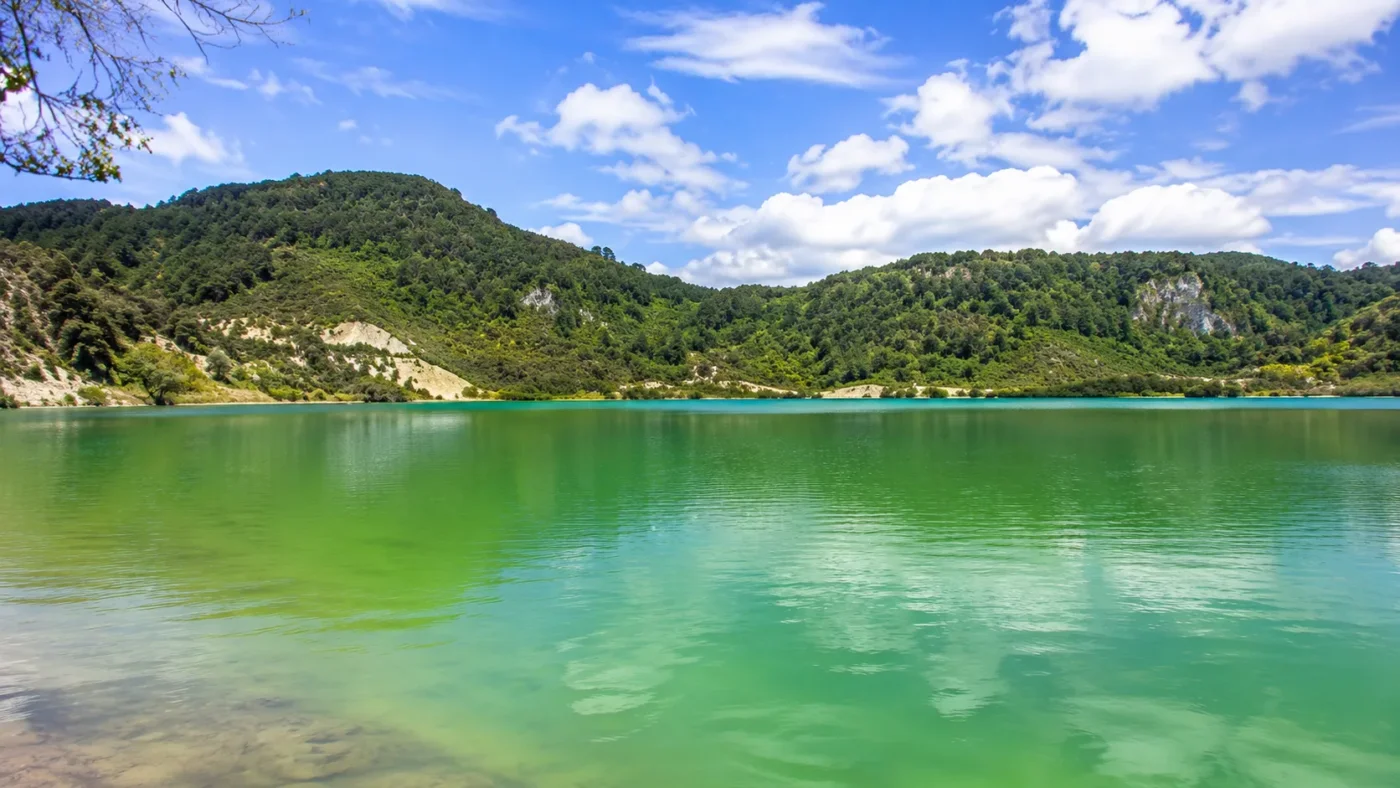
Emerald Green
Primary visual colorWhere Is Lake Rotokākahi / Green Lake?
Bay of Plenty · New Zealand
Drag or zoom the real map. Verified shoreline geometry is highlighted with the lake’s LakeColors palette color when available.
Lake Rotokākahi / Green Lake on the Globe
Rotate the world or focus directly on the lake.
Winter Monitoring Shows an Optical Shift Without a Measured New Hue
September 2006–September 2007Monthly monitoring recorded increased chlorophyll-a during winter together with reduced Secchi depth, indicating greater phytoplankton biomass and lower water clarity. The study did not assign Rotokākahi a different winter color, so these measurements are evidence of changing optical conditions rather than a documented seasonal recoloring.
Color Through the Year
Why Rotokākahi Looks Different from Tikitapu
How Strong Is the Color Evidence?
Lake Rotokākahi is best described as emerald green when viewed from above. Authoritative New Zealand sources link that appearance primarily to relatively shallow water over a sandy lakebed, while scientific monitoring shows that chlorophyll and water clarity can also vary through the year without establishing a separate seasonal color for the lake.
Why Rotokākahi Looks Emerald Green from Above
The familiar Green Lake name describes an apparent surface color rather than a laboratory-defined pigment or spectral value. Te Ara and Tourism New Zealand both attribute Rotokākahi’s emerald-green aerial appearance to its relative shallowness and sandy bottom.
That explanation matters because a shallow lake can show a stronger optical contribution from its bed than deep water does. Light entering the water can reach the substrate and return toward an observer after interacting with the water column and lakebed. Rotokākahi therefore should not be treated as a simple case of green pigment suspended uniformly throughout the lake.
The available sources do not provide a measured dominant wavelength, standardized reflectance spectrum, Lab value, or equivalent scientific color coordinate for Rotokākahi. “Emerald green” is consequently best treated as a well-documented visual description.
The Green Color Is Not Evidence of a Permanent Algal Bloom
Rotokākahi does contain phytoplankton, and chlorophyll can influence the optical character of lake water. A University of Waikato study based on monthly sampling from September 2006 to September 2007 found higher chlorophyll-a during winter and reduced Secchi depth, indicating increased phytoplankton biomass and lower transparency during that period.
Those measurements do not demonstrate that phytoplankton creates the lake’s namesake emerald color. The study measured water-quality and biological variables rather than assigning standardized visible colors to each month. The safer interpretation is that biological conditions can modify water clarity and the balance of light returning from the water column and lakebed.
This distinction prevents two different claims from being merged: Rotokākahi has a documented green visual identity, while its phytoplankton abundance and transparency can also change over time. The first does not automatically prove the second is its primary cause.
Rotokākahi and Tikitapu Form a Natural Color Contrast
Rotokākahi sits beside Tikitapu, commonly called Blue Lake, making the pair unusually useful for understanding how lakebed conditions can influence apparent water color. Te Ara notes that the contrast is particularly apparent in fine weather.
Rotokākahi’s green appearance is associated with its relatively shallow water and sandy bottom. Tikitapu, by comparison, is described as blue because light interacts with its pale rhyolite and pumice lakebed. The neighboring lakes therefore demonstrate that two nearby volcanic water bodies can present noticeably different colors without requiring completely different regional climates or sky conditions.
The contrast also shows why photographs should not be used as the sole basis for assigning a lake color. Sun angle, cloud cover, surface reflection and viewpoint can alter both lakes in individual images, while the repeated green-versus-blue distinction remains documented independently of any one photograph.
Seasonal Water Changes Are Better Documented Than Seasonal Color Changes
There is enough temporal evidence to show that Rotokākahi is not optically identical throughout the year. Winter monitoring has recorded changes in chlorophyll-a and water clarity, both of which affect how light travels through lake water.
There is not, however, reliable evidence for a twelve-month sequence in which Rotokākahi turns from green to another named color and back again. No reviewed source provides month-specific color measurements for every part of the year. The annual color record therefore distinguishes measured winter water-quality changes from an unproven seasonal hue cycle.
This also means that a darker, brighter or less obviously green photograph taken at a particular time should not by itself be interpreted as evidence of a recurring seasonal phase. Short-term lighting, surface reflection and water transparency can all change appearance without producing a new underlying color state.
Depth Complicates the Simple “Shallow Green Lake” Description
Calling Rotokākahi shallow is useful for explaining its aerial color, but it should not imply that the entire basin is shallow. Bay of Plenty Regional Council records a maximum depth of about 32 metres, with the deepest part toward the western end.
The sandy-bottom explanation is therefore strongest as an account of the lake’s overall aerial appearance and the optical influence of shallower areas. It should not be stretched into a claim that the same amount of bottom-reflected light controls every point across the lake. Deeper water, changes in transparency and local viewing geometry can reduce the visibility of the substrate and make parts of the surface appear darker.
Color Observation Has an Important Access Boundary
Rotokākahi is a privately owned lake of major cultural significance and is regarded as tapu. Rotorua Lakes Council states that swimming, fishing and boating are not permitted. Its color can be observed from permitted viewpoints, but the lake should not be treated as an unrestricted site for shoreline access, water sampling or recreational field observation.
That restriction is also relevant when interpreting the evidence record. Public descriptions and established monitoring data carry more weight than unsupported claims based on supposed close-range observations from areas where public lake access is not permitted.
Sources