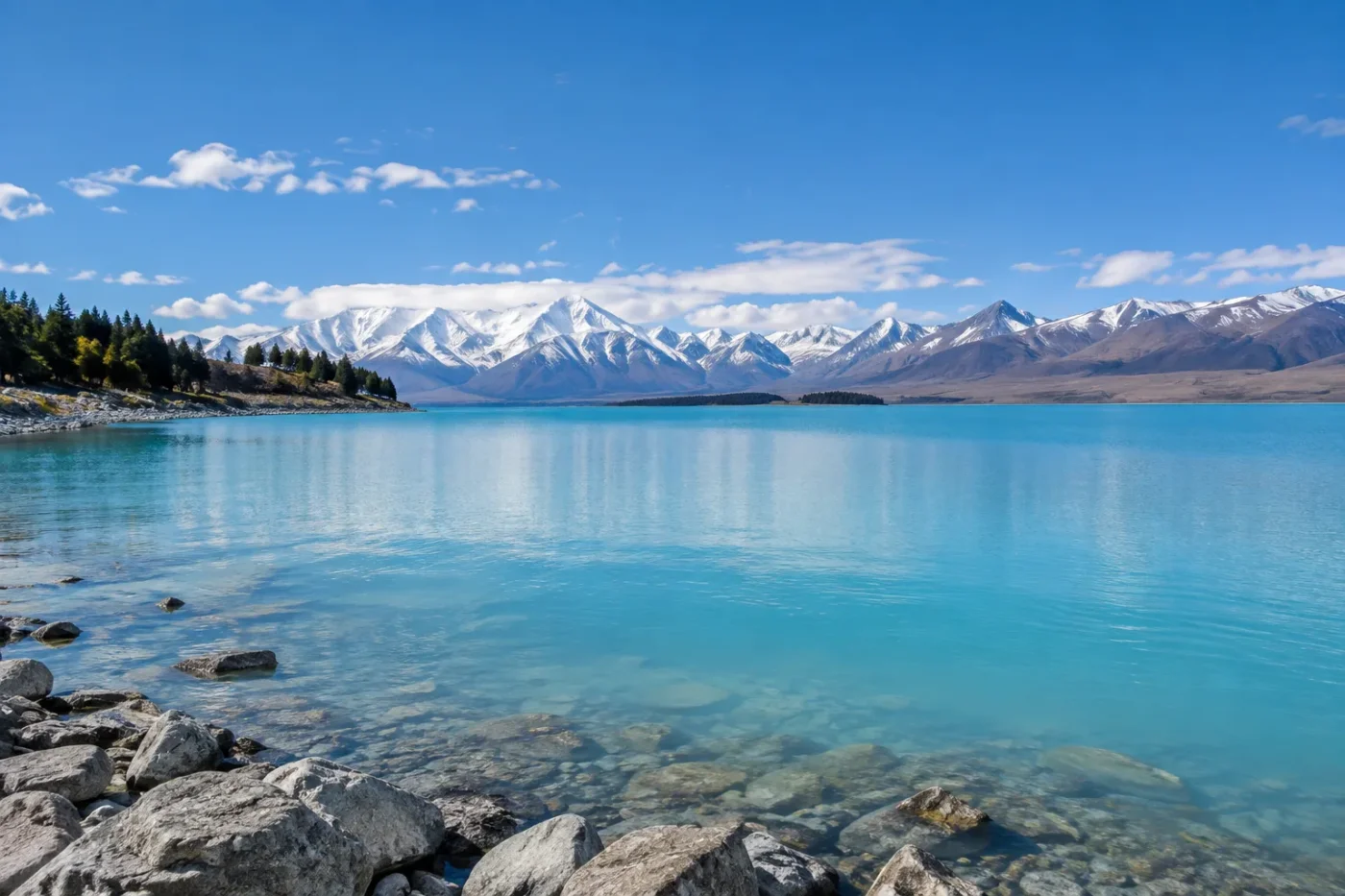
Milky Turquoise
Primary visual colorWhere Is Lake Tekapo / Takapō?
Canterbury · New Zealand
Drag or zoom the real map. Verified shoreline geometry is highlighted with the lake’s LakeColors palette color when available.
Lake Tekapo / Takapō on the Globe
Rotate the world or focus directly on the lake.
Recent Lake-Centre Turbidity
Documented measurement dataLake Tekapo Centre, surface
Lake Tekapo Centre, surface; 2026 data may be provisional
Lake Tekapo Centre, surface; 2026 data may be provisional
Lake Tekapo Centre, surface; 2026 data may be provisional
Lake Tekapo Centre, surface; 2026 data may be provisional
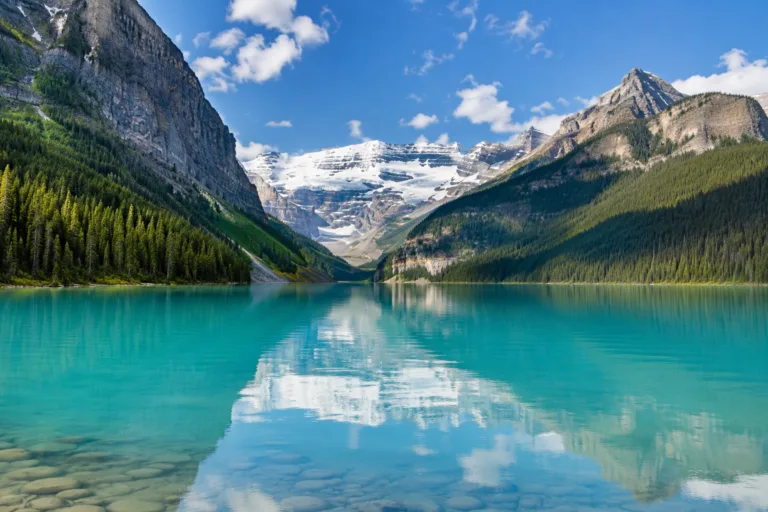
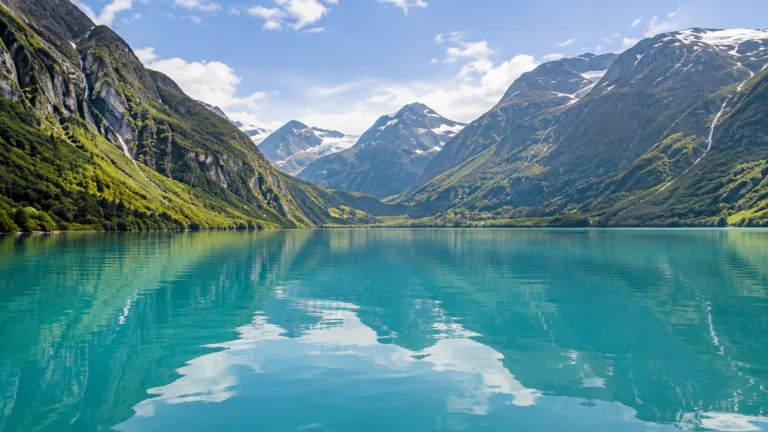
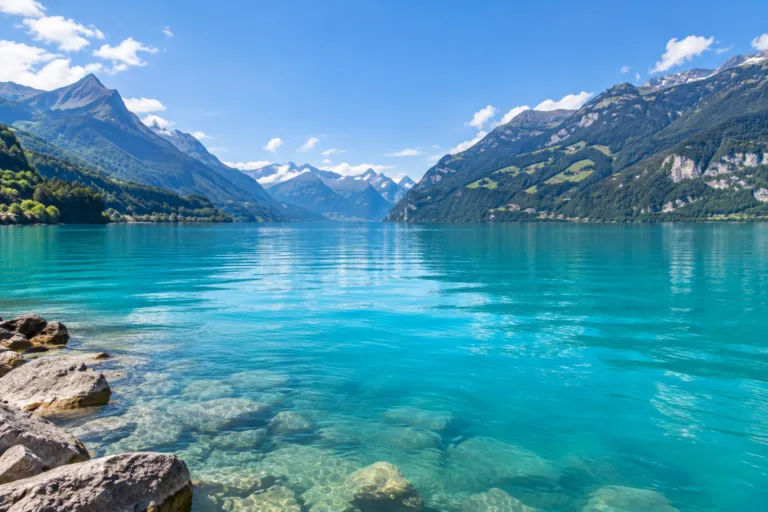
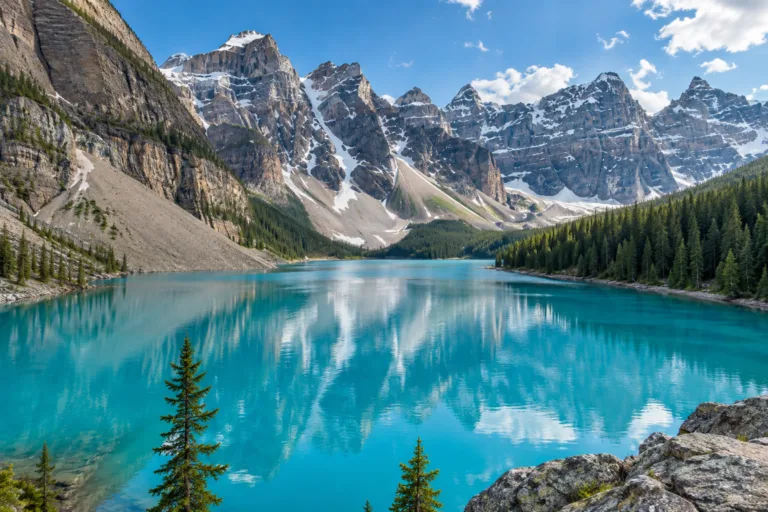
Lake Tekapo’s milky turquoise water comes from glacial rock flour: extremely fine mineral particles produced when glaciers grind bedrock in the Southern Alps. Meltwater carries that material into the Godley River and then into the lake, where much of it stays suspended long enough to alter how sunlight moves through the water. The result is the pale turquoise to milky-blue appearance repeatedly described by New Zealand conservation and science sources.
The Godley River Delivers Rock Flour From Three Glacier Systems
Lake Tekapo is not simply a blue lake reflecting the sky. NASA satellite reporting identifies the Godley River as the main northern pathway for water rich in glacial flour, with meltwater from the Classen, Gray and Godley glaciers draining into that river before it reaches the lake.
The sediment begins upstream, where moving ice abrades valley rock into very fine silt and clay. Those particles are small enough to travel with meltwater rather than dropping out immediately. Te Ara describes Tekapo as mainly fed by the Godley River, while the Department of Conservation places the lake in a valley left by retreating ice and behind moraines from the Tekapo glacial advance. The basin and the modern sediment supply therefore come from the same glacial landscape, but on very different timescales.
Blue-Green Light Survives the Water-and-Particle Filter
Rock flour does not color the lake in the way a dissolved dye would. NASA explains that the finest suspended mineral particles interact with incoming sunlight while the water itself absorbs other parts of the spectrum. Longer red, orange and yellow wavelengths are strongly absorbed by water, while the particle-rich water leaves more blue and green light available to be scattered back toward an observer.
A turquoise appearance can be associated with suspended glacial sediment, but turbidity is a measurement of cloudiness rather than a direct measurement of hue. An NTU value cannot be converted into a reliable turquoise, blue-green or RGB value without separate optical color data.
This also explains why “turquoise,” “milky turquoise” and “milky-blue” can all be defensible visual descriptions of the same lake. They are descriptive color terms, not interchangeable laboratory color coordinates.
Summer Meltwater Adds Rock Flour Without Creating a Simple Four-Season Color Cycle
A Department of Conservation wetland inventory links Lake Tekapo’s distinctive milky-blue appearance to summer glacial meltwater inflow together with permanently suspended rock flour. That gives the lake a real seasonal sediment signal, but it does not establish a precise month-by-month hue chart.
The same source notes that lake levels are often lower in winter and that the Mackenzie glacial lakes do not freeze over. Lower water levels can expose bays and shoreline areas, changing the visible balance between water, sediment flats and shore. That is a shoreline-state change, not evidence that the whole lake becomes a different winter color.
Summer is directly tied to glacial meltwater input and the milky-blue appearance. Outside that period, the cited sources do not publish a reliable month-by-month visual color classification, so unsupported seasonal colors should not be assigned.
Recent Turbidity Samples Show How Fast Measured Cloudiness Can Change
Environment Canterbury’s lake-centre surface samples recorded turbidity of 5.7 NTU on 4 December 2025 and 5.6 NTU on 6 January 2026. Later samples in the same sequence measured 3.0 NTU in February, 1.9 NTU in March and 1.4 NTU in April. The measurements show a clear decline in cloudiness across those particular sampling dates.
That sequence should not be treated as a universal annual curve. LAWA states that Lake Tekapo is monitored from the centre during the summer months and warns that data displayed from 2026 may not yet have completed council quality-assurance processes. The recent values are therefore useful as a measured snapshot, while the longer-term visual claim remains broader: suspended glacial flour is the established cause of Tekapo’s pale turquoise character.
Turbidity can support an interpretation of changing suspended material, but it does not by itself prove a corresponding change from one named color to another. Direct spectral or standardized water-color measurements would be needed for that.
“Milky Turquoise” Is a Visual Description, Not a Spectral Reading
The Department of Conservation describes Lake Tekapo as turquoise in one public geology account and as milky-blue in its wetland inventory, while Te Ara uses the phrase milky turquoise for glacier-fed lakes such as Tekapo. Those descriptions are compatible because they refer to the lake’s observed appearance under a shared glacial-sediment mechanism.
The cited Lake Tekapo monitoring record reports water-quality variables such as turbidity, chlorophyll, nutrients and clarity rather than a lake-specific dominant wavelength, Lab coordinate or standardized RGB value. Assigning an exact spectral color from those records would go beyond the available evidence.
Sources
- Department of Conservation — Lake Tekapo area
- Te Ara — Glacial lakes
- NASA Earth Observatory — How Glaciers Turn Lakes Turquoise
- Environment Canterbury — Lake Tekapo Centre water quality
- Land, Air, Water Aotearoa — Lake Tekapo centre
- Department of Conservation — A Directory of Wetlands in New Zealand: Canterbury Conservancy