Turquoise
Primary visual colorWhere Is Moraine Lake?
Alberta — Banff National Park · Canada
Drag or zoom the real map. Verified shoreline geometry is highlighted with the lake’s LakeColors palette color when available.
Moraine Lake on the Globe
Rotate the world or focus directly on the lake.
Summer Melt Builds the Turquoise Signal
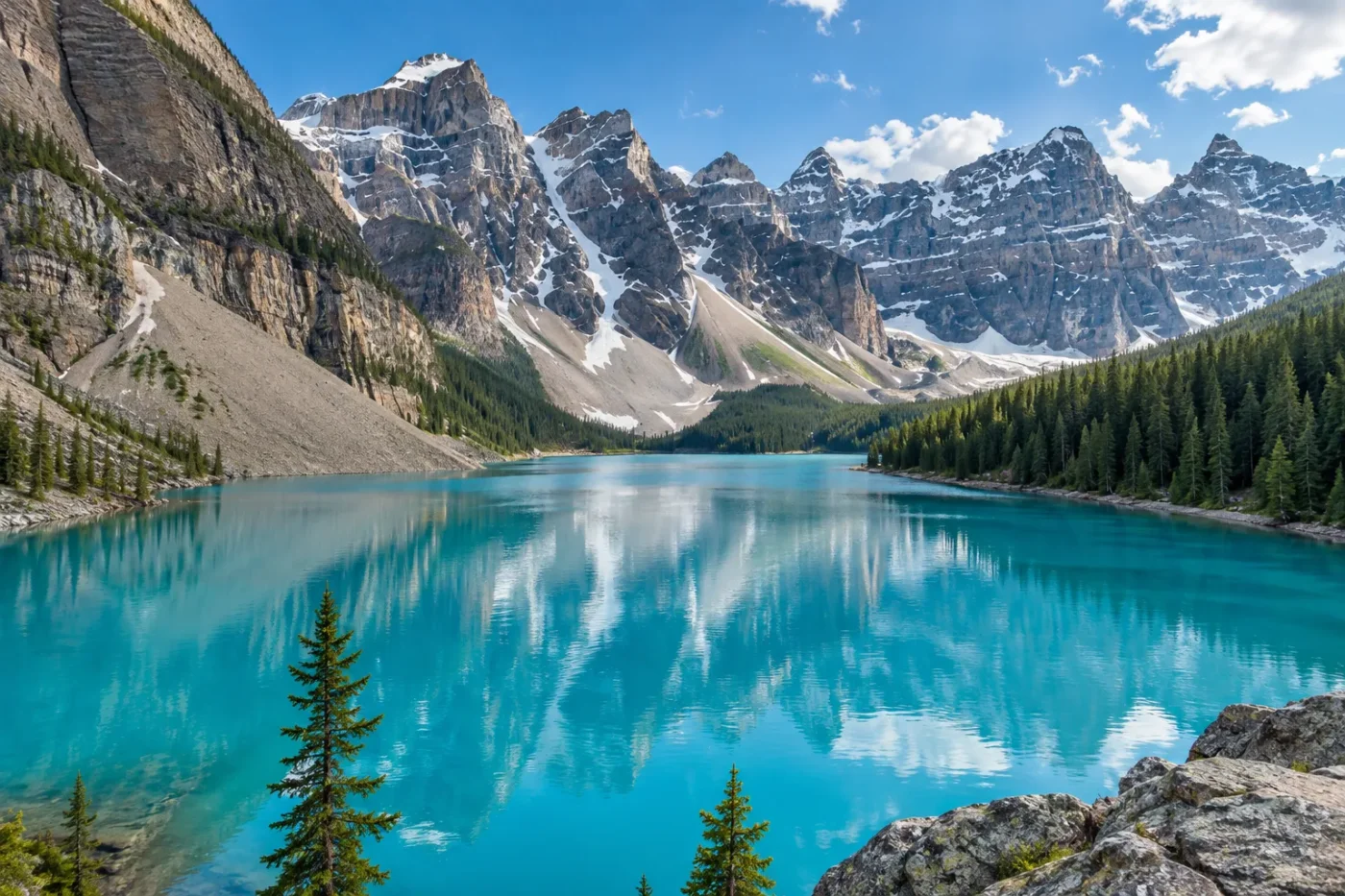
As the high-elevation lake thaws and summer meltwater increases, glacier-ground mineral particles remain suspended in the water and strengthen the blue-green appearance. The mid–late July peak is a seasonal visual description rather than a direct pigment or spectral measurement.
From Bedrock Grinding to Turquoise Water
Evidence Behind the Moraine Lake Color Profile
Claim-level supportThe Canadian Geographical Names Database lists Moraine Lake as an official Alberta lake feature and provides the decimal coordinates.
Government of Canada — Canadian Geographical Names Database: Moraine LakeEvidence: HighIndependent regional and Earth science descriptions connect the blue-green appearance with glacial rock flour.
Banff & Lake Louise Tourism — Why Banff Lakes Are BlueUSRA Earth Science Picture of the Day — Moraine Lake (NASA/GSFC contribution)Evidence: HighBanff & Lake Louise Tourism gives this as typical seasonal timing rather than an instrument-measured color maximum.
Banff & Lake Louise Tourism — Best Dates to Visit in SummerEvidence: ModerateThe structured waterbody identity aligns with the official Canadian geographical position for Moraine Lake.
OpenStreetMap — Moraine Lake WaterbodyGovernment of Canada — Canadian Geographical Names Database: Moraine LakeEvidence: ModerateMoraine Lake is best known for an intense turquoise to cyan-blue summer appearance produced by fine glacier-ground sediment suspended in its water. The color develops as the high-elevation lake thaws and meltwater carries rock flour into the basin, with Banff & Lake Louise Tourism placing the typical peak turquoise period in mid-to-late July. The exact shade visible on any given day can still change with sunlight, cloud cover and viewing conditions.
Rock Flour Changes How Sunlight Leaves the Water
The material responsible for Moraine Lake’s color begins above the lake. Moving glacier ice grinds against bedrock and produces extremely fine mineral particles commonly called rock flour or glacial flour. Meltwater carries some of that material downstream into the lake.
Unlike coarse sand or gravel, a portion of these fine particles can remain suspended in the water column. The suspended sediment changes the way incoming sunlight is scattered and reflected back toward an observer. Earth science material prepared by a NASA/GSFC contributor describes Moraine Lake’s cyan or turquoise water as the result of fine rock powder suspended in the lake and interacting strongly with blue wavelengths of light.
The mineral particles do not dye the lake turquoise. Their presence changes the optical path of sunlight through the water, helping blue and blue-green wavelengths dominate the visible appearance.
This also explains why photographs of Moraine Lake can show turquoise, cyan, azure or a somewhat greener blue without requiring a different chemical coloring agent for each shade. The underlying mechanism is the same suspension of very fine glacier-derived sediment interacting with water and sunlight.
The Famous Turquoise Arrives After the High-Elevation Thaw
Moraine Lake does not display the same surface state throughout the year. Its elevation and alpine setting keep snow and ice around much later than at many lower-elevation lakes. Banff & Lake Louise Tourism notes that Moraine Lake generally thaws later than Lake Louise and places its typical peak turquoise color in mid-to-late July.
The seasonal connection is physical. As snow and glacier ice melt, runoff supplies both water and freshly produced fine sediment. That creates the conditions associated with Moraine Lake’s brighter summer blue-green appearance. The lake’s color therefore has a seasonal component tied to meltwater and suspended sediment, rather than being a static painted-looking property of the basin.
Mid-to-late July is a useful seasonal description, but thaw and melt conditions vary from year to year. A colder spring, lingering snowpack or different summer weather can shift the timing and intensity of the visible color.
Public guidance also illustrates why a single thaw date should not be treated as exact. Parks Canada states that Lake Louise and Moraine Lake usually melt by late May, while Banff & Lake Louise Tourism describes high-elevation lakes as sometimes remaining snow-covered into early or mid-June and specifically notes that Moraine Lake thaws later than Lake Louise. Those descriptions cover different levels of detail and should be read as a variable seasonal window rather than conflicting calendar guarantees.
Mid-to-Late July Is a Visual Peak, Not a Laboratory Maximum
The seasonal peak used for Moraine Lake is based on an authoritative local description of when the lake typically reaches its strongest turquoise appearance. It should not be confused with a measured annual maximum in suspended sediment concentration, reflectance, dominant wavelength or another optical metric.
That distinction matters because several processes operate at once. Meltwater can alter sediment delivery over weeks, while sunlight and weather can change the apparent color over minutes or hours. A clear summer afternoon may make the water appear much brighter than an overcast morning even if the underlying sediment concentration has changed very little.
The source record supports a turquoise-to-cyan visual identity, a glacial rock-flour mechanism and a typical mid-to-late July color peak. It does not establish a Moraine Lake-specific calibrated RGB, HEX or dominant-wavelength series for every month of the year.
Why the Same Lake Can Look Cyan, Turquoise or Azure
Moraine Lake is often described with several neighboring color terms. Earth science material uses cyan or turquoise, while regional sources also use turquoise, blue-green and azure descriptions for glacier-fed lakes in the Banff area. These words describe overlapping visual appearances rather than separate permanent color states.
Three influences are especially useful for interpreting those differences:
- Suspended rock flour: glacier-ground mineral particles create the sediment-rich optical environment associated with the bright blue-green water.
- Seasonal meltwater: the amount and timing of runoff influence how much sediment-rich water reaches the lake during the open-water season.
- Illumination: sunlight angle, cloud cover and the amount of direct light reaching the surface can make the same water appear brighter, darker, bluer or greener.
This is why a photographic color shift should not automatically be treated as proof that the lake has undergone a new chemical or biological state. Some variation is real and seasonal, while another portion is apparent color produced by changing illumination and observation conditions.
The Summer Color Follows a Physical Chain from Glacier to Lake
- Glacier movement mechanically grinds rock beneath and beside the ice.
- The grinding produces very fine mineral sediment.
- Seasonal meltwater mobilizes part of that sediment.
- Runoff carries the rock flour into the Moraine Lake system.
- Fine particles remain suspended instead of settling immediately.
- Sunlight interacting with the water and sediment produces the characteristic bright blue-green appearance.
The process connects Moraine Lake’s color directly to its alpine environment. The turquoise water is therefore not merely associated with nearby glaciers as scenery; glacier erosion and meltwater supply are part of the mechanism that creates the visual effect.
Moraine Lake’s Color Record Is Strongest for Summer
The available source record is much more specific about Moraine Lake’s summer appearance than about a precise color for every month. Summer descriptions consistently identify vivid turquoise, cyan or azure water and explain the role of glacial sediment. The annual transition around thaw is also documented, although public sources use somewhat different timing for when the lake becomes fully open.
For autumn and early winter, the evidence used for this profile does not justify assigning a precise month-by-month water color. Those months are therefore left neutral in the Color Year rather than extending the summer turquoise state without direct month-level support. The same approach is used wherever an exact color state would require inference beyond what the cited sources establish.
Sources
- Government of Canada — Canadian Geographical Names Database: Moraine Lake
- Parks Canada — Lake Louise and Moraine Lake
- Banff & Lake Louise Tourism — Best Dates to Visit in Summer
- Banff & Lake Louise Tourism — Why Banff Lakes Are Blue
- USRA Earth Science Picture of the Day — Moraine Lake (NASA/GSFC contribution)
- OpenStreetMap — Moraine Lake Waterbody