Light Blue
Primary visual colorWhere Is Jökulsárlón?
Hornafjörður, Southern Region · Iceland
Drag or zoom the real map. Verified shoreline geometry is highlighted with the lake’s LakeColors palette color when available.
Jökulsárlón on the Globe
Rotate the world or focus directly on the lake.
A Measured Red-Brown Surface Event in 2012
A red-brown surface discoloration was observed during hydrographic and nutrient sampling. Microscopy linked the color to Peridiniella catenata in a shallow low-density surface layer within a limited part of the outer lagoon.
Why the Ice Can Look Blue, White or Black
Evidence Behind the Color Profile
Claim-level supportNASA documents light-blue and milky-white icebergs and describes electric-blue ice carrying black volcanic-ash streaks.
NASA Earth Observatory — Iceland’s Glacial LagoonEvidence: HighUSGS explains the wavelength-selective absorption and scattering that makes a longer optical path through glacier ice appear increasingly blue.
U.S. Geological Survey — Why Is Glacier Ice Blue?Evidence: HighHydrographic surveys identify a surface layer containing ice melt, freshwater and Atlantic-derived water, with saline inflow occurring on tidal cycles.
Annals of Glaciology — Multiple Melt Plumes at BreiðamerkurjökullEvidence: HighSampling and microscopy connected a localized red-brown surface color with high abundance of Peridiniella catenata.
Marine Research Institute — Peridiniella catenata in JökulsárlónEvidence: HighJökulsárlón has a predominantly glacial-blue visual identity, but its color cannot be explained as a uniformly turquoise lake. Much of the blue-to-white palette belongs to icebergs calved from Breiðamerkurjökull, while the lagoon itself contains a changing mixture of glacial meltwater, freshwater and Atlantic-derived water. A very different color was measured on 23 August 2012, when part of the outer lagoon developed a localized red-brown surface discoloration associated with a dense dinoflagellate population.
The Blue Is Not One Single Color Mechanism
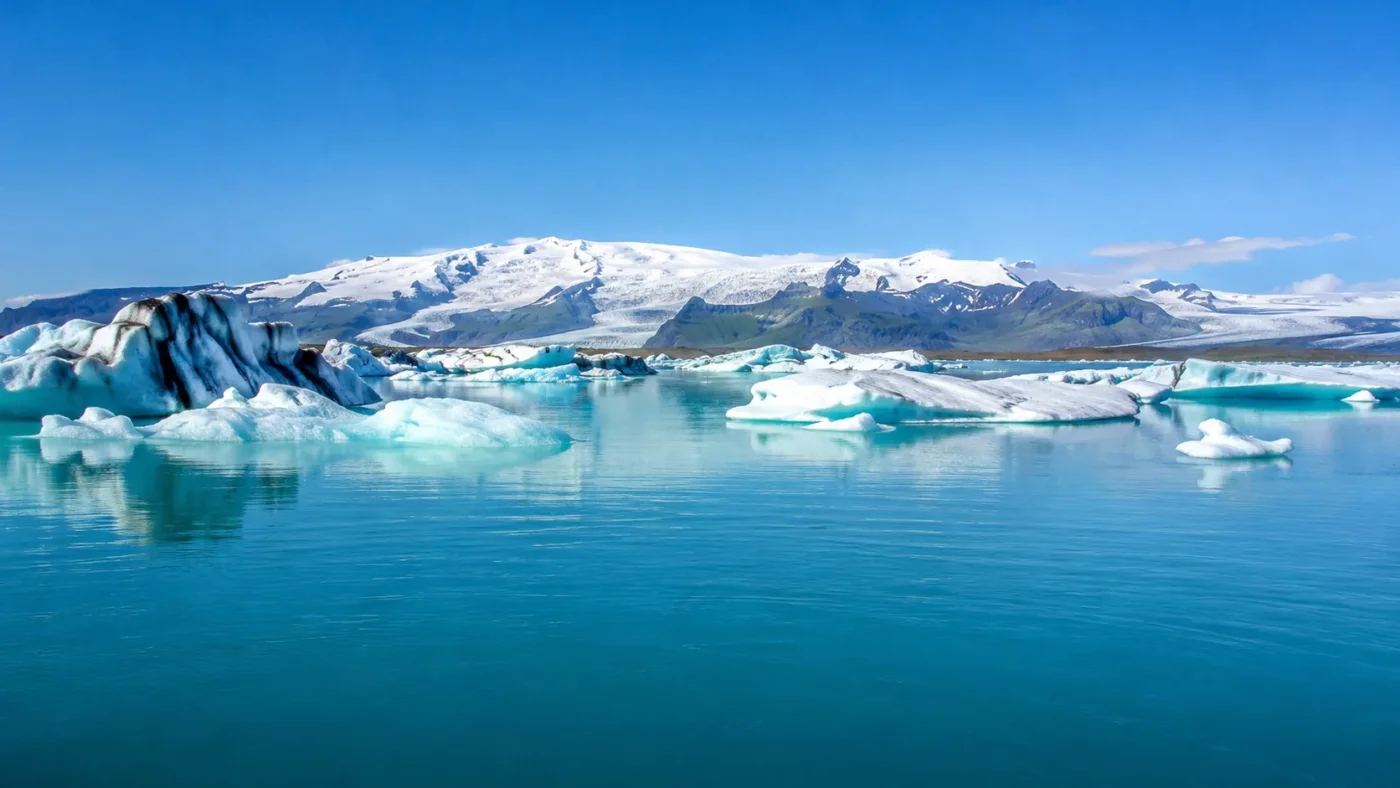
Descriptions of Jökulsárlón often merge the color of the lagoon water and the color of its icebergs into one idea. They need to be separated. NASA imagery and field photography document light-blue, milky-white and, in some cases, electric-blue icebergs. These floating blocks provide a large part of the lagoon’s recognizable blue appearance.
The water beneath them belongs to a more complex system. Hydrographic surveys published in Annals of Glaciology found that the lagoon is connected to the North Atlantic through a narrow channel and receives warm saline ocean water during each tidal cycle. Near the surface, researchers identified a layer made from ice melt, freshwater and Atlantic-derived water. Deeper water is substantially influenced by the saline inflow.
The optical mechanism that makes dense glacier ice blue should not be treated as a complete explanation for the lagoon water. Jökulsárlón combines floating glacier ice with a stratified, tidally influenced body of water, so the visible scene has several color-producing components.
This distinction also means that a photograph showing intense blue does not by itself establish a measured blue-water state. Ice concentration, iceberg orientation, clouds, illumination, surface reflection and the proportion of open water can all change what dominates the scene without requiring the lagoon water to undergo an equivalent chemical color change.
Why Some Icebergs Look Electric Blue While Others Look White
The blue of glacier ice is an optical property of the ice itself. The U.S. Geological Survey explains that ice absorbs more of the red, longer-wavelength part of white light while transmitting and scattering shorter blue wavelengths. The farther light travels through the ice, the stronger the blue appearance can become.
Dense ice therefore can expose an unusually saturated blue interior when an iceberg fractures, rolls or melts into a form that allows light to travel through relatively clear ice. White ice has a different optical structure: abundant small air spaces and strongly scattering surfaces return more of the incoming light before it travels far through the ice.
Jökulsárlón adds another color that is not produced by water or ice optics. NASA describes some icebergs as electric blue with black streaks of ash from earlier volcanic eruptions. These dark layers are material preserved within the glacier and later exposed when the ice calves into the lagoon. An individual iceberg can consequently display blue ice, white ice and black bands at the same time.
The Lagoon Has Also Produced a Measured Red-Brown Color
Jökulsárlón’s most unusual documented color event occurred during scientific sampling on 23 August 2012. Researchers noticed a red-brown color in the surface water, collected samples and examined them microscopically. The discoloration was associated with the dinoflagellate Peridiniella catenata.
The abundance was not merely a visual estimate. Counts reached as high as 4.8 million cells per liter in a shallow, low-density surface layer. The organism was concentrated within a limited area of the outer lagoon rather than across the entire waterbody, making this a spatially restricted biological color event.
The red-brown observation is tied to a measured event on 23 August 2012. The cited evidence does not establish that Jökulsárlón normally turns red-brown every August or that this is a predictable annual phase.
This event matters because it demonstrates that the lagoon’s visible color is not controlled exclusively by glacier ice, mineral particles or illumination. Biological abundance can become high enough to alter surface-water appearance under particular conditions. It also shows why a rare color should be kept separate from the lagoon’s dominant blue-and-white visual identity.
Tides Make Jökulsárlón a Glacier–Ocean Color System
Jökulsárlón is not an isolated freshwater basin. Breiðamerkurjökull calves directly into the lagoon, while the lagoon exchanges water with the North Atlantic. The 2017 hydrographic study found saline ocean water entering on each tidal cycle and sinking beneath the fresher surface layer.
That structure gives Jökulsárlón several simultaneous sources of visual variability. Glacier melt changes the freshwater contribution. Icebergs continually alter how much of the surface is occupied by blue or white ice. Atlantic-derived water enters from the coast, while runoff and suspended material arrive from the glacier system. Surface reflections and illumination are then superimposed on those physical changes.
The hydrographic evidence establishes the mixing processes, but it does not assign a specific visible hue to each salinity or meltwater value. A darker or lighter photograph therefore should not be converted into a precise claim such as “more seawater makes the lagoon deeper blue” unless direct optical measurements support that relationship.
The Lagoon Is Expanding, but a Long-Term Color Trend Has Not Been Established
Jökulsárlón’s physical setting continues to change. A NASA Landsat visualization released in May 2026 follows Breiðamerkurjökull from 1985 through 2025 and shows prolonged retreat of the glacier edge together with expansion of the lagoon. NASA also notes that warm North Atlantic saltwater entering the basin contributes to melting and calving at the glacier margin.
This changes the ingredients of the visible landscape: the position of the glacier front, the area of open lagoon, the distribution of calved ice and the geometry of the shoreline are not fixed. Such changes can alter how much blue ice, white ice or open water occupies a view.
They should not, however, be converted into an unsupported long-term hue trend. The available retreat record documents changes in ice and lagoon extent, not a continuous colorimetric record showing that Jökulsárlón has steadily become bluer, greener, darker or lighter. Physical change is well documented; a directional color trend is not.
Why Jökulsárlón Does Not Have a Reliable Month-by-Month Color Calendar
There is strong evidence for the lagoon’s blue-and-white iceberg palette, its tidal water structure and the isolated red-brown event of August 2012. That evidence does not provide a recurring January-to-December sequence of measured colors.
The exact date of the 2012 bloom is useful historical evidence, but placing “red-brown” into every August of a Color Year would turn a one-time observation into a seasonal prediction. Likewise, hydrographic differences between sampling seasons describe temperature, salinity and mixing more directly than visible color.
For Jökulsárlón, the defensible color profile is therefore event-aware rather than calendar-driven: glacial blue and white dominate the documented iceberg scene, black volcanic-ash bands occur in some ice, and a localized biological event has demonstrated that the surface can occasionally depart sharply from that familiar palette.
Sources
- NASA Earth Observatory — Iceland’s Glacial Lagoon
- U.S. Geological Survey — Why Is Glacier Ice Blue?
- Annals of Glaciology — Multiple Melt Plumes at Breiðamerkurjökull
- Marine Research Institute — Peridiniella catenata in Jökulsárlón
- NASA Scientific Visualization Studio — The Receding Breiðamerkurjökull Glacier
- Wikimedia Commons — Jökulsárlón Geographic Record