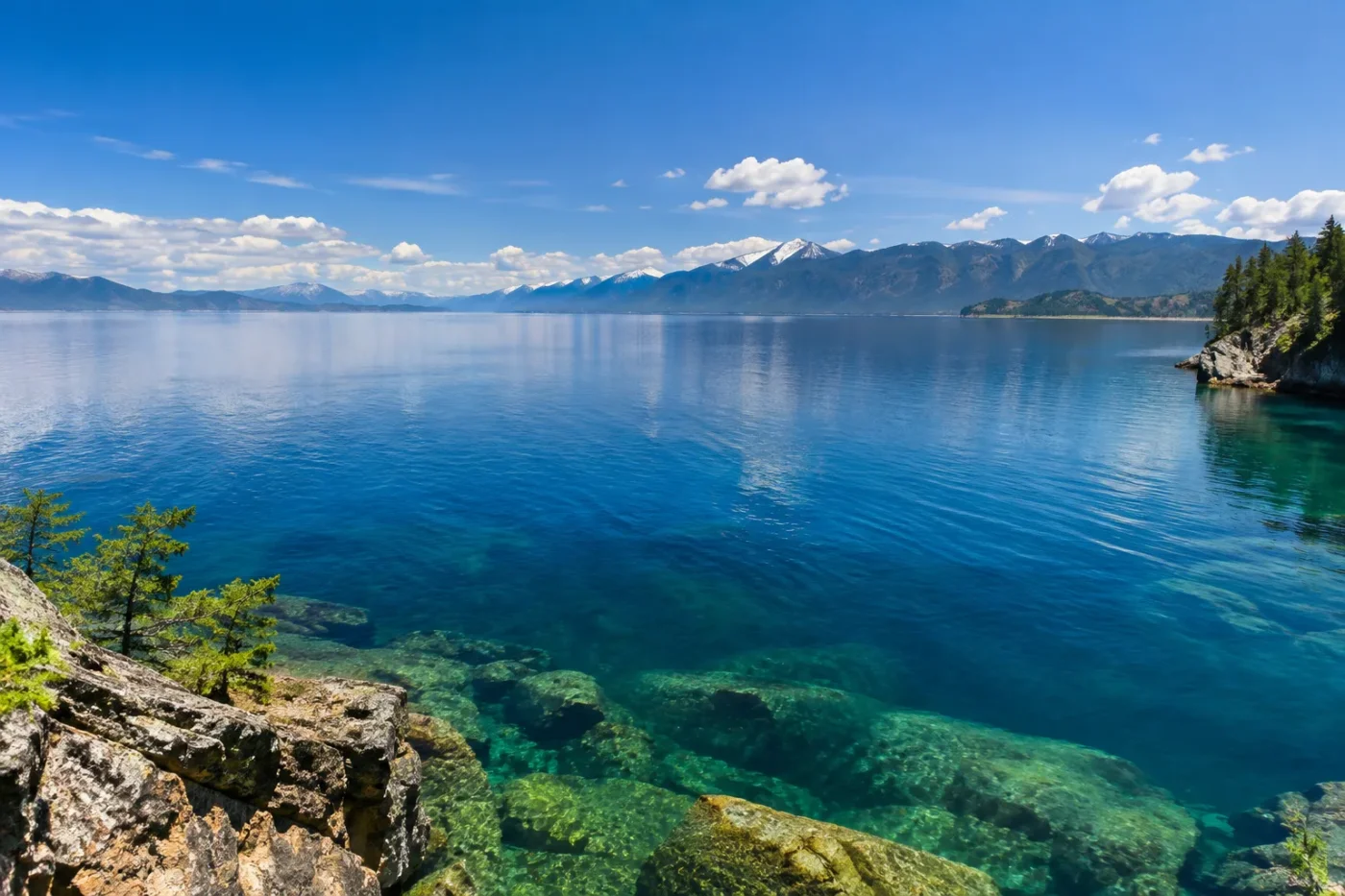
Deep Blue
Primary visual colorWhere Is Lake Baikal?
Irkutsk Oblast and Republic of Buryatia · Russia
Drag or zoom the real map. Verified shoreline geometry is highlighted with the lake’s LakeColors palette color when available.
Lake Baikal on the Globe
Rotate the world or focus directly on the lake.
The Transparent Light-Blue Ice Window
Primary clear ice over much of the deep lake can remain outwardly structureless and highly transparent before stronger spring insolation introduces bubbles and internal changes.
Why Baikal Is Not the Same Color Everywhere
Low particle loads and low chlorophyll support strong water clarity and a blue open-water appearance.
Higher chlorophyll and terrigenous input can shift local optical conditions away from the clear pelagic blue, especially in late summer.
Filamentous green algae Spirogyra have been detected in pelagic monitoring during some years, with the strongest seasonal presence reported in summer–autumn rather than as a permanent lake-wide state.
Baikal Color Through the Year
Why Clear Pelagic Water Reads Deep Blue
How Strong Is the Color Evidence?
NASA true-color imagery and clear-water bio-optical measurements agree on a strongly blue pelagic state.
NASA MODIS — Lake Baikal, Eastern Russia (May 2012)Heim et al. — Variation in Lake Baikal's Phytoplankton Distribution and Fluvial InputEvidence: HighA dedicated Lake Baikal ice study describes transparent primary ice and its late-winter evolution.
Mizandrontsev & Makukhin — Gas Exchange Between Baikal and the Atmosphere During Under-Ice PeriodEvidence: HighHigher chlorophyll near coasts and the Selenga Delta, plus episodic green-algal presence, support a localized biological shift rather than a uniform annual greening of the whole lake.
Heim et al. — Variation in Lake Baikal's Phytoplankton Distribution and Fluvial InputJournal of Great Lakes Research — Spirogyra in Lake Baikal Pelagic WatersEvidence: ModerateLake Baikal’s open pelagic water is best described as deep blue, with its strongest blue appearance associated with unusually clear, particle-poor water. That color is not uniform across the lake or fixed through the year. Winter replaces open water with transparent light-blue and white ice, while chlorophyll, river-borne material and local algal events can push some coastal or biologically active water toward greener tones.
Very Clear Pelagic Water Creates Baikal’s Deep Blue Identity
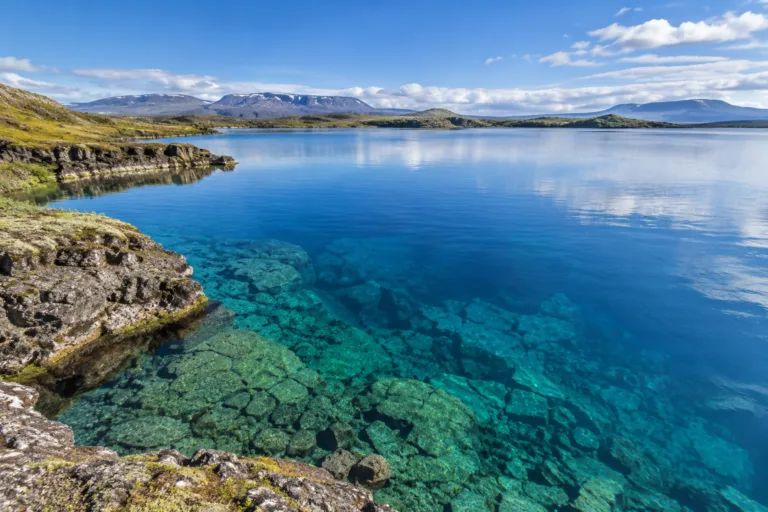
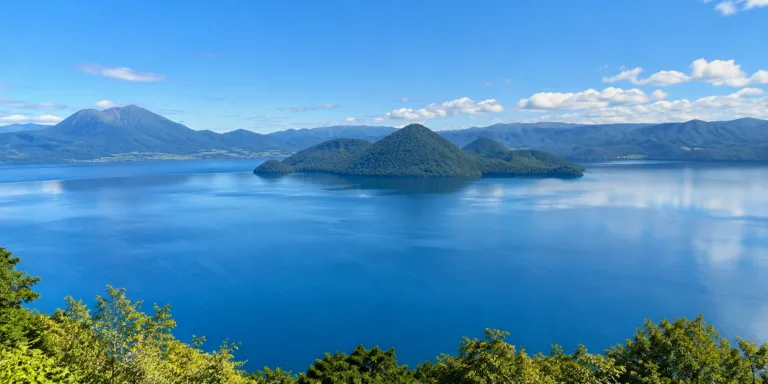
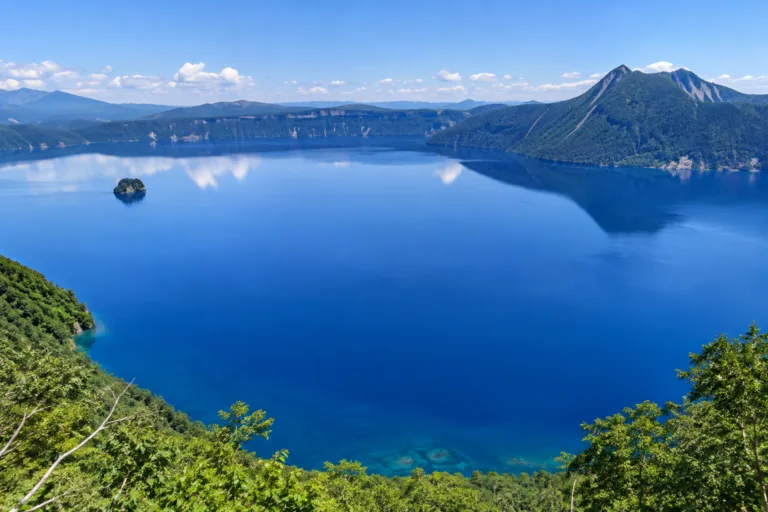
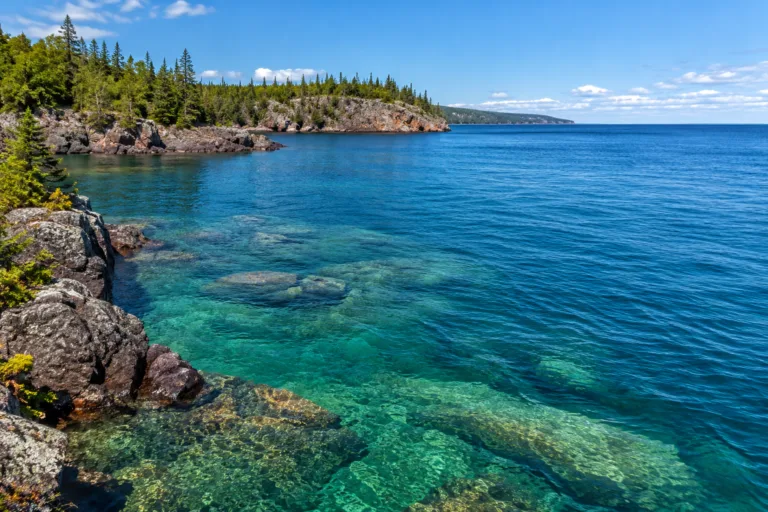
Baikal’s blue appearance begins with the optical character of its open-water basins. Pelagic water generally contains little suspended material and relatively low concentrations of phytoplankton compared with productive lakes. With fewer particles to scatter light back from the surface, light can travel farther through the water column before returning to the eye or a satellite sensor.
That long optical path matters in a lake as deep as Baikal. Red and longer visible wavelengths are absorbed more readily through water, while blue to blue-green wavelengths persist farther. The result over deep, clear water is a dark or deep blue appearance rather than the pale turquoise associated with abundant suspended mineral particles in many glacial lakes.
Satellite observations provide direct visual support. NASA’s May 2012 true-color imagery recorded deep blue open water in southern Baikal while northern parts of the lake were still ice-covered. Separate NASA imagery from September has also described Baikal’s open water as deep blue.
A Secchi disk measures how far an object remains visible through the water. It does not assign the lake a color. High transparency helps explain why deep pelagic water can retain a strongly blue appearance, but surface reflections, viewing angle, weather and the concentration of algae or suspended matter still affect the color a visitor or satellite records.
Bio-optical research based on field observations and SeaWiFS satellite data documented pelagic Secchi depths reaching about 40 meters in June and remaining around 20 meters in July in the cited observations, even as phytoplankton became more abundant. The same work reported typical summer pelagic chlorophyll-a concentrations of roughly 0.5–2.5 µg/L. These values describe measured conditions rather than a permanent monthly rule for every part of the lake.
Baikal’s Clear Ice Has Its Own Light-Blue Color Phase
Winter color at Lake Baikal should be separated from the color of the liquid water. Research on Baikal ice describes primary ice over much of the main deep-water lake as crystal-clear and light blue. During February and the first half of March, this ice can remain visually structureless and highly transparent.
The clarity develops when relatively clean lake water freezes into large columnar ice crystals with few light-scattering inclusions. Snow, granular ice, trapped bubbles, cracks and pressure features can change that appearance sharply. This is why one winter view can look almost glass-clear while another part of the lake looks opaque white.
Spring sunlight begins to alter the ice internally. The same ice study describes gas bubbles appearing in the upper ice as solar heating strengthens during the second half of March. The transparent late-winter state therefore has a seasonal window rather than lasting unchanged until the final breakup.
NASA satellite imagery also shows the contrast at larger scale. During breakup, thin ice can appear light blue while thicker ice appears bright white, with newly exposed open water showing deep blue nearby. Baikal can therefore display blue water, pale blue ice and white ice simultaneously during the spring transition.
Green Tints Are Stronger Near Productive Coasts Than in the Open Basins
Baikal does not follow a simple annual cycle in which the entire lake changes from blue to green. The strongest evidence instead points to spatially uneven biological color influence. Clear pelagic water and more productive coastal water can behave differently at the same time.
Remote-sensing and field research found summer chlorophyll-a in the open lake at roughly 0.5–2.5 µg/L, while concentrations near bays, the coast and the Selenga Delta could reach about 5 µg/L in late summer. River input also adds suspended and dissolved material. Both processes modify how light is absorbed and scattered, making these waters optically different from the clear pelagic basins.
Where chlorophyll-bearing phytoplankton becomes more abundant, reflected light can shift away from pure deep blue toward blue-green or greenish tones. The effect may be enhanced where river plumes or nearshore particles increase scattering. The exact visual result depends on local water composition, depth, sunlight and observation angle, so a chlorophyll increase does not translate into one fixed shade of green.
A greenish appearance should not be treated as Lake Baikal’s normal lake-wide summer color. The evidence is stronger for coastal, deltaic and biologically active zones, with large differences possible between basins and from one year to another.
Recent monitoring adds another layer to this picture. A 2026 study reported intermittent detection of the filamentous green alga Spirogyra in open pelagic monitoring samples collected from 2014 to 2023. Its occurrence was strongest during some summer–autumn periods and absent from the samples during other years. That pattern supports treating green biological influence as variable rather than as an automatic annual color switch across Baikal.
Under-Ice Algae Can Grow Before the Lake Looks Green
One of Baikal’s less intuitive color processes occurs while the surface is still frozen. Spring phytoplankton growth can intensify beneath the ice before widespread open water appears. Research from the southern basin places strong under-ice biological development in late March and early April, with diatom growth building near the end of the ice season.
This means biological activity and visible surface color do not always move together. A transparent or pale-blue ice sheet can cover water in which phytoplankton production is already rising. Snow thickness, ice structure and the amount of light passing through the ice determine how much solar radiation reaches those organisms.
The distinction matters when interpreting seasonal photographs. A blue or white frozen surface does not imply biologically inactive water below it, just as greener coastal water in late summer does not mean the whole lake has moved into the same ecological state.
Baikal’s Size Produces Several Color Environments at Once
Lake Baikal stretches across southern, central and northern basins and receives water from large tributaries, including the Selenga. The optical conditions around a river delta, an enclosed bay and the offshore pelagic zone are therefore not interchangeable.
- Deep offshore water: generally the strongest setting for Baikal’s clear deep-blue identity.
- River-influenced water: suspended sediment and dissolved material can reduce clarity and change the balance of reflected wavelengths.
- Productive coastal water: higher phytoplankton concentrations can add a green component to the visible color.
- Frozen surface: clear primary ice, bubbly ice, snow and thicker white ice create colors that belong to the ice rather than to the liquid water below.
Because these environments coexist, one photograph cannot define a universal Baikal color. A satellite image of the whole lake can also contain several optical states at once, particularly during spring breakup when southern open water, drifting ice and persistent northern ice may all be visible together.
“Cobalt Blue” Is a Visual Description, Not a Fixed Scientific Color Value
Cobalt blue is a useful descriptive phrase for Baikal when the open water appears intensely dark blue, but the lake does not have one permanent RGB, HEX or wavelength value. Water color is produced by the combined effects of absorption, scattering, depth, suspended material, phytoplankton and illumination.
The same stretch of water can therefore look darker under a high viewing angle, brighter under direct sun, greener when biological particles increase, or nearly black-blue when a deep clear water column is viewed against limited surface glare. Scientific measurements of chlorophyll, transparency or spectral optical properties describe parts of that process; none should be converted directly into a single universal color code for the lake.
For Lake Baikal, the most defensible color identity is consequently layered: deep blue for the clear pelagic open water, light blue to white for seasonal ice, and localized greenish influence where biology or river input changes the optical character of the water.
Sources
- NASA MODIS — Lake Baikal, Eastern Russia (May 2012)
- Heim et al. — Variation in Lake Baikal’s Phytoplankton Distribution and Fluvial Input
- Scientific Reports — Ice and Under-Ice Microbial Communities in Lake Baikal
- Mizandrontsev & Makukhin — Gas Exchange Between Baikal and the Atmosphere During Under-Ice Period
- Journal of Great Lakes Research — Spirogyra in Lake Baikal Pelagic Waters
- Wikidata — Lake Baikal Geographic Record