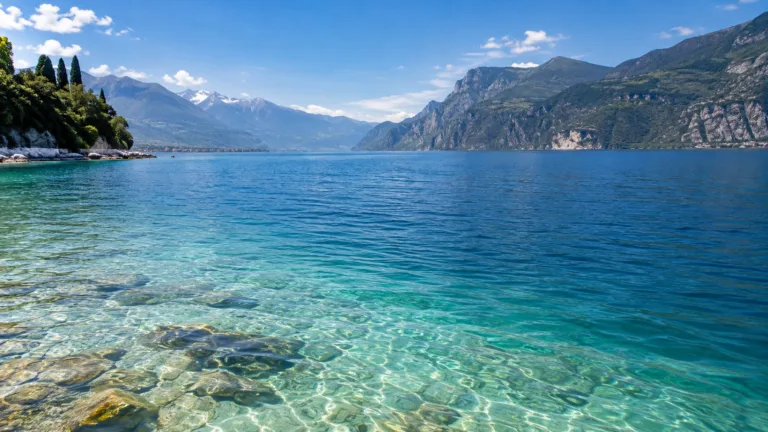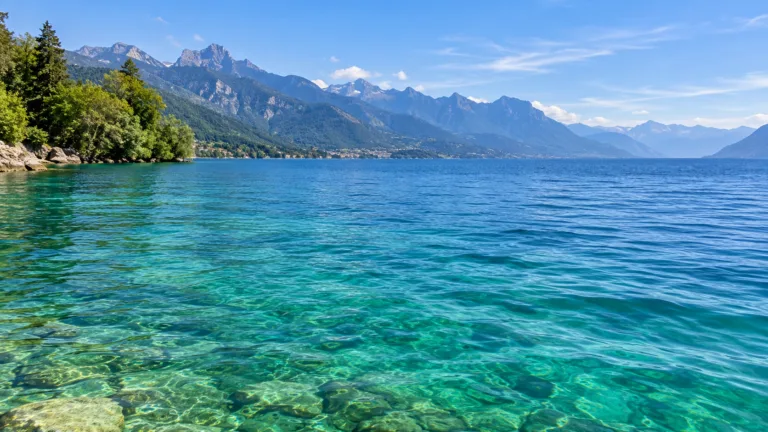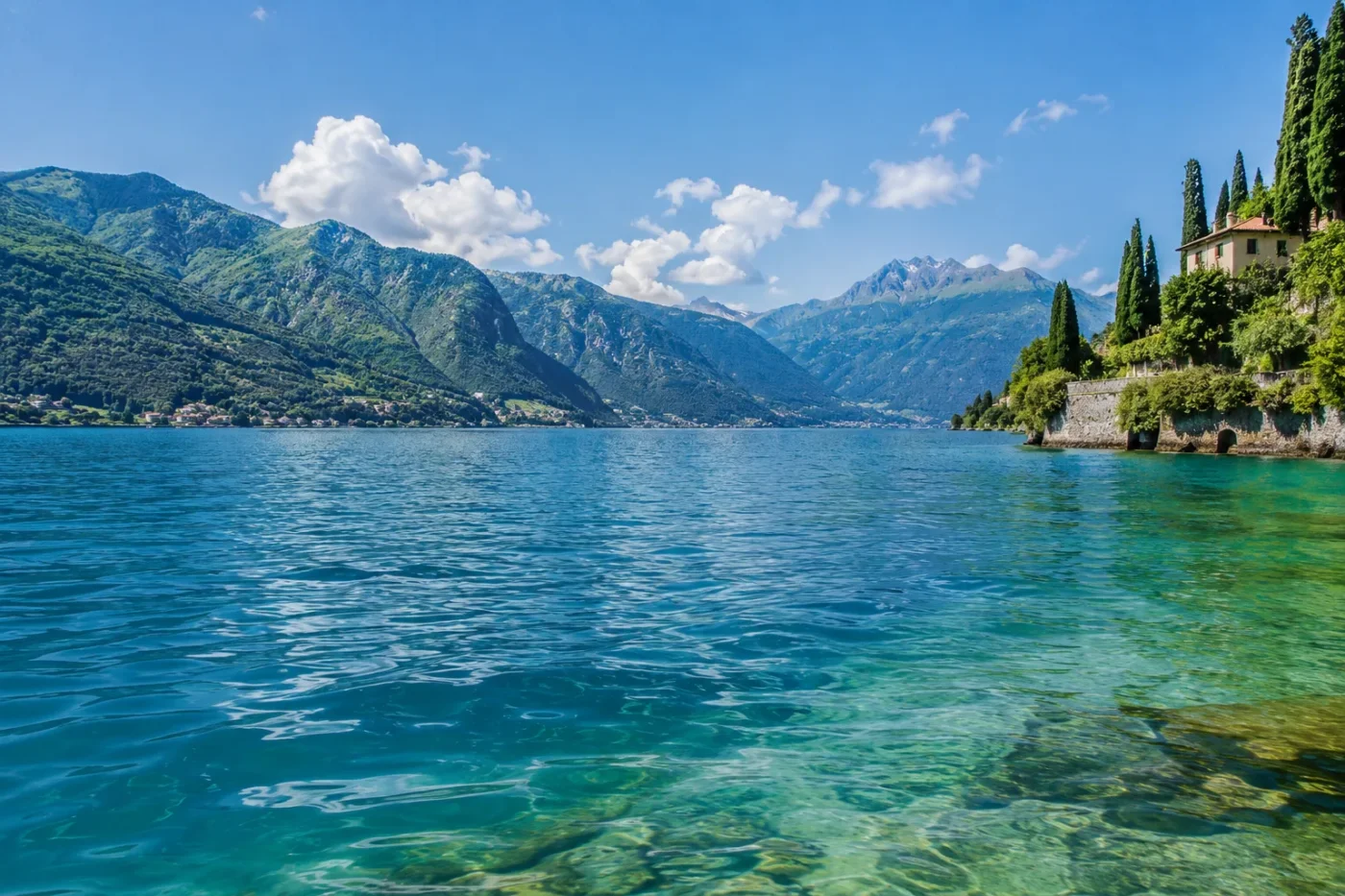
Blue
Primary visual colorWhere Is Lake Como (Lago di Como / Lario)?
Lombardy · Italy
Drag or zoom the real map. Verified shoreline geometry is highlighted with the lake’s LakeColors palette color when available.
Lake Como (Lago di Como / Lario) on the Globe
Rotate the world or focus directly on the lake.
The 2017 Blue-Green Calcite Event
ARPA Lombardia reported a greenish-blue coloration of Lake Como when calcite crystals precipitated during a period of high phytoplankton photosynthetic activity.
A 2016 Bloom Spread Unevenly Across the Lake
August 2016Satellite mapping detected a chlorophyll-a increase in northern Lake Como on August 10, followed by a pattern extending southward. Field sampling confirmed cyanobacteria during the event.
Value: About 10 mg m−3 in the northern lake on August 10
Value: Extension from north toward the southern lake
Value: Cyanobacteria present in the August 11 sample
Color Evidence Through the Year
What Moves the Water from Blue Toward Teal or Green
What the Color Evidence Can and Cannot Show
Official tourism description supports the visual label, while water optics explain why deep clear water can appear blue.
Italia.it — Lake Como: Nature and FascinationUSGS Water Science School — Water ColorEvidence: ModerateThe 2017 calcite episode was reported by the national environmental protection system from ARPA Lombardia information.
SNPA / ARPA Lombardia — Como, City of Water: Lake Como StatusEvidence: HighBloom mapping shows strong spatial variability, while regional monitoring tracks chlorophyll and suspended matter across the lake.
Bresciani et al. — Mapping Phytoplankton Blooms in Deep Subalpine LakesARPA Lombardia — Lake Water Quality and MonitoringEvidence: ModerateLake Como is most often associated with blue water, but blue-green, teal-like and greener appearances can occur when the optical properties of the water change. Those shifts do not follow a simple calendar: depth and water itself establish a blue baseline, while phytoplankton, suspended particles and exceptional calcite precipitation can move parts of the lake toward blue-green or green.
Deep Water Gives Lake Como a Natural Blue Baseline
Lake water does not appear blue only because it mirrors a blue sky. Water itself absorbs visible wavelengths unevenly. According to the U.S. Geological Survey, red wavelengths are absorbed more strongly as light travels through water, while blue wavelengths persist farther through the water column. The effect becomes easier to see across a long optical path, which is why deep, relatively clear water can develop a distinctly blue appearance.
That mechanism is especially relevant to Lake Como because it is an exceptionally deep subalpine lake rather than a shallow basin where the bottom commonly dominates the visible color. Its familiar blue appearance therefore has a plausible physical basis in the water column itself. Surface lighting can change brightness and reflections, but the underlying color is also controlled by what the light encounters below the surface.
The distinction matters when comparing photographs. A dark blue view from open, deep water and a lighter blue-green view near another part of the lake do not automatically document a permanent difference in water chemistry. They may represent different optical paths, different concentrations of particles, or a short-lived biological or mineral event.
The 2017 Calcite Episode Produced a Documented Blue-Green Shift
One of Lake Como’s most useful color records comes from 2017. Italy’s National System for Environmental Protection, reporting information from ARPA Lombardia, described precipitation of calcite crystals associated with high phytoplankton photosynthetic activity. The event produced a verdeazzurra coloration—a greenish-blue appearance—in the lake.
This is stronger evidence than simply interpreting a turquoise-looking photograph. Calcite consists of calcium carbonate, and when fine crystals are suspended in water they add another population of light-scattering particles. The 2017 observation therefore shows that Lake Como can undergo a real optical change within the water, rather than every teal appearance being caused by sky reflection or camera processing.
The documented calcite episode establishes that blue-green water can occur in Lake Como. It does not establish teal as a permanent color or as an event that returns on the same dates every year.
Green Water Can Develop in Patches Rather Than Across the Entire Lake
Phytoplankton provides another route toward greener water. The USGS notes that water rich in phytoplankton and other algae commonly appears green because these organisms change the way light is absorbed and scattered. Lake Como has direct evidence that such biological material can be distributed very unevenly.
A peer-reviewed satellite study of Italian subalpine lakes mapped a Lake Como bloom during August 2016. On August 10, the researchers detected chlorophyll-a values reaching about 10 mg m−3 in the northern part of the lake. The mapped pattern extended southward rather than appearing uniformly across the entire surface. Sampling on August 11 confirmed cyanobacteria, with Planktothrix rubescens and Tychonema bourrellyi making up most of the measured phytoplankton biomass in that sample.
The color implication is not that every cyanobacterial event turns Lake Como the same shade of green. Chlorophyll concentration, species composition, particle density, depth distribution and the optical contribution of the surrounding water all matter. The study is more useful as evidence that color-forming biological material can concentrate in one portion of the lake while another portion remains optically different.
Lake Como’s Three Basins Can Experience Different Optical Conditions
Lake Como’s inverted-Y shape divides it into northern, western and eastern basins with different bathymetric and hydrological characteristics. That geography makes a single color assigned to the entire lake especially limiting. Water masses receive inflows from different directions, biological material can accumulate unevenly, and suspended particles do not have to be distributed uniformly from one branch to another.
The August 2016 bloom illustrates this spatial behavior: satellite imagery could follow a feature that was stronger in the north and extended southward. Regional monitoring has since used satellite observations to map chlorophyll, total suspended solids and surface-water temperature over the broader lake surface. These are not decorative color maps; chlorophyll and suspended matter are among the substances that can change water reflectance and therefore influence what the eye or a camera records.
A blue photograph from one branch and a greener photograph from another location can consequently both be plausible without proving that either image represents Lake Como’s universal color at that moment.
Blue water should not automatically be read as cleaner, and green water does not by itself identify a harmful bloom. Lake monitoring relies on biological, chemical and physical measurements rather than visual color alone.
There Is No Verified Blue-to-Green Month-by-Month Cycle
The available evidence does not support a fixed annual sequence in which Lake Como predictably becomes blue in one season, teal in another and green in another. The August 2016 bloom provides a firm historical month-level observation, but it should not be converted into a claim that August is normally Lake Como’s “green month.” Likewise, the documented 2017 calcite coloration establishes an event, not a recurring annual phase.
This difference is useful when judging seasonal photographs. Biological production, suspended material and individual bloom events can vary from year to year. A color change that was strong during one summer does not automatically define the next summer. Lake Como’s long-term monitoring records phytoplankton and water chemistry precisely because these conditions change over time.
For the months without a documented recurring color state, leaving the color unspecified is more accurate than assigning a decorative shade. The lake may still look blue, blue-green or locally greener on particular days, but those appearances should not be turned into a month-level rule without supporting observations.
Teal Describes an Appearance, Not a Scientific Water-Color Class
“Teal” is useful everyday language for water that visually falls between blue and green. It is not, by itself, a scientific classification of Lake Como’s water. Environmental monitoring is more likely to quantify chlorophyll-a, suspended matter, transparency, temperature, oxygen or other physical and biological variables than to label the lake with a named design color.
This is why the 2017 record is particularly informative: the environmental report explicitly described the lake as greenish-blue and connected that appearance with calcite precipitation. By contrast, the 2016 bloom study quantified chlorophyll and mapped its spatial distribution but did not establish a universal RGB, HEX value or permanent “green” classification for the lake.
The most defensible color model for Lake Como is therefore conditional. Blue is the familiar baseline appearance; blue-green is directly documented during at least one calcite event; and greener water is physically consistent with changes in phytoplankton and suspended material that can occur unevenly across the lake. The boundary between those visible colors is gradual rather than a fixed line.
Sources
- Italia.it — Lake Como: Nature and Fascination
- SNPA / ARPA Lombardia — Como, City of Water: Lake Como Status
- Bresciani et al. — Mapping Phytoplankton Blooms in Deep Subalpine Lakes
- ARPA Lombardia — Lake Water Quality and Monitoring
- DEIMS-SDR / LTER Europe — Lago di Como
- USGS Water Science School — Water Color