Blue
Primary visual colorWhere Is Lake Garda?
Lombardy, Veneto and Trentino-Alto Adige · Italy
Drag or zoom the real map. Verified shoreline geometry is highlighted with the lake’s LakeColors palette color when available.
Lake Garda on the Globe
Rotate the world or focus directly on the lake.
Why the Shore Can Be Turquoise While Open Water Is Blue
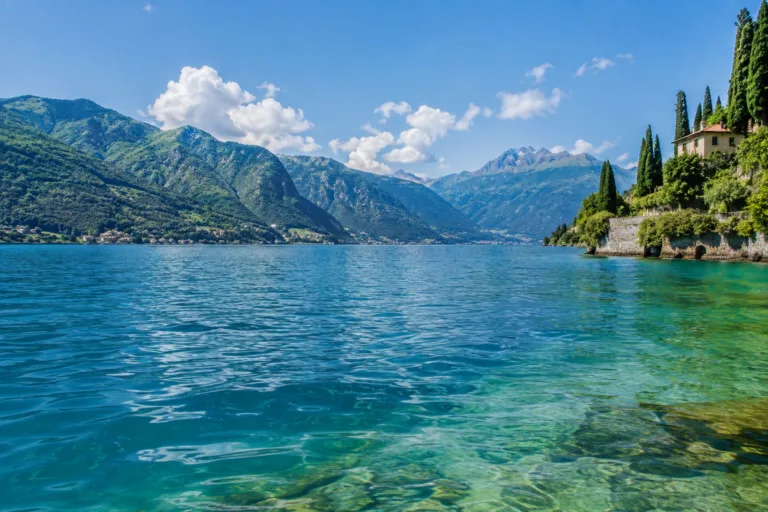
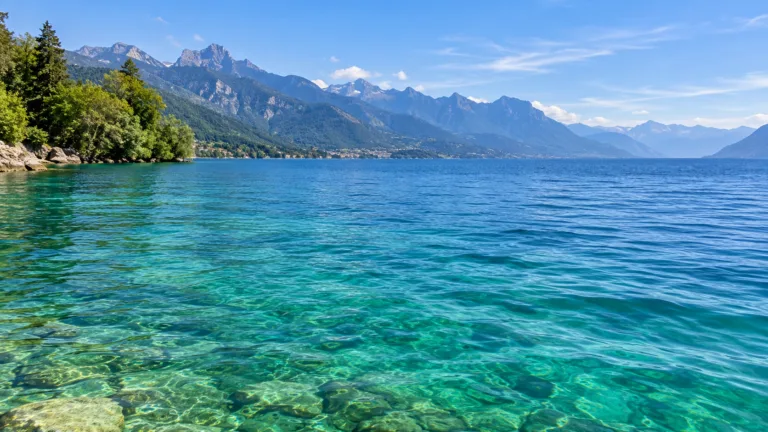
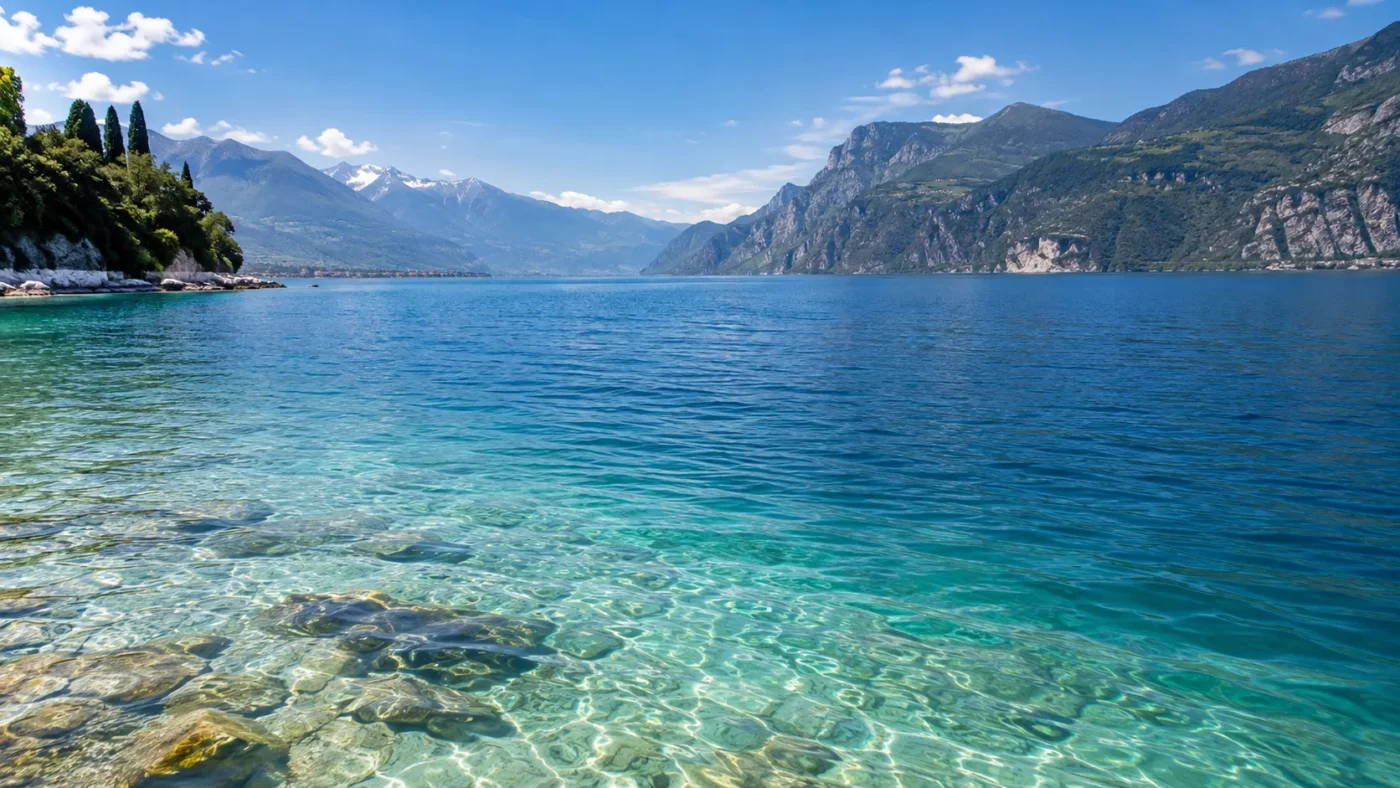
Color by water zoneWhere the bottom remains visible, reflected light from the lakebed returns through a short water column and mixes with the lake's blue-green water-leaving light.
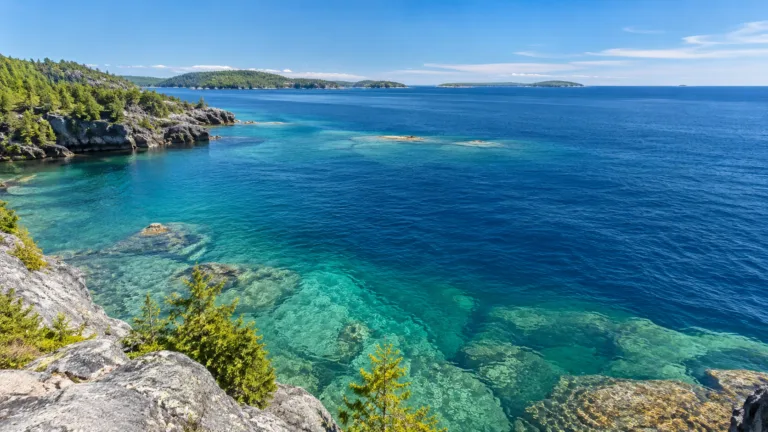
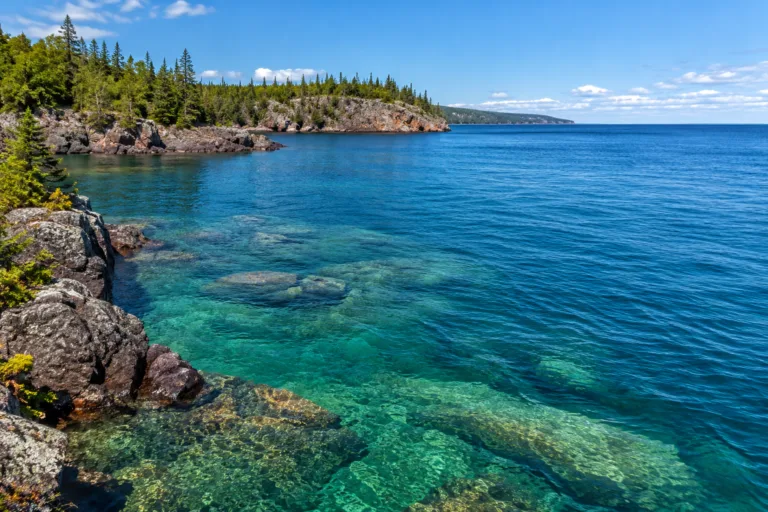
The bottom contribution weakens with depth, so the apparent color grades toward the blue of the water column rather than changing at one fixed depth.
The lakebed is no longer part of the visible signal; longer wavelengths are absorbed more strongly and the remaining water-leaving light is dominated by blue.
Color Profile Facts
Blue Is the Stable Lake-Wide Identity
How Depth Changes the Seen Color
Color Through the Year
What Supports the Blue–Turquoise Interpretation
Claim-level supportA Sentinel-2 color study of Italian lakes classified Garda as blue in spring and reported that it remained blue in late summer.
Evidence: HighA Lake Garda field campaign near Sirmione measured high transparency; at a 3 m station the bottom was visible, while pelagic Secchi depth reached about 8 m.
Evidence: HighLake Garda's clear shallow-water observations align with established water-optics evidence that shallow bottom reflectance can strongly alter apparent color while deeper water is governed more by the water column itself.
Evidence: ModerateLake Garda is primarily a blue lake at open-water scale, while many clear shallow margins can look turquoise because the lakebed still contributes to the light returning to the eye or a satellite sensor. As the water deepens, that bottom signal fades and the longer optical path through water favors blue wavelengths, so offshore and deep-basin water appears darker blue. The contrast is therefore mainly a depth, clarity and bottom-visibility effect rather than evidence that the lake contains two chemically different kinds of water.
The Same Water Can Look Turquoise at the Edge and Blue Offshore
Water color is controlled by the light that leaves the surface after sunlight has been absorbed, scattered and reflected within the water column. Water itself absorbs longer visible wavelengths, especially toward the red end of the spectrum, more strongly than blue wavelengths. That selective absorption becomes more influential as the optical path through the water grows longer.
Shallow water adds another component: the bottom. Where Lake Garda is clear enough for sunlight to reach submerged rock, gravel or other bright lakebed material, part of that light is reflected upward and passes back through the water. The return signal contains both the spectral effect of the water and the reflectance of the bottom. Under favorable sun, viewing angle and surface conditions, that mixture can move the visible appearance from blue toward turquoise or blue-green.
In deeper water, the lakebed is no longer optically visible. The observer is then seeing light shaped mostly by the water column and its suspended or dissolved material. Lake Garda’s relatively clear, low-particle open water is repeatedly described in limnological and remote-sensing work as blue, which fits the darkening blue appearance over its deep basins.
Lake Garda’s Basin Shape Makes the Color Boundary Easy to See
The lake is not one uniform bowl. Its larger northern-to-southwestern basin contains the deepest water, while the southeastern part is much shallower. Published descriptions place the maximum depth at roughly 350 metres, creating a large optical contrast between littoral shelves and deep pelagic water within the same lake.
A field campaign near the Sirmione Peninsula shows why the southern shallows can look so different from the offshore basin. Pelagic stations had Secchi depths of about 8 metres, while at a station only 3 metres deep the bottom was visible. Another station had a Secchi depth close to its 7-metre bottom depth. Those measurements do not assign a turquoise color to a fixed depth, but they demonstrate that Lake Garda can be clear enough for the lakebed to remain part of the visible signal across shallow areas.
This is also why aerial views around Sirmione often show a sharp-looking but physically gradual transition: pale or turquoise water over submerged shelves, then a stronger blue as the lakebed drops away. The boundary can appear narrow where bathymetry changes quickly and broader where the bottom slopes gently.
Turquoise Does Not Mean Lake Garda Is Colored by Glacial Flour
Lake Garda has a glacial origin, but that does not mean its present turquoise shallows should automatically be explained by the same mechanism that colors glacier-fed alpine lakes. In many glacier-fed systems, very fine suspended mineral particles scatter light and can create a bright, milky turquoise appearance. Lake Garda’s commonly observed shallow turquoise can be explained without invoking a persistent rock-flour plume: clear water plus a visible bottom is enough to change the apparent color.
“Turquoise” is a visual description, not a diagnosis of one specific mineral or particle source. In clear shallow water, bottom reflectance can shift apparent color even when the overlying water is part of the same lake-wide blue water mass.
The distinction matters because the visual result can look similar while the optical cause is different. A suspended-particle turquoise is produced within the water column; a shallow-bottom turquoise receives a large share of its brightness from below the water column. Lake Garda can show both changes in particles and algae over time, but the familiar shore-to-offshore turquoise-to-blue gradient does not require a separate mineral-rich shallow-water body.
Blue Remains the Lake-Wide Optical Identity Across the Warm Season
Satellite work comparing the color of Italian lakes found Lake Garda distinctly blue in spring and still blue in late summer. That evidence separates the broad optical identity of the lake from local shoreline shades. Turquoise patches along shallow shelves do not imply that the entire lake changes into a turquoise state during summer.
Water clarity does change through the year. Published Lake Garda measurements report Secchi depths around 4–5 metres in summer and roughly 15–17 metres in late winter. Earlier ecological work links high winter transparency to limited algal development and dilution of particles through deeper mixing. Summer stratification and biological activity reduce transparency, yet the lake can still remain within a blue optical class at the basin scale.
That means “more transparent” and “more blue” are related ideas but are not interchangeable measurements. A Secchi disk records how deep a high-contrast target remains visible; a satellite color classification describes the spectrum of light leaving the surface. Both respond to water constituents, but they do not measure the same property.
Rain, Wind and Plankton Can Temporarily Blur the Blue–Turquoise Gradient
The depth pattern is easiest to see when the water is clear and the surface is calm enough for the bottom signal to remain visible. Lake Garda research shows that suspended sediment can rise along the shore after precipitation and catchment runoff, while wind can resuspend bottom material. Those events increase scattering and can make normally transparent littoral water look duller, greener, browner or simply less luminous depending on the material involved.
Phytoplankton also modifies the optical signal. Lake Garda generally has low chlorophyll-a concentrations for a lake of its size, but occasional higher-biomass periods and rare fall cyanobacterial blooms have been reported. When algae increase, they absorb and scatter light differently from clear water and can weaken the simple “turquoise shallows, blue depths” appearance.
These short-lived effects should not be confused with the permanent geometry of the basin. Bathymetry controls whether the bottom can contribute to the observed color; particles and plankton control how much of that bottom signal survives and how the water column modifies it on the way back to the surface.
There Is No Single Depth Where Turquoise Becomes Blue
A fixed rule such as “Lake Garda is turquoise below three metres and blue beyond five metres” would be misleading. The transition depth changes with transparency, bottom brightness, sun elevation, wave roughness, viewing angle, algal abundance and suspended sediment. Even two neighboring shallow sites can look different if one has a bright visible bed and the other has vegetation, darker substrate or more turbid water.
The Sirmione measurements provide a useful reality check: a bottom was plainly visible at 3 metres, while strong water transparency was also recorded farther offshore. They show that the bottom can influence shallow-water appearance, not that 3 metres is a universal color threshold.
For Lake Garda, the most defensible color model is spatial rather than binary. Clear littoral shelves can produce turquoise or blue-green tones because the lakebed remains optically involved; as depth and optical path increase, the bottom contribution fades and the lake’s basin-scale blue identity dominates.
Sources
- Slow response of surface water temperature to fast atmospheric variability reveals mixing heterogeneity in a deep lake — Scientific Reports.
- Evaluation of Multi-Resolution Satellite Sensors for Assessing Water Quality and Bottom Depth of Lake Garda — Sensors.
- Application of New Hyperspectral Sensors in the Remote Sensing of Aquatic Ecosystem Health: Exploiting PRISMA and DESIS for Four Italian Lakes — Resources.
- The Color of Water from Space: A Case Study for Italian Lakes from Sentinel-2.
- Water Color — U.S. Geological Survey Water Science School.
- Lake Garda — Wikidata geographic record, including OpenStreetMap relation identity.