Blue-Green
Primary visual colorWhere Is Lake Lucerne?
Central Switzerland · Switzerland
Drag or zoom the real map. Verified shoreline geometry is highlighted with the lake’s LakeColors palette color when available.
Lake Lucerne on the Globe
Rotate the world or focus directly on the lake.
Why Alpnachersee Can Look Different
Official monitoring treats the Obermatt station as representative of six basins and describes Lake Lucerne overall as naturally nutrient-poor.
This shallower, more isolated basin has higher nutrient concentrations and stronger algal growth; official monitoring notes a visibly cloudier summer coloration.
Lake Lucerne Color Context
How the Blue-Green Appearance Is Supported
True Water Color vs. Reflected Alpine Color
Color Through the Year
How the Color Profile Is Supported
Claim-level supportA bio-optical study comparing Lake Lucerne with Lake Zug classified Lake Lucerne as blue-green by chromaticity analysis.
Jaquet et al. (1994), Aquatic SciencesEvidence: HighLong-term official monitoring reports low phosphorus concentrations and an oligotrophic state.
Lake Lucerne Water Quality — AKVLake Lucerne: Lake & Shore — AKVEvidence: HighThe basin is shallower and more nutrient-rich, supporting stronger algal growth that is visible as cloudier summer coloration.
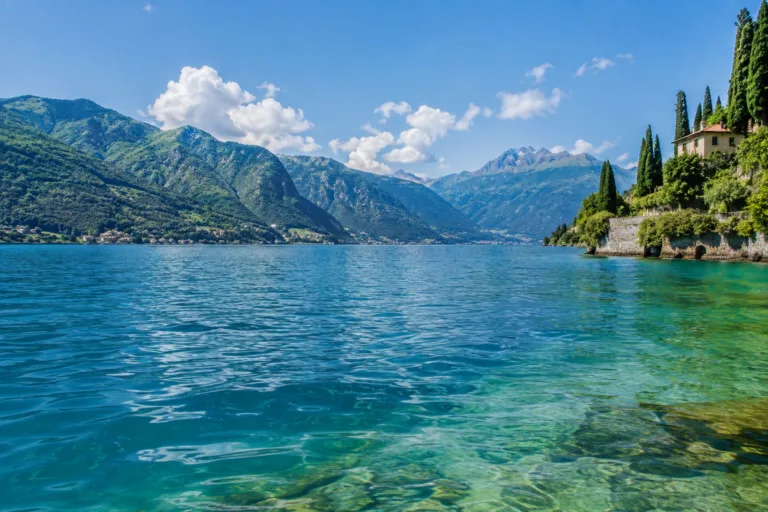
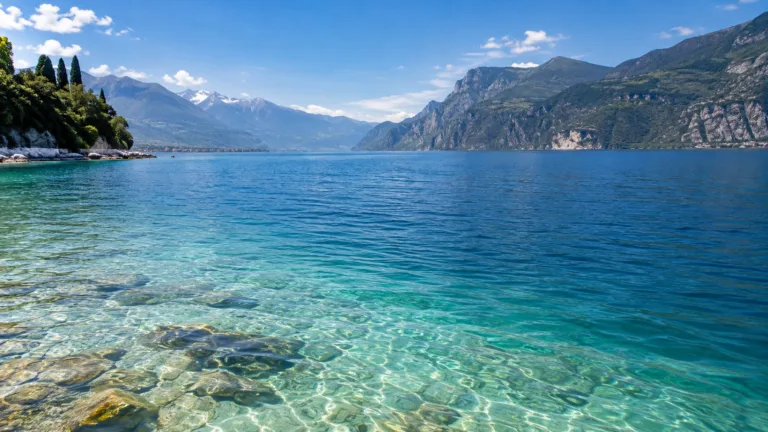
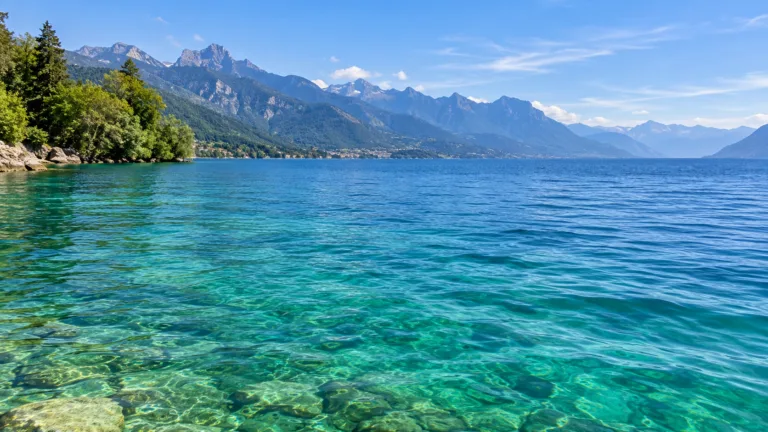
Lake Lucerne Water Quality — AKVEvidence: HighLake Lucerne is scientifically documented as blue-green, a range that often reads visually as teal-blue in clear-water views. The measured color is not simply a reflection of the Swiss sky or surrounding mountains: water-column optics, low nutrient levels and relatively low phytoplankton abundance contribute to the lake’s clear blue-green identity, while reflected scenery and viewing angle can substantially alter the shade visible at the surface.
Blue-Green Is the Measured Color; Teal-Blue Is the Visual Reading
A peer-reviewed bio-optical study of Lake Lucerne and Lake Zug provides unusually direct evidence for Lake Lucerne’s color. Researchers measured optical and water-quality properties during an airborne remote-sensing campaign and classified Lake Lucerne’s water as blue-green by chromaticity analysis. Lake Zug, by comparison, was classified as green.
That distinction matters because descriptive labels such as teal, turquoise and blue can overlap in ordinary photography. For Lake Lucerne, blue-green is the stronger scientific term. “Teal-blue” is useful as a visual description of the same general range, but it should not be mistaken for a separate laboratory color measurement.
The optical study also found that Lake Lucerne had substantially higher reflectance than Lake Zug even though the two lakes had similar suspended-solid concentrations. Color therefore cannot be reduced to one variable such as sediment concentration. Chlorophyll, dissolved substances, suspended particles, water itself and the illumination geometry all contribute to the signal reaching an observer.
Depth Explains the Lake’s Scale, Not the Hue by Itself
Lake Lucerne reaches 214 metres in the Gersauer Basin and has an official mean depth of about 117 metres. Those numbers help explain why large parts of the lake behave optically as deep water, but “the lake is teal because it is deep” would be an oversimplification.
In very deep water, the lake bottom does not provide the kind of visible color contribution that can occur in clear, shallow shoreline zones. The light seen from the surface is instead dominated by processes in the water column and at the air-water interface. Water selectively absorbs portions of visible light, while particles, algae and dissolved material modify absorption and scattering. The result depends on both the water’s optical properties and the light leaving or reflecting from its surface.
Current monitoring gives useful context for Lake Lucerne’s clarity. The lake is naturally nutrient-poor, and phosphorus concentrations have fallen markedly from their twentieth-century peak. Since 2004, official monitoring reports phosphorus values generally in the range of roughly 3–5 milligrams per cubic metre, with individual exceptions. Lower nutrient availability limits algal production, helping maintain clearer water than would be expected in a strongly eutrophic lake.
The 214-metre maximum depth is a verified morphological fact. It should not be converted into an assumed “deep-blue” color zone without direct optical measurements showing that relationship in Lake Lucerne.
Alpine Reflections Change the Surface Without Replacing the Water’s Own Color
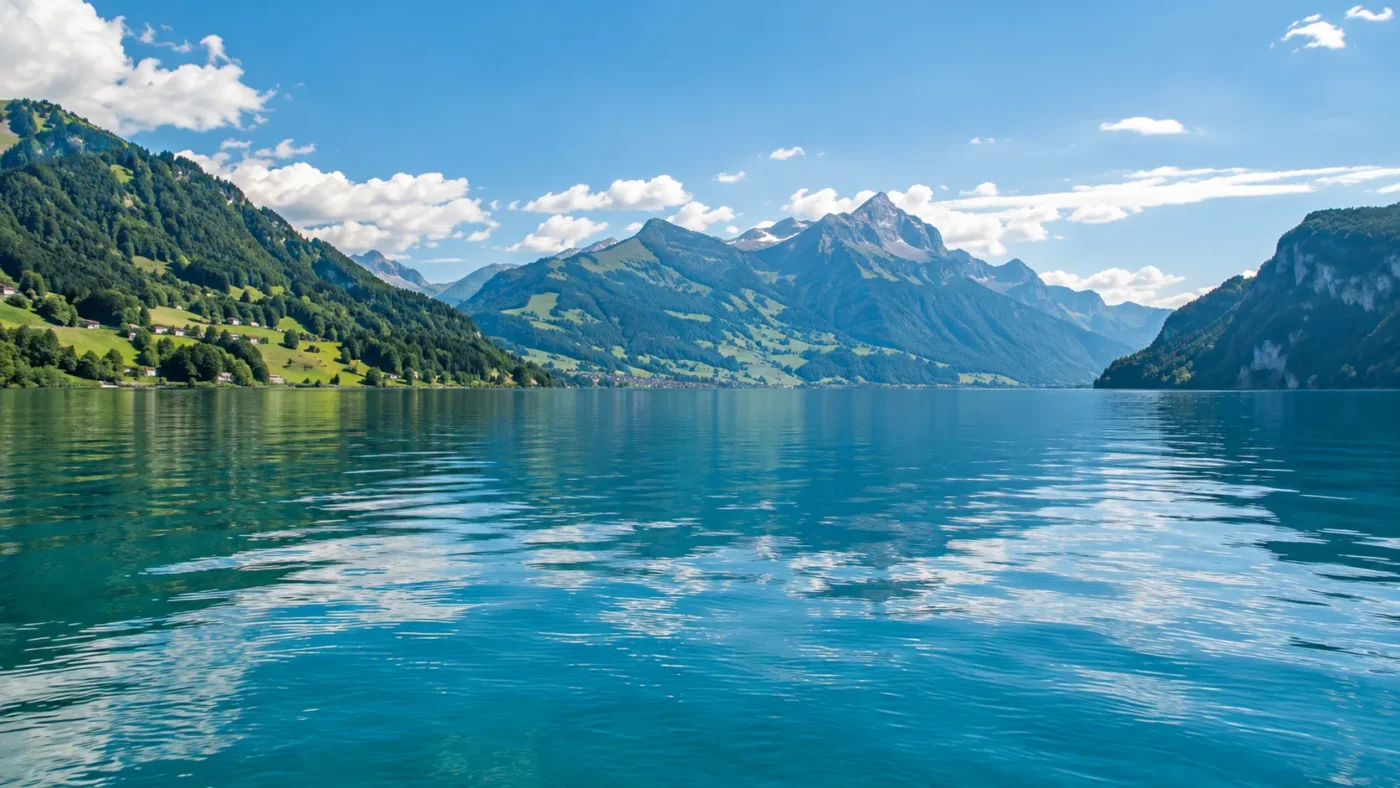
Lake Lucerne is surrounded by steep mountain terrain, so photographs frequently contain reflected sky, cloud and alpine slopes. These reflections form a separate optical layer from the light returning from within the water itself.
Aquatic remote-sensing science distinguishes between the inherent optical properties of the water and the apparent signal recorded by an observer or sensor. The apparent color depends not only on substances in the water but also on incoming illumination and viewing direction. Surface-reflected light can therefore make the same water look darker, brighter, grayer or more mirror-like from different positions.
This is especially relevant to the “teal-blue” appearance. Under conditions where water-leaving blue-green light is visually prominent, the lake can show a clear teal-blue cast. When the surface reflects a bright sky, dark mountain slope or cloud field more strongly, the visible surface may shift even though the underlying water chemistry has not changed.
Reflections should therefore be treated as apparent color variation, not evidence that Lake Lucerne has changed from one intrinsic water-color class to another.
Alpnachersee Is the Main Color Exception Within the Lake System
Lake Lucerne is not one uniform basin. Its characteristic shape is divided into seven basins or arms, and official monitoring identifies Alpnachersee as a measurable exception to the rest of the system.
Alpnachersee is only about 34 metres deep at its deepest point and is connected to the rest of Lake Lucerne through a narrow passage. Water exchange is limited, its residence time is shorter and nutrient concentrations are higher than in the other major basins. These differences affect biological production.
The color consequence is directly visible in summer. The Lake Lucerne supervisory authority reports that Alpnachersee develops a cloudier summer coloration, partly because its higher nutrient availability supports more algal growth. This is stronger evidence for a real spatial color difference than simply comparing photographs taken from different shores.
The distinction also shows why one color label cannot describe every square kilometre of Lake Lucerne under every condition. Blue-green remains the best supported general optical classification, while local basin chemistry and biology can alter clarity and appearance.
Seasonal Physics Changes the Viewing Conditions, Not a Proven Monthly Palette
Lake Lucerne has a clear annual thermal cycle. Eawag observations at Kastanienbaum show the surface warming through spring and summer, sometimes reaching about 25 °C, before cooling again through autumn and winter. At roughly 100 metres depth, temperature remains near 5 °C throughout the year.
The lake is stratified for much of the year, with warmer, lighter surface water above colder deep water. In winter, when surface temperatures approach about 4 °C and wind assists circulation, the water column can mix much more deeply. These processes influence nutrient transport, phytoplankton conditions and water-column structure.
They do not, however, establish a reliable January-to-December sequence in which Lake Lucerne turns from teal to blue, green or another fixed hue on particular dates. Available evidence supports seasonal changes in temperature, mixing and biological conditions, but not a precise monthly color chart. The Color Year therefore records the verified seasonal physical cycle while leaving month-level hue unspecified rather than assigning unsupported colors.
What Makes the Teal-Blue Appearance Persistent
The strongest explanation combines several factors rather than relying on a single cause. Lake Lucerne is an oligotrophic pre-alpine lake with low current phosphorus concentrations and comparatively low phytoplankton abundance. Those conditions help preserve a relatively clear water column. Within that clear-water setting, the optical behavior of water and its constituents produces the documented blue-green signal.
The surrounding Alps then modify what reaches the eye. Sun position, clouds, wind-driven surface texture and reflected mountain scenery can all change the apparent shade without requiring a chemical color change. Shallow shoreline water can also behave differently from the deep basins because bottom reflectance becomes relevant where the bed is visible.
This combination explains why Lake Lucerne can look teal-blue, deeper blue, muted blue-green or reflective gray in different images while still retaining a scientifically supported blue-green water-color identity.
Sources
- Jaquet et al. — Measurements and Significance of Bio-Optical Parameters for Remote Sensing in Two Subalpine Lakes
- Aufsichtskommission Vierwaldstättersee — Water Quality
- Aufsichtskommission Vierwaldstättersee — Lake & Shore
- Eawag — Lake Lucerne Water Temperature at Kastanienbaum
- U.S. Geological Survey — Introduction to Aquatic Remote Sensing
- Wikidata — Lake Lucerne Geographic Record