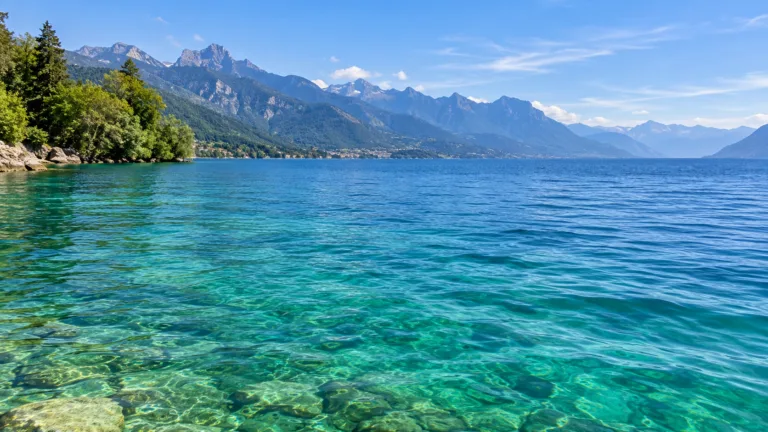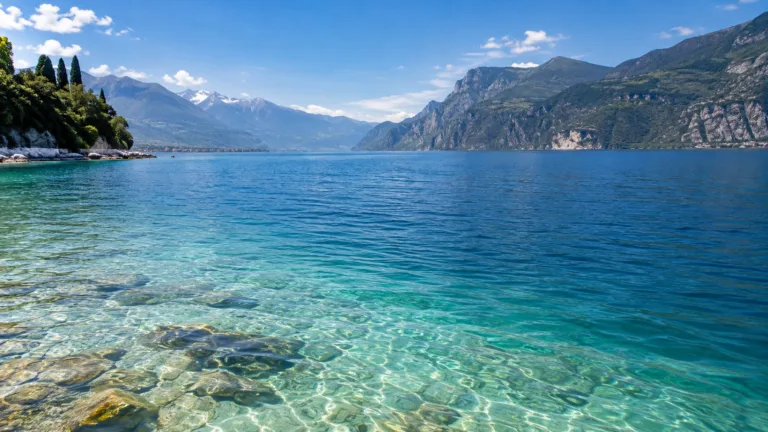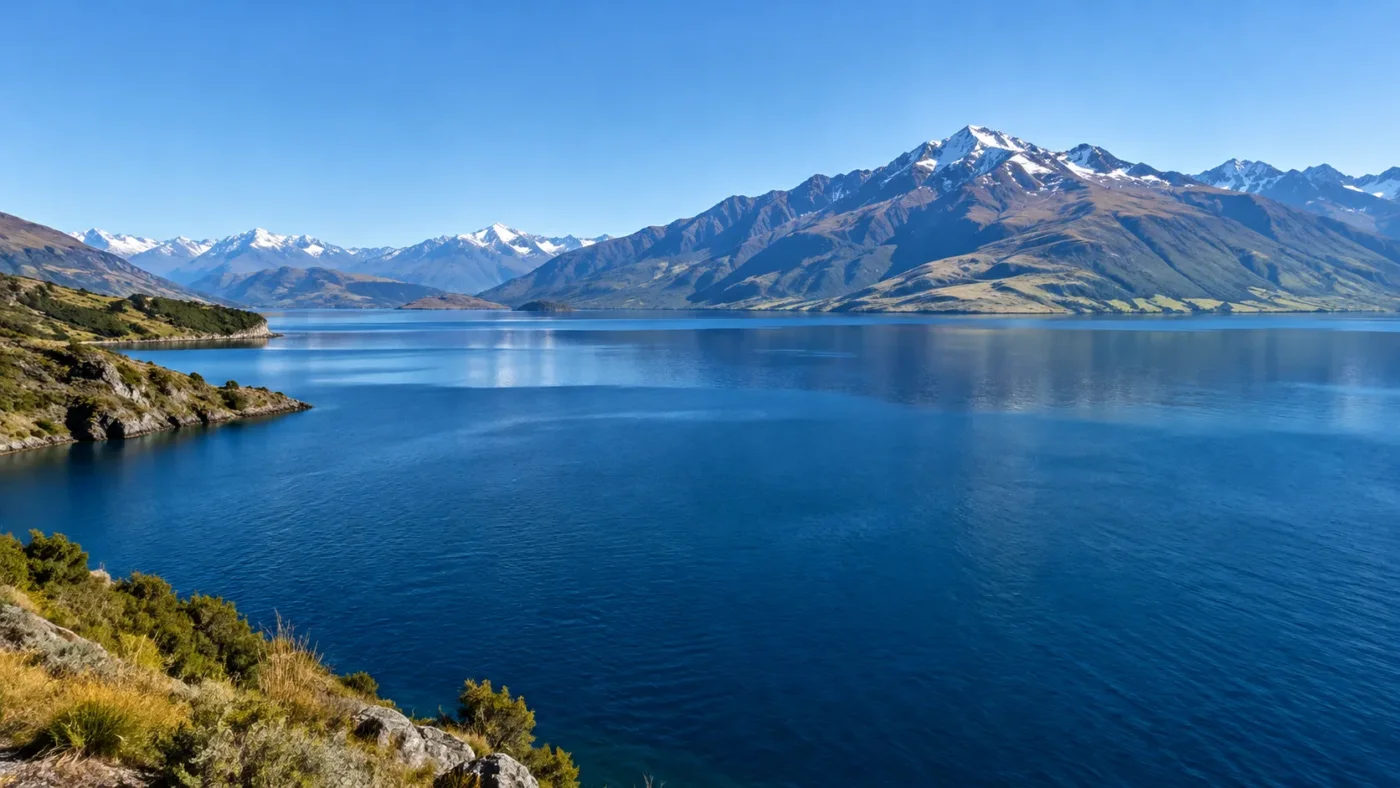
Dark Blue
Primary visual colorWhere Is Lake Wānaka?
Otago · New Zealand
Drag or zoom the real map. Verified shoreline geometry is highlighted with the lake’s LakeColors palette color when available.
Lake Wānaka on the Globe
Rotate the world or focus directly on the lake.
Why Nearby Glacial Lakes Do Not Share the Same Color
Wānaka Color Context
Why the Water Reads as Dark Blue Instead of Milky Turquoise
How Stable Is the Dark-Blue Identity?
Lake Wānaka usually presents a dark-blue lake-scale color rather than the pale, milky turquoise associated with several other large South Island glacial lakes. The distinction is not that Wānaka lacks a glacial history: its basin was carved by ancient ice. The stronger difference is in the water column today, especially the amount of fine suspended glacial sediment available to scatter light.
A Glacier-Carved Lake Does Not Automatically Become Turquoise
Lake Wānaka belongs to a landscape shaped by major glaciers, and Otago Regional Council describes Wānaka, Hāwea and Whakatipu as deep high-country lakes formed in terrain carved by ancient ice. That geological origin explains the lake basin, but it does not by itself determine the color of the water that fills it now.
Turquoise glacial lakes require another ingredient: a substantial supply of extremely fine mineral sediment remaining suspended in the water. NASA’s natural-color satellite comparison of the South Island shows Lake Pukaki, Lake Tekapo, Lake Ōhau and Lake Benmore as markedly lighter than the dark-blue waters of Wānaka and Hāwea. NASA attributes the contrast to rivers draining large, active glaciers into the turquoise lakes.
Those glaciers continually grind bedrock as they move through mountain valleys. The resulting particles of silt and clay are commonly called glacial flour or rock flour. Meltwater carries the particles downstream, and the finest material can remain suspended for long periods instead of settling rapidly to the lakebed.
Rock Flour Changes the Light Before It Reaches Your Eyes
The pale turquoise of a sediment-rich glacial lake is an optical effect produced by the interaction between sunlight, water and suspended mineral particles. Fine glacial flour strongly scatters light through the water column. NASA notes that this leaves much of the blue and green portion of visible light available to be scattered back toward an observer, producing the characteristic bright blue-green appearance.
Lake-color research across New Zealand provides the broader optical context. In relatively clear water with few strongly absorbing or scattering constituents, the optical properties of water itself favor a blue appearance. Suspended particulate matter, phytoplankton pigments and colored dissolved organic matter can all modify that baseline by absorbing or scattering different wavelengths.
A bright glacial-turquoise lake can contain more suspended inorganic particles than a darker blue lake. Lake Pukaki’s famous color is associated with glacial flour, while Wānaka has repeatedly been described as a clear, low-productivity lake. Visual brightness and water clarity are therefore not interchangeable measurements.
Clear Water Allows a Deeper Blue Optical Signature to Dominate
Lake Wānaka is both large and deep, reaching about 311 metres at its deepest point. Its major inflows are the Makarora and Matukituki rivers, and research has consistently treated the lake as an oligotrophic system: a lake with relatively low nutrient concentrations and low biological productivity compared with nutrient-rich lakes.
That matters to color because phytoplankton and suspended particles are among the substances capable of altering the light leaving a lake. When their influence is limited, the blue optical character of clear water becomes more important. In a deep water column, that blue can appear substantially darker than the milky blue-green created when abundant mineral particles scatter light back toward the surface.
This also explains why describing Wānaka simply as a “glacial lake” is not enough to predict its color. Lake Pukaki and Lake Tekapo are also glacial lakes, but their present-day sediment pathways connect them much more strongly to the finely ground material produced by active glaciers. The relevant distinction is not the origin of the basin alone; it is the ongoing delivery and suspension of optically active sediment.
The Catchments on the Two Sides of the Southern Alps Are Optically Different
NASA’s South Island comparison identifies another difference around Wānaka and Hāwea. The valleys north of these lakes carry noticeably more vegetation than the sparsely vegetated glacial valleys feeding Pukaki and Tekapo.
Vegetation can contribute dissolved organic substances to rivers and lakes. In optical-water science these substances are grouped under colored dissolved organic matter, or CDOM. CDOM absorbs light and can darken water. NASA specifically points to this catchment contrast when discussing why Wānaka and Hāwea look darker than the intensely glacial-flour-influenced lakes farther east.
This does not mean CDOM alone makes Lake Wānaka dark blue. Lake color results from several optical components acting together, including the water itself, suspended particles, dissolved material and biological pigments. For Wānaka, the more defensible interpretation is that the intense mineral-particle scattering responsible for Pukaki-style turquoise is not the dominant lake-wide optical signal.
Why Hāwea Is a Better Color Neighbor Than Pukaki
Lake Hāwea is geographically close to Wānaka and provides an important check on the idea that all nearby alpine lakes should be turquoise. NASA’s natural-color imagery places Wānaka and Hāwea in the same dark-blue visual group, while Pukaki, Tekapo, Ōhau and Benmore form the conspicuously lighter group.
The comparison shows why proximity and a shared glacial landscape are weak predictors of lake color on their own. Two lakes can occupy neighboring mountain basins yet receive different quantities and types of suspended sediment. Conversely, lakes farther east can share a similar turquoise appearance because their upstream glacier-river systems continuously supply highly scattering mineral flour.
Does Lake Wānaka Have a Turquoise Season?
The sources used for this profile do not document a recurring lake-wide milky-turquoise phase comparable to the dominant appearance of Lake Pukaki or Lake Tekapo. NASA’s broad-area satellite comparison instead identifies Wānaka as dark blue, and the available limnological literature emphasizes its clear, low-productivity water rather than persistent glacial-flour turbidity.
That should not be interpreted as a claim that the lake has exactly the same visible shade at every place and every moment. Apparent water color depends on optical conditions as well as the substances in the water, and localized changes in turbidity, algae or sediment can affect what sensors and observers see. There is not enough evidence in the cited sources to convert those possible short-term variations into a separate verified seasonal Wānaka color state.
Modern Monitoring Tracks the Variables That Could Change the Color Signal
Otago Regional Council now monitors Wānaka as part of its deep-lakes programme. A high-frequency buoy installed in 2022 is supplemented by other sampling through the water column, and the programme measures variables including chlorophyll, turbidity and water clarity. The council also tracks sediment movement and physical lake conditions.
Those measurements are directly relevant to a lake-color profile even though they are primarily collected for environmental monitoring. A sustained increase in suspended sediment could increase scattering and reduce clarity, while changes in phytoplankton could alter both clarity and spectral appearance. The existence of those processes does not establish that Wānaka is currently undergoing a major color transition; it identifies the measurable variables that would reveal one.
For that reason, Wānaka’s dark-blue identity is best treated as a documented dominant appearance rather than an immutable color label. The contrast with the turquoise glacier-fed lakes is strong, but continued clarity, sediment and chlorophyll monitoring provides the evidence needed to detect any future shift in the lake’s optical character.
Sources
- NASA Earth Observatory — How Glaciers Turn Lakes Turquoise
- Land, Air, Water Aotearoa — Lake Wanaka
- Otago Regional Council — Otago’s Deep Lakes
- Lehmann et al. — Colour Classification of 1486 Lakes across a Wide Range of Optical Water Types
- FEMS Microbiology Ecology — Lake Wānaka Study
- OpenStreetMap — Lake Wānaka Relation 2709