Turquoise
Primary visual colorWhere Is Lake Salda?
Burdur Province · Türkiye
Drag or zoom the real map. Verified shoreline geometry is highlighted with the lake’s LakeColors palette color when available.
Lake Salda on the Globe
Rotate the world or focus directly on the lake.
The White Shore Is Part of the Color Story
Value: Hydromagnesite-rich carbonate material
Provenance: NASA Scientific Description
Evidence: High
Value: Hydromagnesite microbialites occur in the lake
Provenance: Peer-Reviewed Study
Evidence: High
Value: Pale shallows contrast with turquoise water
Provenance: Derived from documented water and shoreline descriptions
Evidence: Moderate
From Basin Geology to the White-and-Turquoise Contrast
What Is Measured and What Is Visual
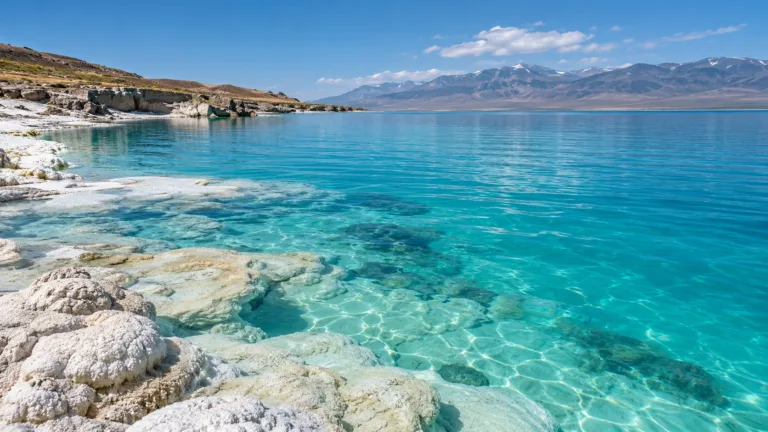
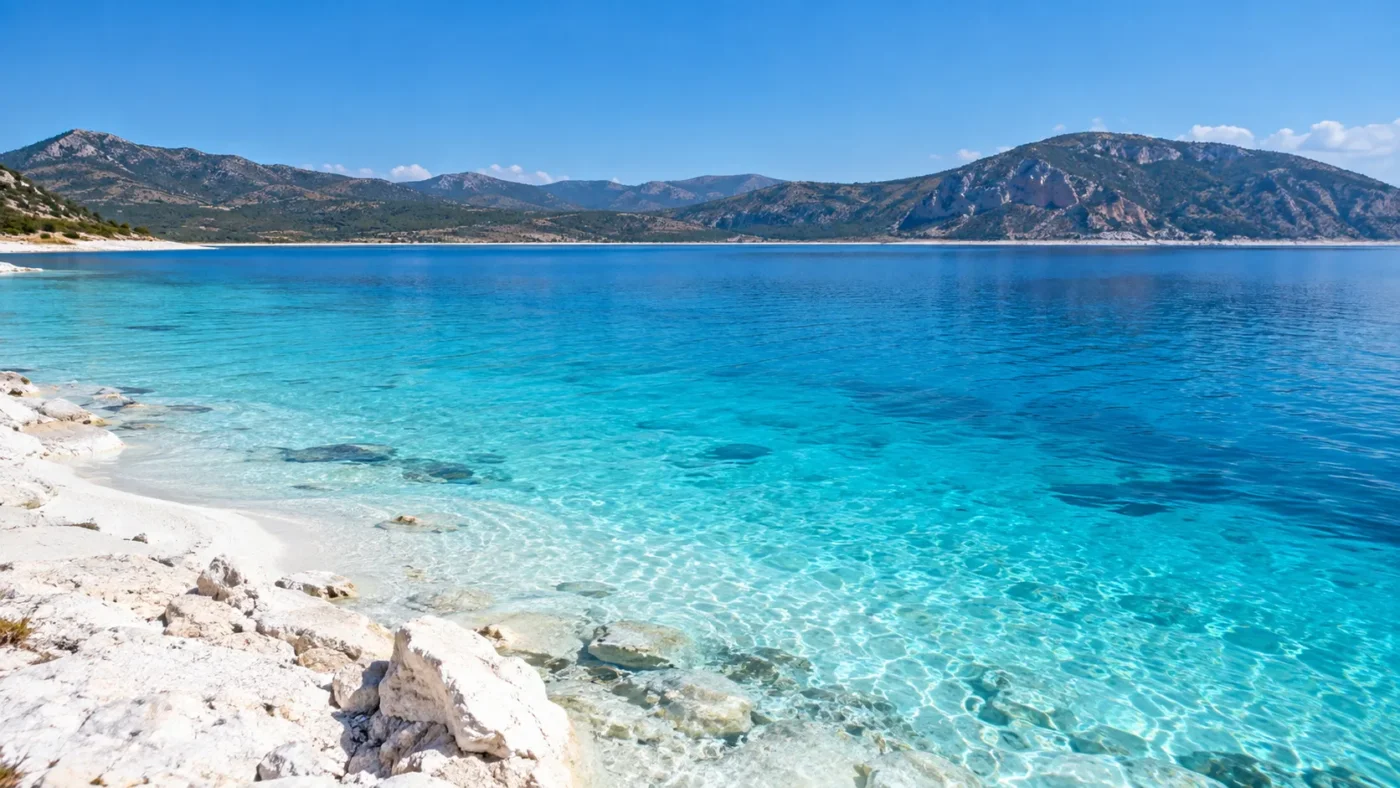
Lake Salda is best described as a clear turquoise lake with darker blue water toward deeper parts of the basin. Its famous white margin is a different feature: the pale material around parts of the shore is rich in magnesium carbonate minerals, especially hydromagnesite. The strongest color contrast therefore comes from two connected but distinct parts of the landscape—the water and the mineral-rich shoreline.
Turquoise Is the Best-Supported Primary Water Color
Türkiye’s Ministry of Environment describes Lake Salda’s water as both clear and turquoise. That makes turquoise the most defensible primary color for the lake rather than a color chosen only from photographs.
Local government material adds another useful detail. It describes the water as beginning with lighter blue-green or turquoise tones and tending toward indigo-blue in the deepest areas. That matches a familiar visual pattern at Salda: pale-looking water near bright shallow margins and darker water farther into the basin.
Water color and shore color should not be merged. Salda’s white margin is mineral sediment and carbonate material. The lake water itself is described primarily as turquoise and blue.
Why the Shore Looks So White
The white material is one of the most unusual parts of Salda’s color system. NASA describes light-toned shoreline sediment containing hydromagnesite, a hydrated magnesium carbonate mineral. Darker sediment derived from surrounding bedrock can occur nearby, so the shoreline is not chemically or visually uniform everywhere.
Salda also contains hydromagnesite microbialites. These are mineralized structures associated with microbial communities. A 2024 Geobiology study documented active, subfossil and fossil microbialites around the lake and found hydromagnesite in microbialite material from both shallow and deeper settings.
This matters for color because the brilliant white margin is not ordinary pale quartz beach sand. It belongs to a magnesium-rich carbonate system operating within the lake and along its margins.
The Chemistry Behind Salda’s Mineral Setting
Water chemistry measurements help explain why magnesium minerals are so prominent. A peer-reviewed hydrogeochemical study measured pH values of 9.08 to 9.34 and identified the dominant water type as Mg-CO3-HCO3. The researchers linked the lake’s high magnesium content to weathering of ultramafic rocks within the basin.
- Ultramafic rocks weather within the drainage basin.
- Magnesium enters the lake system through water-rock interaction.
- Alkaline lake chemistry favors unusual magnesium-carbonate environments.
- Hydromagnesite develops in sediments and microbialites around parts of the lake margin.
- Bright carbonate-rich surfaces sit beside clear turquoise water, producing Salda’s characteristic white-and-blue-green contrast.
The final step is best treated as a visual interpretation rather than a laboratory measurement of Salda’s exact perceived color. The geology, chemistry, white carbonate deposits and turquoise appearance are all documented; assigning a precise percentage of the visible turquoise to each optical process would require dedicated spectral measurements.
Microbialites Add a Second Layer to the Mineral Story
It is tempting to explain Salda’s appearance with a simple phrase such as “magnesium makes the lake turquoise.” The scientific record is more detailed.
NASA reports that hydromagnesite sediments along the shore are thought to have been derived in part from microbialites, while modern microbial communities participate in hydromagnesite precipitation. The 2024 Geobiology work found several microbialite morphologies distributed across six zones and showed that microbial community composition varies with depth and microbialite form.
Hydromagnesite and aragonite were found in material associated with microbial structures. This gives Salda’s white mineral deposits a biological as well as geological dimension, but it does not mean that microorganisms alone determine the visible color of the entire lake.
Turquoise Water Does Not Mean One Uniform Shade
“Turquoise” is an accurate primary label, but Salda should not be represented as a flat sheet of one color. Official local descriptions distinguish lighter turquoise or blue-green appearances from darker blue water in deeper parts of the lake.
Several visual effects can exist at the same time: the pale bottom and carbonate-rich margins remain visible through clear shallow water, deeper water appears darker, and viewing angle and illumination can alter the apparent saturation. These short-term visual differences should not be mistaken for evidence that the lake undergoes a documented annual transformation from one named color to another.
No month-by-month color cycle is assigned here. The available scientific and government sources support Salda’s turquoise-to-blue visual identity, mineral shoreline and water chemistry much better than a fixed January-to-December sequence of different water colors.
Measured Chemistry Is Not the Same as Measured Color
Salda has good scientific evidence for alkaline water chemistry, magnesium enrichment, carbonate mineral formation and microbialites. It also has strong official descriptions of clear turquoise water. Those are two different kinds of evidence.
A chemical measurement such as pH 9.08–9.34 is numerical. “Turquoise,” by comparison, is a documented visual description. None of the sources used here provides a standardized dominant wavelength, CIE color coordinate, Forel-Ule value or other direct numerical water-color measurement for Salda.
For that reason, an exact HEX value, RGB value or wavelength would imply a level of precision that the evidence does not support. Salda’s defensible database identity is broader and more useful: turquoise as the primary appearance, darker blue as a depth-associated visual variant, and bright white hydromagnesite-rich material along parts of the lake margin.
Sources
- Republic of Türkiye Ministry of Environment — Lake Salda Special Environmental Protection Area
- Yeşilova District Governor’s Office — Lake Salda
- NASA Science — What a Lake in Turkey Can Tell Us about Mars
- Geobiology — Morphological and Microbial Diversity of Hydromagnesite Microbialites in Lake Salda
- Environmental Earth Sciences — Assessment of Water Quality and Hydrogeochemical Processes of Salda Alkaline Lake
- OpenStreetMap-Based Geographic Record — Lake Salda