Deep Blue
Primary visual colorWhere Is Lake Thun?
Canton of Bern · Switzerland
Drag or zoom the real map. Verified shoreline geometry is highlighted with the lake’s LakeColors palette color when available.
Lake Thun on the Globe
Rotate the world or focus directly on the lake.
Two Alpine Inflows, Different Sediment Loads
Inflow: Aare from Lake Brienz
Water Supply: About 50%
Sediment Role: Almost free of sediment particles after passing through Lake Brienz
Color Relevance: Supports a clearer basin-scale optical background
Provenance: Peer Reviewed
Evidence: High
Inflow: Kander
Water Supply: About 40%
Sediment Role: About 85% of Lake Thun's sediment supply
Color Relevance: Main pathway for mineral-particle input
Provenance: Peer Reviewed
Evidence: High
From Low Particle Load to a Deeper Blue
Annual Water-State Context
What Supports the Lake Thun Color Profile
Claim-level supportSwitzerland Tourism explicitly describes Lake Thun as deep blue.
Switzerland Tourism — Lake ThunEvidence: HighA separate official Switzerland Tourism description uses turquoise blue for the lake.
Switzerland Tourism — Mountains around Lake ThunEvidence: ModerateCanton of Bern lake monitoring distinguishes the clearer particle regime of Lake Thun from turbid Lake Brienz.
Canton of Bern — Lake Monitoring and Lake Thun StatusEvidence: HighSediment research identifies the Kander as the dominant sediment source while Aare water arrives after particle removal in Lake Brienz.
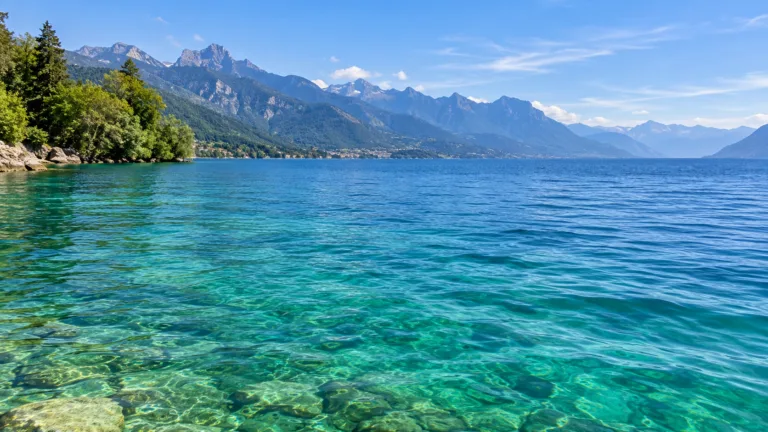
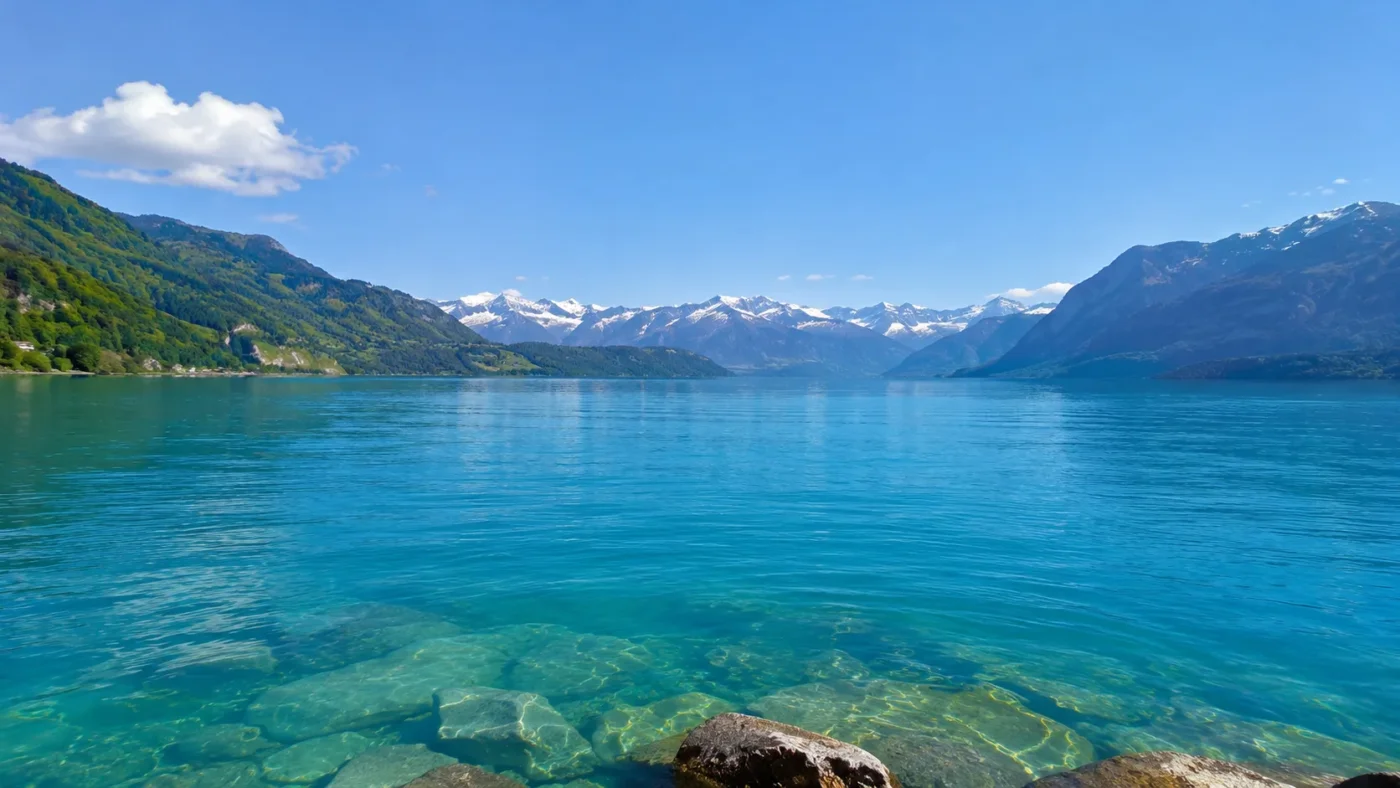
Lake Thun Sediment and Inflow StudyEvidence: HighLake Thun is most consistently documented as deep blue, while Switzerland’s national tourism authority also uses turquoise blue for some views of the lake. Its color profile differs from the more visibly glacial Lake Brienz upstream: Bernese monitoring describes Lake Thun as nutrient-poor and comparatively low in suspended solids, while sediment studies show that Lake Brienz removes much of the Aare’s particle load before the river reaches Lake Thun. The result is a predominantly deeper-blue lake rather than a basin that is permanently milky turquoise.
Lake Brienz filters the Aare before it reaches Lake Thun
Lake Thun and Lake Brienz are connected by the Aare, but their particle regimes are not the same. Canton of Bern monitoring describes Lake Brienz as turbid because of suspended mineral material, whereas Lake Thun contains fewer suspended solids. That difference is central to understanding why the neighboring lakes can display noticeably different blue tones.
Peer-reviewed sediment research provides a physical explanation. A large share of the particles carried into Lake Brienz settles before the Aare leaves that lake, so the river reaches Lake Thun with very little sediment compared with a direct glacial inflow. Lake Thun therefore receives a substantial volume of Aare water without receiving an equally large mineral-particle load.
That upstream settling matters optically. Fine suspended particles can brighten water and push its appearance toward pale blue or turquoise by changing how light is scattered through the water column. With fewer particles present over much of Lake Thun, darker blue appearances can remain visually dominant across deep water.
The Kander carries most of Lake Thun’s sediment
The Aare is not the lake’s main sediment pathway. Research on Lake Thun’s sediments identifies the Kander as the dominant source of incoming mineral material even though both rivers are major contributors of water. Hydrological importance and particle input are therefore distributed very differently between the two inflows.
This distinction prevents an overly simple description of Lake Thun as uniformly clear. Mineral particles still enter the system, but their main route is concentrated in the Kander rather than evenly associated with all inflowing water. Changes in particle concentration can alter local clarity and light scattering without establishing a basin-wide switch to a new named color.
A sediment pulse can alter transparency and light scattering, yet that does not by itself prove that the entire lake has entered a recurring turquoise, green or gray color phase. Lake-wide color claims require direct visual or optical evidence.
Deep blue and turquoise blue are visual labels, not two measured water types
Official Swiss tourism material uses both deep blue and turquoise blue for Lake Thun. Those descriptions are compatible as visual observations because apparent lake color varies with illumination, water depth, surface conditions, viewing geometry and the amount of material suspended in the water. They should not be interpreted as two sharply separated chemical states.
Environmental monitoring addresses a different set of properties. Nutrients, suspended particles, temperature, oxygen and water clarity can help explain the conditions under which a lake looks clearer or more turbid, but they are not interchangeable with a named human-visible color. Lake Thun does not have an official month-by-month series assigning exact color names to the water.
Available monitoring and research support a clear, nutrient-poor lake with relatively low suspended-particle concentrations, together with official deep-blue and turquoise-blue visual descriptions. They do not establish a repeating monthly sequence of named colors or a scientifically measured peak-color month.
Seasonal mixing changes the water column more clearly than the named color
Lake Thun has real seasonal physical changes, but those changes should not be converted automatically into a decorative color calendar. Long-term Swiss lake data identify Lake Thun as one of the cooler lakes in the dataset because of direct Alpine river inflow. During the warm season the water column stratifies; colder conditions favor deeper mixing, although complete deep overturn does not occur every year.
Long-term warming is also changing the duration and strength of stratification and can influence oxygen conditions in deep water. These are measured changes in lake physics. They do not demonstrate that a particular summer month is always more blue or more turquoise than a winter month.
For Lake Thun, the defensible annual pattern is therefore one of changing water-column state rather than a fixed sequence of named colors. Deep blue remains the strongest documented visual identity, while turquoise blue is a supported visual variant whose appearance should not be assigned to a specific month without direct evidence.
Sources
- Canton of Bern — Lake Monitoring and Lake Thun Status
- Switzerland Tourism — Lake Thun
- Switzerland Tourism — Mountains around Lake Thun
- Lake Thun Sediment and Inflow Study
- Bärenbold et al. — Long-Term Temperature, Oxygen and Water Clarity Trends in Swiss Lakes
- Canton of Bern — THU1 Deepest-Point Monitoring Profile